
- Kitchen know-how
- Vintage
- Measurements
When a Spoonful Came With Instructions
Mary Lincoln shook the heap down. Fannie Farmer leveled it. Their cookbooks show why an old spoonful depends on how it was filled.
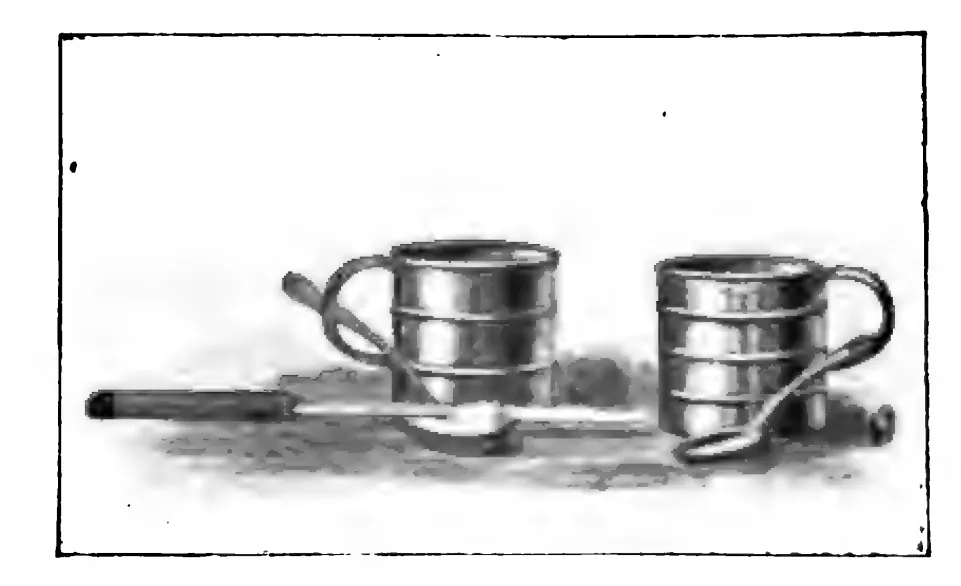
Mary J. Lincoln’s teaspoon could carry a little hill. Fill it with a dry ingredient, she told readers of her 1884 Boston Cook Book, and shake it until a rounded top remains. If the recipe asks for an even or scant teaspoonful, fill it lightly and take a knife to the top. If it asks for a heaping spoonful, carry as much as the spoon will hold. Three small movements, all made with the same spoon, could deliver three different amounts.
Twelve years later, Fannie Merritt Farmer instructed readers to level both teaspoons and tablespoons. Pick up either book and the recipes still say teaspoonful. What changed was the instruction the cook had already read before getting to the recipe.
A knife belongs beside the spoon
Lincoln specified the silver spoons in ordinary use and a kitchen cup that held half a pint. Then she got particular about the cook’s hand. For dry material in a cup, she told the reader to heap it lightly and level it. A scant cup stopped about a quarter of an inch below the top. A scant spoon, by contrast, was filled lightly and leveled. In her kitchen, the same adjective gave a different instruction for a cup and a spoon.
Farmer also called for a half-pint measuring cup, but described one marked in quarters or thirds and paired it with spoons of regulation sizes. To measure flour, she told cooks to sift it, fill the cup with a spoon or scoop, and level it with a case knife. She warned against shaking the cup. For butter or lard, she wanted the opposite treatment inside the vessel. Pack the fat in firmly, then level the top.
The knife gives flour and butter the same finish. The flour goes in loose and the fat goes in packed. A modern measuring cup can reproduce the line at the rim, but the cook still decides what happens below it.
Four little spoons for liquid, three for dry
Lincoln’s table gives four teaspoonfuls to a tablespoonful of liquid and three to a tablespoonful of dry material. It also gives sixteen liquid tablespoonfuls to the cup, twelve dry tablespoonfuls, and eight heaping dry tablespoonfuls. Read down that column and you can see how much work the words liquid, dry, and heaping are doing.
Say a reader wants to halve a tablespoonful in one of her recipes and work with a smaller spoon. For a liquid, half of Lincoln’s tablespoonful corresponds to two of her teaspoonfuls. For dry material, the table gives one and a half. That’s arithmetic within the book. To translate either answer into a modern measuring spoon, the reader still needs to decide how to represent Lincoln’s vessel and filling method.
Farmer’s 1896 table gives three teaspoons to the tablespoon, and her measuring instructions say to level them. Apply that ratio to one of Lincoln’s liquid recipes and you’ve changed the quantity before pouring a drop.
How small was a saltspoon?
Lincoln puts a saltspoonful of salt into a quart of milk for custards in her table of proportions. On the preceding page she gives four liquid saltspoonfuls to a teaspoonful. In the 1906 revision of Mrs. Beeton’s Book of Household Management, one saltspoonful equals half a teaspoonful. The 1910 Home Helps gives about an eighth. Two saltspoonfuls would therefore correspond to one of Beeton’s teaspoonfuls or about a quarter of a teaspoonful in Home Helps.
That’s about a fourfold difference in the stated fraction. It leaves open the actual capacity of each book’s teaspoon and the weight of a spoonful of salt. Home Helps, which Lincoln coauthored, gives its own custard proportion of a quarter teaspoonful of salt per quart of milk. The book gives that amount directly, so the saltspoon arithmetic can stay on the measuring page.
The saltspoon is an unusually clear example because the books make the differences visible in print. When a recipe simply says spoonful, you may have to go back to the measuring pages to learn what the author expected you to do. A later edition or another writer may be worth comparing, provided you keep its instructions attached to its own recipes.
Lincoln’s table gets smaller still. It describes a speck of cayenne by what the point of a penknife can lift. That instruction lets a cook handle a strong seasoning in a quantity far below the spoonfuls in the same table. An exact weight would depend on how much the particular blade picks up.
Read the motion before doing the arithmetic
Start by finding the book’s measuring instructions. Look at how it describes the vessel, then at the words next to the quantity. A heaping spoonful of sugar in Lincoln has a shape to it. A level spoonful of butter in Farmer still has to be packed. The little word next to the spoon can matter as much as the number in front of it.
If you need to write the old recipe out for a modern kitchen, keep its original wording beside the amount you choose. If you make a second batch, you’ll know whether you repeated the source’s method or your own adaptation. For the cups, glasses, and spoon relationships that can be traced to particular books, see our guide to old recipe measurements.
Sources
The illustration of the measuring cups and spoons comes from Farmer’s 1896 cookbook, p. 28.
- Mary J. Lincoln, Mrs. Lincoln’s Boston Cook Book (Boston, 1884), pp. 28–31.
- Fannie Merritt Farmer, The Boston Cooking-School Cook Book (Boston, 1896), pp. 27–29 and 32.
- Mrs. Beeton’s Book of Household Management, revised edition (London, 1906), p. 127.
- Home Helps: A Pure Food Cook Book (Chicago, 1910), p. 8.