
- Vintage
- Food History
- Pickles
- Kitchen Equipment
Green Pickles, a Brass Pan and a Cookbook's Warning
Elizabeth Raffald warned against metal-assisted pickle greening, yet some of her recipes named brass pans. Reading the details complicates a familiar accusation.
TuneMyRecipe
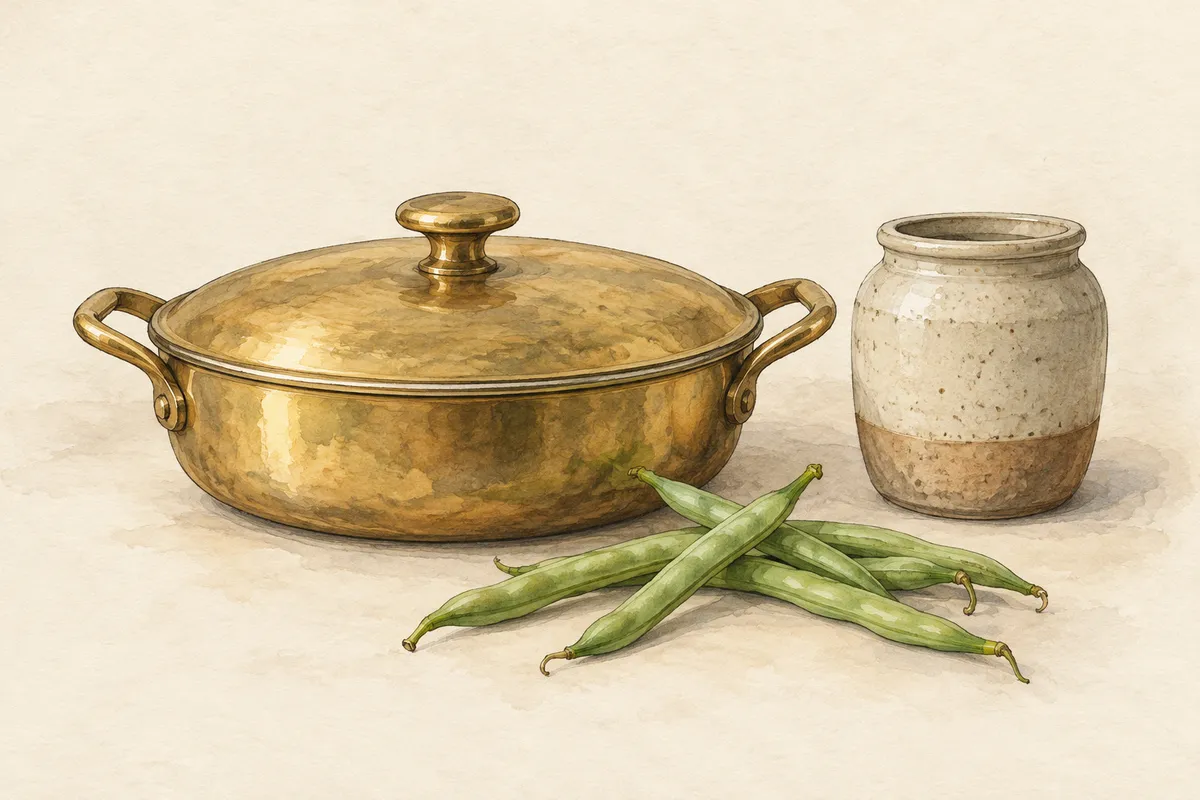
Elizabeth Raffald warned her readers about making pickles attractive through dangerous means. Then, a few pages later, her cookbook named a brass pan in a recipe intended to turn young beans green.
Both passages belong to the Manchester 1769 edition of The Experienced English House-keeper. Their coexistence makes a better starting point than a verdict on whether Raffald was enlightened or reckless. A qualification about tinning, the order of the recipe’s liquids and a later critic’s incomplete citation all change what we can reasonably say. A bright green pickle was a desired result; how a cook pursued that color is the harder question. Raffald, “Observations on Pickling,” p. 321, and “To pickle Kidney Beans,” pp. 325–326.
The warning did not overlook appearance
Raffald’s title page presented expertise to ladies, housekeepers and cooks. Her advertised repertoire included confectionery and table decoration. A pleasing appearance was part of the book’s promise, so her pickling warning came from within that interest rather than from indifference to it.
She objected to making food please the eye through pernicious means. The opening observations specifically associated brass pans with the desire for a good green and said that brass and verdigris could be avoided. This was a writer recognizing and criticizing a practice, rather than evidence that every contemporary cook considered it harmless.
Then comes the qualification that prevents an easy modern summary. Raffald cautioned against brass or copper “that is not well tinned.” The condition concerns the surface between vessel and food. A pan named for its underlying metal might have a lining, but the word brass by itself does not tell us whether one was present or intact.
The warning encouraged readers to be careful and follow the recipes. That sends us directly to the difficulty: what did the individual recipes actually specify?
The bean recipe leaves the lining unstated
The kidney-bean direction names a brass pan during greening. Its young, small beans are understood here as immature pods; it should not be casually recast as a recipe for dried red kidney beans. More crucially, the named brass stage uses brine. A separate vinegar preparation follows after the beans are drained. Raffald, pp. 325–326.
The brine stage and the later vinegar stage need to stay distinct. The text doesn’t specify bare metal, and it doesn’t identify the vessel used to heat the vinegar.
The general warning makes a well-tinned pan a possible interpretation, but the individual direction leaves it unstated. The uncertainty concerns the contact surface. The choice of brass during greening is there on the page.
Other entries prevent the bean recipe from looking like a stray word. Raffald’s “Mangoe,” a prepared cucumber rather than the fruit now usually meant by mango, also names brass in its greening stage. So do codlins and samphire. Their liquids and operations differ. Together they establish several brass directions in the same book, without establishing a single uniform process or measured exposure. Raffald, pp. 323–326.
A stone jar belongs to the same collection
Raffald’s sliced cucumbers give the comparison a different vessel. Those vegetables go into a stone jar and receive repeated applications of hot spiced ale vinegar. The recipe identifies shallots, mace, pepper, ginger and horseradish, a useful reminder that pickle flavor had more to offer than a green finish. “To pickle Cucumbers in Slices,” p. 323.
This direction does not prescribe copper or brass for the vegetables, although it leaves the vinegar’s heating vessel unnamed. It also belongs to a historical keeping practice. Reading it doesn’t validate its closure or storage instructions for a modern kitchen.
The comparison is useful without declaring the stone-jar recipe a fully demonstrated modern alternative. One book could specify different vessels and pursue different results. Looking at the instruction attached to the particular food tells us more than assigning a safety verdict to the collection as a whole.
Our Pickled Baby Artichokes offer a separate, later comparison: a 1914 recipe adapted for refrigerator serving, with ginger, mace, nutmeg and pepper. Their interest lies in the spiced vinegar, rather than a metal-assisted green finish.
Accum’s accusation has an edition problem
In 1820, Fredrick Accum attacked harmful ways of making pickles look appealing. His Treatise on Adulterations of Food, and Culinary Poisons criticized cookbooks for transmitting such methods and proposed removing the directions from future editions. That was an editorial remedy as well as a chemical warning. Accum, Philadelphia edition, “Poisonous Pickles,” pp. 217–219.
He attributed to Raffald advice involving halfpence or an extended stay in copper or brass. His footnote named pages 352 and 354 without identifying an edition. The reference is precise enough to investigate and incomplete enough to cause trouble.
In the 1769 book, those pages contain seasonal lists. In the inspected London 1771 second edition, sold by R. Baldwin, they contain appendix material. The London 1782 eighth edition, also published by Baldwin, gets closer: page 352 has an elder-bud recipe naming brass, but the checked pages still do not supply Accum’s exact wording. Three editions are a bounded comparison, not a search of every printing. The quotation remains untraced in the cited pages examined.
A mistaken page reference, another edition or a mistaken attribution remain possibilities. Accum also cited other books nearby, assigning different hazardous directions to each. His criticism of Raffald has to be distinguished from those separate accusations.
Color, contact and evidence
Modern food-color scholarship helps explain the appeal of keeping vegetables green: heat and acidic conditions can dull plant greens. Coultate and Blackburn discuss that chemistry and Raffald’s warning in their history of food colorants. Their explanation supplies context, rather than an assay of one eighteenth-century pan. “Food colorants: their past, present, and future,” historical and green-color discussions.
The FDA’s Food Code 2022 makes the material concern explicit. Section 4-101.14 restricts copper and copper-alloy contact with foods below pH 6, including vinegar, with a specified beer-brewing exception. Its explanation discusses copper leaching into acidic food. This is a model for jurisdictional adoption in retail and food service, not a claim that one universally enacted rule governs every home kitchen. It does not measure what entered Raffald’s beans. FDA, §4-101.14 and its public-health explanation.
These historical passages are reasons to examine old instructions, not directions for metal-assisted greening. The careful reading leaves several things established: Raffald warned against the practice, her recipes nevertheless named brass, and Accum’s exact accusation remains incompletely traced. What a particular pan released, or whether a particular serving harmed someone, is a different question for which these pages supply no measurement.
Source note
The principal recipe comparisons are from Raffald’s Manchester 1769 edition, pp. 321–326. Accum’s cited edition is Philadelphia, 1820, pp. 217–219. The edition check covers the specified pages in the held 1769, 1771 and 1782 printings; it does not establish that the disputed wording appears nowhere in Raffald’s publication history. No metal-greening or historical preservation procedure is offered for modern use.