
- Cocktails
- Mixing methods
- Vintage and modern
Shake, Stir or Blend: How Mixing Methods Change a Cocktail
Follow three vintage-to-modern cocktail comparisons to understand what stirring, dry shaking and blending change about air, ice and dilution.
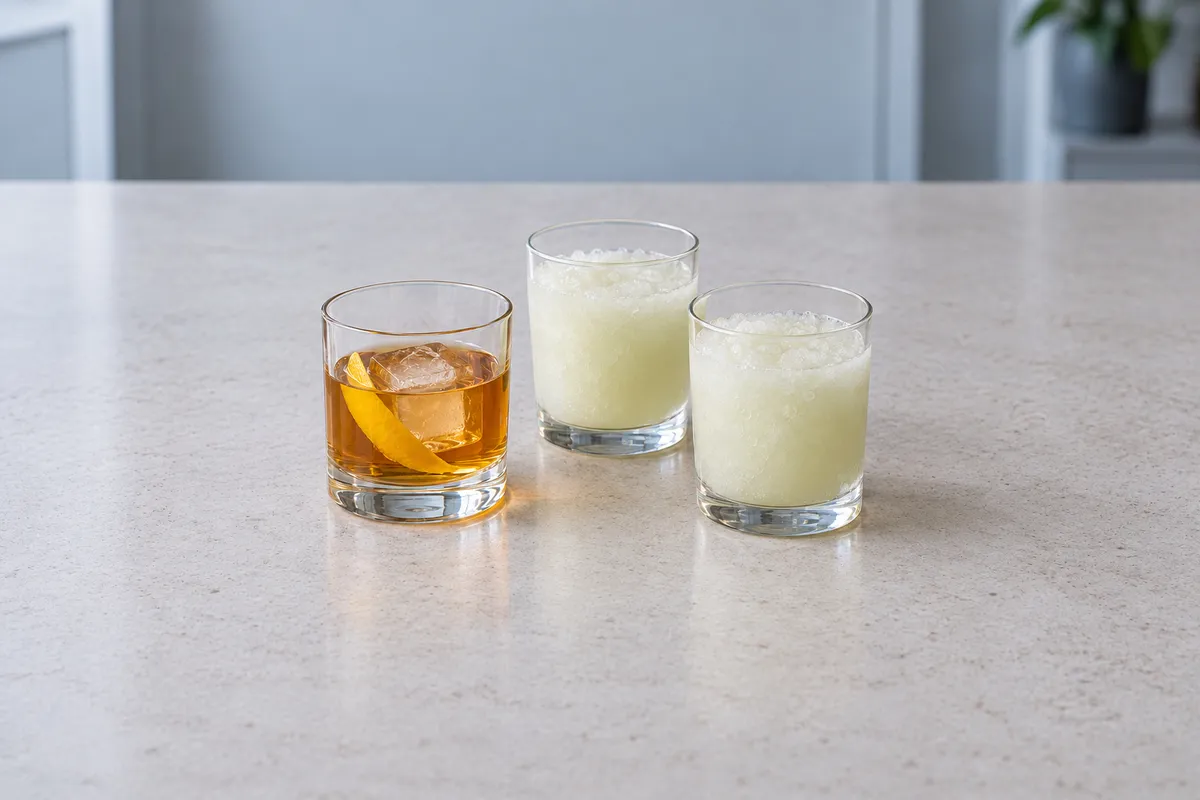
Jerry Thomas tells you to shake his Whiskey Cocktail. A few entries earlier, he tells you to stir a Brandy Cocktail. Both instructions appear on the same page of his 1862 drinks book. The choice between spoon and shaker was already part of the recipe.
Changing an older drink’s method is a tuning decision. We might want a gently mixed whiskey cocktail, a different sequence for building a Clover Club’s foam, or a Daiquiri whose ice becomes part of the texture. The old books give us a starting point; choosing the finish is part of making the drink our own.
Those changes involve three things: movement, air and water. The ingredient list tells you what goes into the vessel. The method helps decide what reaches the glass.
The water you didn’t pour
Ice cools a drink while some of it melts into the liquid. That water belongs to the result, even when the recipe doesn’t list a separate measure. Straining removes the remaining ice, not the meltwater already mixed through the cocktail.
Shaking and stirring move liquid around the ice differently. Bartender Tom Macy explains the practical distinction in his guide to shaking and stirring: vigorous shaking brings aeration as well as chilling, while stirring offers gentler mixing. The choice is about the intended drink, including how it feels when served.
It also changes how quickly you get there. A brief shake and a longer stir aren’t interchangeable units of work, and repeating a number of seconds doesn’t guarantee the same dilution. Your ice, the temperature of the ingredients and the amount in the vessel all affect the starting conditions.
Keep the distinction visible when translating an old recipe. A lump that goes into a shaker and is strained out has a different role from measured ice that stays in a blender drink. Neither description should quietly become an equal volume of water.
| Mixing choice | What happens to the ice | What you are choosing |
|---|---|---|
| Stir and strain | Remaining mixing ice is discarded; melted water stays | Gentle mixing before service |
| Shake and strain | Remaining mixing ice is discarded; melted water stays | Vigorous mixing and aeration |
| Dry shake plus an ice stage | One shaking stage contains no ice | A separate opportunity to build foam |
| Blend with measured ice | Ice particles and meltwater both reach the glass | A frozen texture that changes as it melts |

| Formula / method | Proportions / stages | Additions / ice destination |
|---|---|---|
| Stirred whiskey | Mix whiskey, syrup and bitters → Stir with mixing ice → Strain over fresh serving ice → Express lemon; add peel | Remaining mixing ice stays behind. Meltwater stays in the drink. Fresh serving ice then continues melting. |
| Clover Club · dry shake first | Dry shake: no ice → Add ice; shake again → Fine-strain into the glass | Remaining mixing ice and stray fragments stay behind. Meltwater stays. No serving ice. |
| Clover Club · reverse alternative | Shake with ice → Strain out the ice → Shake without ice → Fine-strain into the glass | Alternative order for comparison. Keep the ingredient formula fixed when comparing. |
| Frozen lime Daiquiri | Measure liquids and solid ice → Blend to pourable slush → Divide into two small glasses | Measured ice particles and meltwater reach the glass. Solid-ice cups are not liquid-water equivalents. |
Whiskey, sugar and bitters, with a different finish
Thomas’s Whiskey Cocktail, recipe 109 on printed page 50, uses whiskey, gum syrup, named bitters and lemon peel. Fine ice goes into the mixing glass, and the drink is shaken and strained into a wine glass. Its familiar ingredients don’t make the historical service identical to a contemporary Old Fashioned.
The adjacent Brandy Cocktail matters, too. Thomas explicitly stirs it. Both tools were available; the question for our whiskey drink is which texture and service we want now.
The current IBA Old Fashioned begins with sugar, bitters and a little water, then adds ice and whiskey for gentle stirring. Our companion stirred whiskey cocktail uses measured plain syrup, aromatic bitters and lemon peel. The syrup, measures and service are declared choices in that adaptation.
There are two decisions to separate here. One concerns sweetness: gum syrup, plain syrup and a sugar cube don’t arrive in the same form. The other concerns mixing. If you change the sweetener and the shaking method together, a different result can’t be credited to the spoon alone.
A useful home comparison keeps the whiskey and measured sweetener constant, then changes how you mix a small serving. Look at the liquid, feel its temperature and consider its texture. There is no need to declare a winner for every whiskey or every drinker.
Fresh ice starts another stage
A stirred drink strained over fresh ice continues changing after service. The mixing ice has already done its job; the fresh pieces now cool the drink in its glass and gradually melt. Serving the same mixture without ice creates a different drinking window.
Set out the serving ice separately from the mixing vessel. For a few friends, having the glasses ready makes it easier to finish each drink promptly and give everyone the same starting point.
Clover Club: where to put the ice-free shake
The 1930 Savoy Cocktail Book gives its Clover Club egg white, citrus, grenadine and gin, followed by a short shake-and-strain instruction. Our published raspberry Clover Club uses raspberry syrup and measured contemporary quantities.
Its method starts with a short dry shake, then an ice shake and a fine strain. “Dry” describes the absence of ice during that first shake; the egg white and other ingredients are still liquids. The cold stage follows it.
A reverse dry shake changes the order. An ice shake comes first, the remaining ice is strained out, and an ice-free shake follows before the final fine strain. Simon Difford’s Clover Club demonstrates that sequence in a different ingredient formula.
To compare the two sequences, keep the gin, citrus, syrup and pasteurized egg-white quantities steady. Adding Difford’s vermouth or changing the citrus at the same time would make it harder to judge what the shaking order contributed.
Foam has a serving job
A white cap makes the Clover Club immediately recognizable, but height alone doesn’t tell you how pleasant the drink will be. The layer needs to sit comfortably above the liquid and reach the rim in a glass with enough room. An enormous mound isn’t the only possible goal.
Fine straining is part of the finish in both modern approaches. It helps keep stray ice fragments out of the glass. That matters when comparing foam and texture: fragments left floating on top can be mistaken for something the shaking order alone has produced.
Follow the published recipe’s pasteurized egg-product guidance and the product’s handling instructions. Changing the order of shaking doesn’t change the ingredient’s handling requirements. Prepare the glasses before mixing so the finished foam isn’t waiting while you search the cupboard.
Daiquiri: when the ice stays
Craddock’s Daiquiri on printed page 54 uses rum, powdered sugar and a choice of lemon or lime juice. It is shaken and strained. The modern frozen lime drink has a different destination: its mixture is blended with ice and served as a slush.
This is where ice stops being only a mixing tool. The particles remain in the glass, bringing the frozen texture as well as the water they will eventually become. The full ice quantity belongs in the recipe, even though some of it remains solid at serving.
Tom Macy’s Frozen Daiquiri supplies the contemporary formula for our frozen lime recipe: rounded metric liquid measures, a specified solid-ice cup measure and two small servings from the batch. Here, a later recipe helps us explore what freezing changes about the older drink’s familiar rum, citrus and sugar combination.
Measure the form as well as the cup
A cup filled with small cubes contains gaps. A cup packed with finely crushed ice is another arrangement. Converting either to a cup of liquid water would remove the very structure you are trying to create.
Choose the specified ice form and measure it consistently. If your blender needs a different form, treat that as a recipe adjustment and reassess the result. An extra unmeasured handful changes more than the height of the drink in the glass.
The syrup deserves the same care. Equal volumes of sugar and water specify one preparation; equal weights specify another. A richer syrup is different again. Replacing one with another without changing the measured dose can move the sweetness even when the rum and lime stay constant.
Use chilled ingredients and cold glasses, then blend close to serving. A frozen drink keeps changing as it stands. More time in the jug, or a long wait on the table, can turn a pourable slush into a thinner drink without anyone adding water.
Scale the ingredients, then plan the mixing
Doubling the measures doesn’t mean doubling the shaking or blending time. Nor does it guarantee the same number of servings will fit in the equipment. A shaker needs working space, and a blender has its own instructions for ice and loading.
For a group, prepare what can sensibly wait: the measured non-egg liquids, the cooled syrup and the serving glasses. Keep egg additions tied to the recipe’s service instructions. Stir or shake in comfortable batches, and blend frozen drinks near the moment they are wanted.
Our scaling guide covers the arithmetic and the practical limits. The mixing decision begins where multiplication ends: choose the movement and the ice’s destination, then give each batch enough room to do what the method asks.
Sources
Jerry Thomas, How to Mix Drinks, or The Bon-Vivant’s Companion (1862), printed p. 50, recipes 107 and 109; Harry Craddock, The Savoy Cocktail Book (1930), printed pp. 48 and 54.
Contemporary method references are the IBA Old Fashioned, Tom Macy’s shaking-and-stirring and Frozen Daiquiri pages, and Simon Difford’s Clover Club, linked beside the relevant comparisons.