
- Kitchen know-how
- Recipe scaling
- Portion sizes
Scaling a recipe without losing its balance
How to scale ingredient amounts, measure a fraction of an egg, and check pans and cooking instructions when making a smaller or larger batch.
For three servings from a recipe for four, use ¾ of each ingredient amount. Keep the original method, cooking time and temperature beside your new list: those don’t change with the same calculation.
The flour is easy to weigh. A result of 1½ eggs takes another step, and a smaller batch may cook differently in the same pan. This article works through those practical decisions. If you need the calculation and a checklist while you cook, use the scaling calculation and checklist.
Make the ingredient list first, then look at the equipment it needs. Batter depth, skillet space and the number of oven batches can change even when the calculation is straightforward.
Start with the original recipe
Divide the servings you want by the servings the recipe makes. Three servings from four gives 3 ÷ 4, or ¾. Multiply each written ingredient quantity by that amount:
| Ingredient | For four | For three |
|---|---|---|
| Flour | 200 g | 150 g |
| Milk | 300 ml | 225 ml |
| Eggs | 2 | 1½ |
This is an arithmetic example, not a complete recipe. Work from the quantities in your recipe, keeping its preparation notes beside the amounts. Check what the yield means, too: twelve cookies aren’t necessarily twelve servings. Decide whether you’re counting cookies or portions, and use that choice consistently.
If you want eight cookies from a recipe that makes twelve, the multiplier is 8 ÷ 12 = ⅔. That changes the number of cookies you plan to shape. It doesn’t tell you how many people will consider them a serving, or change the size of each cookie unless you choose to do that separately.
If you decide to cook for six instead, go back to the original quantities and multiply by 1½. Repeatedly scaling an already rounded list can gradually shift the proportions.
For example, ⅓ cup doubled is ⅔ cup. If you first rewrite ⅓ as 0.3, doubling that rounded amount gives 0.6 cup. Keep the fraction through the calculation and round only when you need a usable measuring instruction. The tool retains its underlying quantities when you switch displays; copying rounded labels into a new recipe loses that advantage.
Make awkward amounts measurable
Half an egg is manageable when the recipe mixes whole eggs into a batter. Beat two eggs together, weigh them without their shells, and take three quarters of that weight to use 1½ eggs. The white and yolk stay together. This approach doesn’t suit a recipe that needs an intact egg or handles the whites and yolks separately.
Suppose your two beaten eggs happen to weigh 104 g. Three quarters is 104 × ¾ = 78 g. Weigh out 78 g for the adjusted batter. Use the scale reading from your own beaten eggs.
Keep the recipe’s egg-size instruction. For a dish needing individual poached or fried eggs, decide how many whole eggs to serve instead of trying to turn the calculated fraction into a physical half-egg. That serving decision belongs beside the ingredient calculation.
If the author gives a range, keep it: half of “2–3 cloves” is “1–1½ cloves.” You don’t need an invented average, and “to taste” can stay as written. Chopping a clove makes a partial amount easier to divide when the method already calls for chopped garlic; it doesn’t establish a universal gram weight for a clove.
Scale the original written amounts first. Converting cups to grams is a separate step, and a weight supplied by the recipe author is the best starting point. Otherwise, look at the ingredient and its preparation: a cup of flour and a cup of sugar don’t weigh the same. Our guide to cups and grams explains how to choose a useful conversion.
Keep divided ingredients divided
Keep track of ingredients used twice. Suppose a recipe lists 60 g butter, with 40 g for the mixture and 20 g for the topping. At three quarters of the recipe, the total is 45 g, divided into 30 g and 15 g. Check that the two adjusted parts still add up to the adjusted total.
Don’t add the full 45 g at the first mention and then add another 15 g at the topping step. Read the whole method before measuring, and label reserved ingredients if that helps. Grease for a pan may need a separate equipment-based decision rather than the same exact ratio as butter mixed into the food.
Look at the pan before the clock
Pancakes make the distinction easy to see. Keep each pancake the same size and cook fewer of them. You’ve changed the batch, but not the individual pancake. The time for one pancake can remain similar while the time for the entire batch changes with how many fit on the griddle.
With a cake, half the batter in the original pan makes a shallower mixture. A double batch may leave that pan too full. For a larger batch, more pans of the original size can be more practical than trying to fit everything into one deeper pan.
Compare area, then check capacity
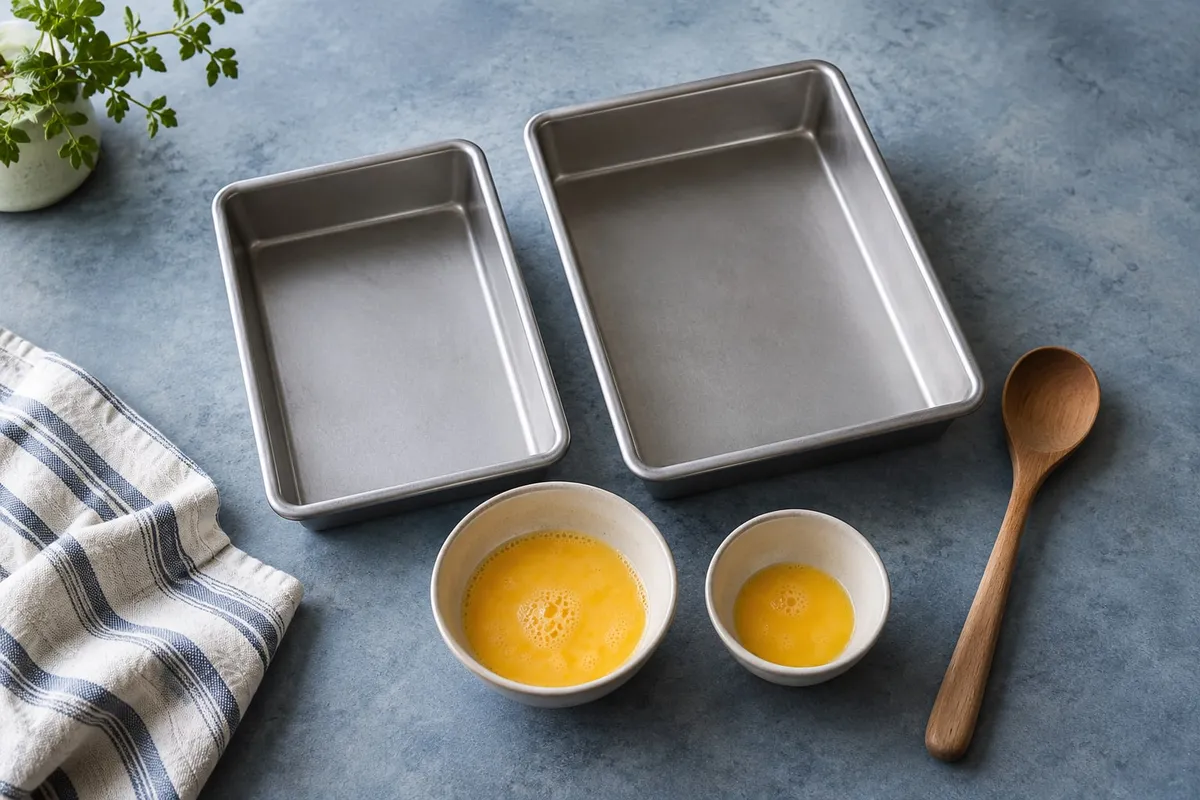
For rectangular pans, length multiplied by width gives the base area. A 20 × 30 cm pan has an area of 600 cm²; a 20 × 20 cm pan has 400 cm². The smaller area is 400 ÷ 600 = ⅔ of the larger. Using two thirds of the batter is a useful starting comparison if the recipe needs a similar layer depth.
Compare the pans’ depths, shape, material and usable inside dimensions too. A shallow tray and a deep casserole with the same base area do different jobs. Follow the author’s smaller-pan guidance when available, including stated fill limits or special pan requirements.
Give food on the stovetop the room its method needs. For browning, another batch can be more useful than a crowded pan. Review water for boiling, oil for frying and grease for a pan separately, since those amounts also depend on the equipment.
For a sheet of vegetables, check whether the larger quantity still fits in the stated layer and spacing. If it doesn’t, plan another tray or another batch before heating the oven.
Half the batter doesn’t automatically mean half the cooking time. Follow the recipe’s doneness checks and any stated food-temperature guidance. Keep the original oven setting unless the recipe gives instructions for the change you’re making.

Build a schedule for the batch you chose
Separate elapsed time from time spent working. Keep the dough’s full chill or rest time unless the author provides instructions for a changed batch.
Batch cooking adds its own arithmetic. If the recipe makes twelve pancakes and your pan holds three, that is four rounds. Eighteen pancakes in the same pan take six rounds. You haven’t multiplied the time for each pancake by 1½; you’ve changed the number of rounds. Leave room for the recipe’s turning, transfer and pan-management steps rather than treating those counts as a complete cooking-time prediction.
For food baked together, consider when to start checking instead of announcing a new fixed finish time. A changed layer depth may affect the result. Keep the original cues beside your plan, and use the stated temperature check where the recipe calls for one. A timer is a reminder to inspect, not a replacement for those instructions.
Leave room to adjust seasoning
Start with the scaled amount of measured seasoning. If the finished dish allows tasting and adjustment, add more gradually if it needs it. Don’t taste raw mixtures that need cooking first.
In baking, salt, sugar and leavening can do more than add flavor. Keep the recipe’s proportions for an initial adjustment rather than treating them all as optional seasonings. Changing sugar because the scaled amount looks large is a separate recipe modification, with effects beyond portion size.
A small result also needs an appropriate measure. ½ teaspoon, scaled to three quarters, is ⅜ teaspoon. Where useful, that is ¼ teaspoon plus ⅛ teaspoon. It needn’t become an invented “pinch.” Use the recipe’s ingredient-specific weight if supplied and your scale can measure it reliably; a cup-to-gram estimate for a different salt or baking powder is not a better substitute.
Keep a short note for next time
A few notes will save you some guesswork next time: how much you made, the pan you used, when you started checking for doneness and any seasoning changes. You won’t have to rely on remembering whether the smaller cake needed five minutes less or ten.
The recipe tool can adjust ingredient amounts and supported measurements. The written method, cooking times and temperatures stay unchanged, including quantities mentioned inside the steps. Check those against your adjusted ingredient list before you start. If the yield isn’t recognized, use the recipe multiplier or correct the yield rather than assuming an item count has become servings.
Keep that adjusted list beside the original method, with reserved quantities marked before you begin.