
- Kitchen know-how
- Measurements
- Unit conversion
Cups, grams and the ingredients between
How to convert cups to grams and back, why the ingredient matters, and when to use the recipe's own weights.
Open the cups-to-grams converter
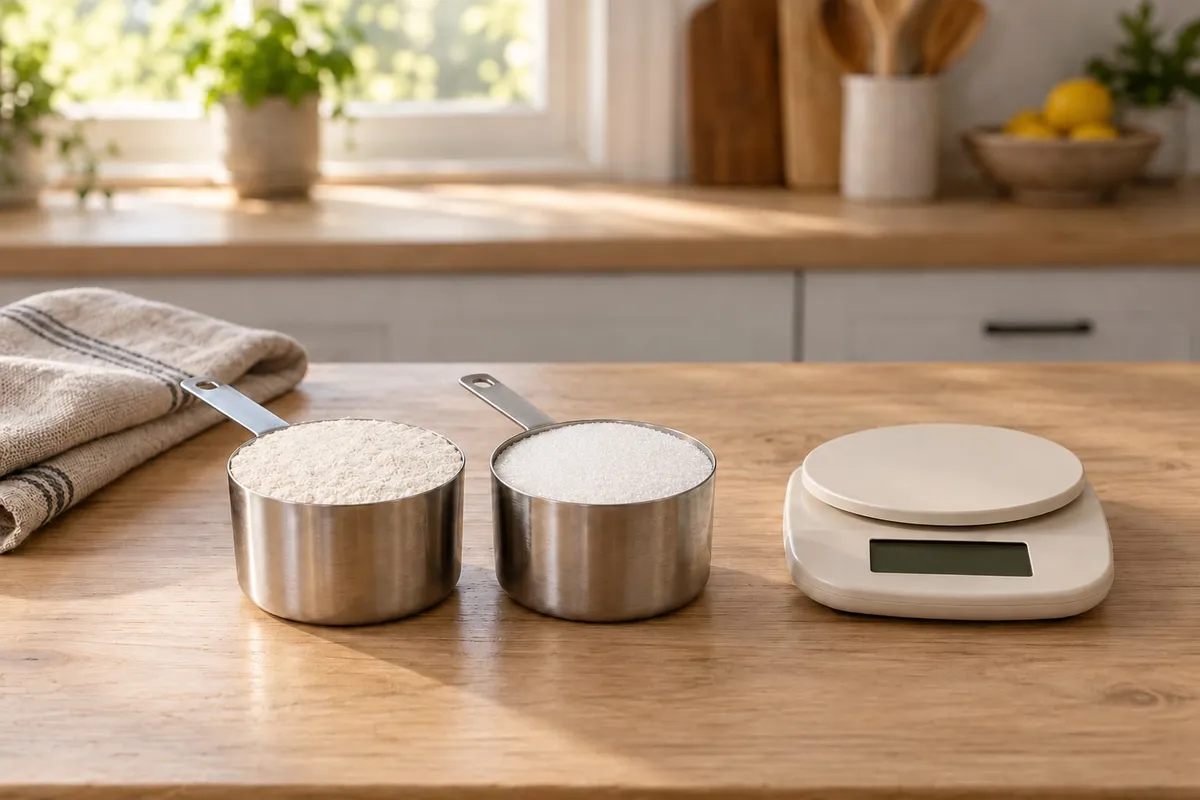
A cup of flour and a cup of sugar fill the same space. Put them on a scale, though, and the numbers are quite different. That’s why a recipe written in cups needs more than a single conversion factor when you want to cook in grams.
Before converting, ask what fills the cup and how it was measured. Packed brown sugar and loosely spooned flour need different weights, even when the cup is identical.
Start with three details: the cup system, the ingredient’s form and any weight the author supplies. Those tell you whether to use a reference estimate, follow a stated weight or keep the original measure. You don’t need to convert every line to cook comfortably.
Which cup does the recipe mean?
Cups, tablespoons, teaspoons and milliliters measure volume: how much space something takes up. Grams measure weight. Changing cups to milliliters only needs the cup size. Changing cups to grams also needs the ingredient.
Our standalone converter uses US customary measures. One US cup is about 237 ml, or 16 US tablespoons or 48 US teaspoons. A metric cup is 250 ml. Those cup sizes are different, even when both recipes simply say “cup.”
Check the recipe’s measurement notes before converting. If it specifies a metric cup, use that stated volume rather than treating it as a US cup. An old family teacup is another matter: unless its capacity is known, a modern conversion chart cannot tell you how much it held.
A liquid example before an ingredient example
For ½ US cup of milk, the exact volume calculation is 236.5882365 ÷ 2 = 118.29411825 ml. Half a 250 ml metric cup is 125 ml. You can see the difference without knowing anything about milk’s weight.
A measuring jug cannot resolve all those decimal places. The converter rounds its milliliter output above 30 ml to the nearest 5 ml, so the half-US-cup example displays 120 ml. It keeps the unrounded quantity for calculation. A rounded label doesn’t redefine the cup.
Check the unit symbols, too. fl oz is fluid volume; oz is weight. A recipe’s ounces of flour should not be treated as fluid ounces. US and UK fluid ounces also have different sizes. Choosing Metric or US display doesn’t settle an unclear source measurement: establish what the recipe means first.
How many grams are in a cup?
Here are five estimates used by our converter. Each refers to one US cup of the named ingredient and form.
| Ingredient | Weight (approx.) |
|---|---|
| All-purpose flour | 125 g |
| White sugar | 200 g |
| Brown sugar, packed | 220 g |
| Oats, regular or quick, dry | 81 g |
| Honey | 339 g |
These are household portion weights from USDA FoodData Central. Your cupful may weigh differently: packing, preparation and the product itself can affect the result.
Keep the words beside the ingredient. “Packed” describes how to fill the brown-sugar cup; “dry” distinguishes oats from cooked oatmeal. Those details choose the right starting weight.
For example, ½ US cup of packed brown sugar calculates to 220 × ½ = 110 g. That says nothing about half a cup of loosely spooned brown sugar. Keep “packed” beside the quantity when you save the recipe; it is part of the instruction, not decorative wording.
Preparation can change which ingredient a reference describes. Chopped nuts and whole nuts leave different spaces between pieces. Sifted powdered sugar and unsifted powdered sugar are different starting forms. A reference for one does not automatically establish a weight for the other. When the available selection doesn’t match, keeping the recipe’s cup or spoon measure is more useful than attaching an unsupported gram number.
An awkward fraction, made useful
Suppose a recipe calls for ¾ cup of all-purpose flour. Using the converter’s 125 g reference, that works out to 93.75 g, or about 94 g for weighing in the kitchen.
The same ¾ cup of white sugar works out to 150 g. The cup fraction has not changed; the ingredient has.
You can apply that arithmetic to a mixed fraction as well. 1½ US cups of flour is 1.5 × 125 = 187.5 g before display rounding. The converter shows 190 g, using a practical weight increment at that size. The cup’s filling technique still affects the result.
When the recipe gives both cups and grams
If the recipe gives its own gram equivalent, use it. A baker who specifies 120 g for their cup of flour has supplied a different starting weight. Replacing it with 125 g would add flour to the recipe.
Consider a line written as 2 cups flour (240 g). At three quarters of the batch, use 240 × ¾ = 180 g. Starting with the generic 125 g-per-cup estimate would instead give 2 × 125 × ¾ = 187.5 g. Both calculations are arithmetically sound, but only the first keeps the author’s stated relationship.
Don’t blend the two approaches by weighing one cup from the author’s value and another from a reference table. Pick the recipe’s own equivalent for that ingredient throughout the adjustment. If its two amounts appear inconsistent, check the wording or ask the author rather than silently rewriting the formula.

Going from grams to cups
The same ingredient-specific estimates work in reverse. In our converter, 250 g of all-purpose flour is 2 US cups. 250 g of white sugar is 1¼ US cups.
Select Weight → Volume, choose the ingredient and enter the weight. Depending on the ingredient, the result uses cups or spoons. For repeatable results, weigh the stated amount where possible.
For another comparison, 110 g of packed brown sugar is 110 ÷ 220 = ½ US cup. Keep the packing instruction when measuring it. Converting the weight back to a loose half-cup measure would lose the ingredient form that made the calculation useful.
If you already have a scale and the recipe gives grams, there is usually no reason to convert back. Put the bowl on the scale, zero it and weigh the ingredient directly. For very small quantities that your scale cannot measure reliably, follow the recipe’s spoon measurements.
A weighing routine that keeps you oriented
Set the scale on a steady, level surface and check its weight unit. Place an empty bowl on it, then use tare or zero before adding the ingredient. If you need 180 g flour, the bowl’s weight should not be part of that number.
You can zero again before adding the next ingredient to the same bowl, provided the recipe mixes them together at that stage. Keep ingredients separate when the method needs them separately. If the recipe reserves some flour for dusting or some butter for the pan, note that split before weighing everything into the batter.
When using cups, follow the recipe’s filling instructions: packed, level, sifted or heaping are meaningful differences. Don’t tap down flour merely to make it fit a target weight from a generic table. That would turn an estimate into a new measuring technique the recipe never requested.
Using the converter and recipe tool
Use the cups-to-grams converter for a single ingredient. Choose Volume → Weight for cups or spoons to grams, or Weight → Volume for the reverse. The ingredient list shows the available choices. Volume conversions switches between cups, spoons and milliliters without needing an ingredient weight.
Use the recipe tool when you want to adjust a whole ingredient list. Review the imported amounts and source measurement system first. Its US weight display uses ounces or pounds; it does not turn every gram amount into cups. Measurements without a supported conversion retain their original unit.
Check the recipe tool’s actual result and measurement notes. Its ingredient matching and supported forms differ from the standalone converter’s selection list. A spoon, count or source unit stays in place when the tool has no supported weight for it.
Changing units also leaves the method intact. A larger batch may need another pan, and doubling ingredients does not mean doubling the cooking time. Scaling a recipe without losing its balance works through those decisions; the scaling checklist is a compact reference while cooking.
Before you start, keep the original recipe beside your adjusted list. Check any quantities repeated in the instructions against the amount you now need. Then choose the measuring tool that suits each line: a scale for a stated weight, a jug for liquid volume and the recipe’s spoon or count where that remains the useful measure.
Sources and measurement notes
US and metric cup conventions are discussed in NIST’s archived household measurement guide. Practical weighing advice follows NIST’s culinary measurement tips.
The ingredient estimates match the converter’s reviewed USDA FoodData Central household portions: all-purpose flour (168894), white sugar (169655), packed brown sugar (168833), dry oats (173904) and honey (169640). The numbers in parentheses identify the source records.