
- Vintage
- Food History
- Desserts
- 1810s
The Custard That Became a Warning
An 1819 letter about cherry-laurel custard reveals how a school meal became a warning about flavor, ingredients and a cook's judgment.
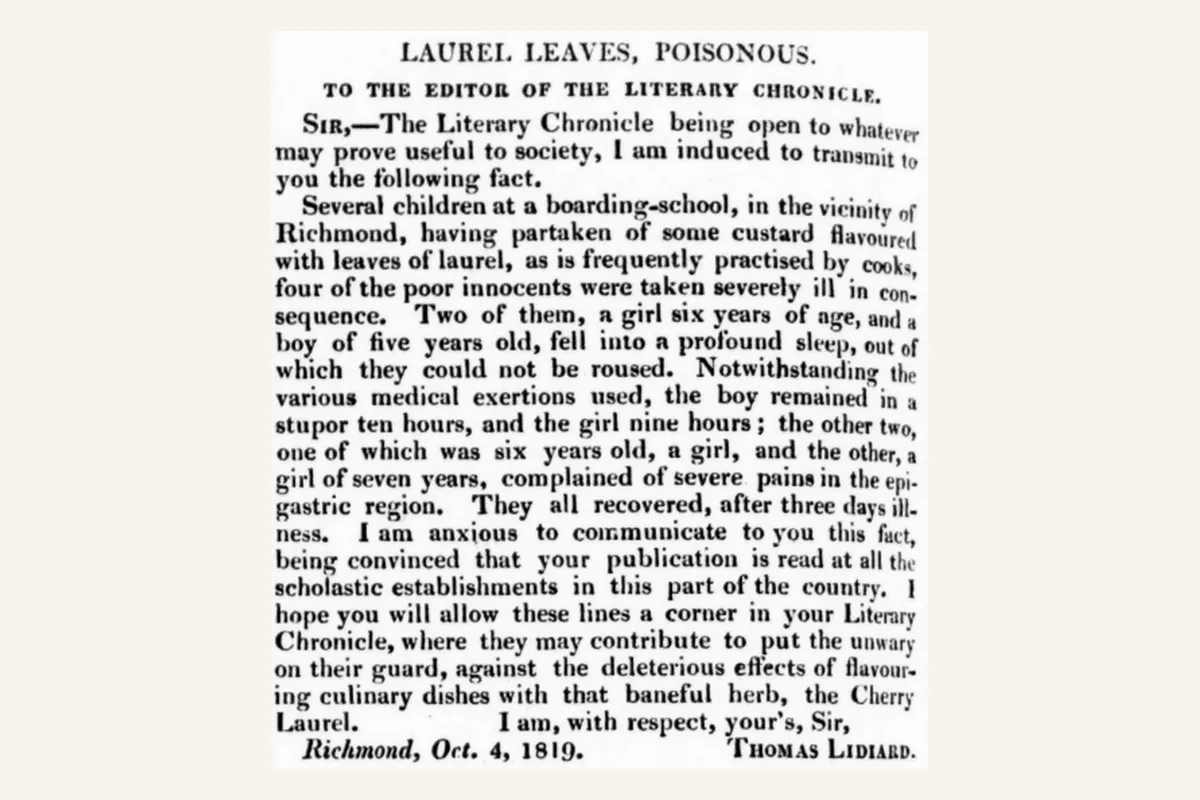
Thomas Lidiard / Literary Chronicle (1819) / Internet Archive scan
Read the complete original letter at full size
Thomas Lidiard wanted his letter read in schools. Four children at a boarding school near Richmond had become seriously ill after eating custard, he reported, and he blamed the leaves used to flavor it. All four recovered. His purpose in writing was to keep the same thing from happening elsewhere.
The letter appeared in the Literary Chronicle and Weekly Review on October 16, 1819. It names cherry laurel, a plant quite different from the culinary bay leaf in a modern spice cupboard. The story is often repeated as a startling example of dangerous old cooking. Its original wording offers something more interesting: a warning already being made at the time, and a disagreement about how much trust to place in a cook’s idea of a harmless addition. Lidiard, “Laurel Leaves, Poisonous,” p. 348.
A letter with a particular audience
Lidiard’s account was brief. A five-year-old boy and a six-year-old girl reportedly could not be roused for hours. Two other girls complained of severe pain in the upper abdomen. He said they recovered after three days of illness, despite the alarming symptoms.
The details make the consequences immediate without opening the school kitchen to us. Lidiard doesn’t identify the school, the children or the person who prepared the meal. He signs his letter without stating whether he was a parent, teacher, doctor or witness. Its Richmond dateline is October 4, but that dates the communication, not the meal. Nothing in the account supplies a recipe or a quantity of leaves.
His reason for choosing the journal is clearer. He believed it was read in schools in that part of the country and asked it to carry a warning. A household or institutional incident could travel through a publication to people who might make the same choice. The original appeal is evidence of that intention; it doesn’t tell us how many schools read the letter or changed their cooking.
The first reference to the flavoring says simply laurel leaves. The letter’s ending specifies cherry laurel. It doesn’t describe a mix-up with culinary bay.
Why an almond-like flavor appealed
Fredrick Accum explained the culinary attraction when he reused the letter in his 1820 Treatise on Adulterations of Food, and Culinary Poisons. Cherry laurel supplied an almond-like flavor to custards, creams, puddings and blancmanges. He challenged the assurance that a very small amount could be treated as harmless. Lidiard’s account gave that argument a human consequence. Accum, Philadelphia edition, “Poisonous Custard,” pp. 231–233.
Accum’s objection was aimed at judgment as much as at an ingredient. A cook might know that something was potent and still believe a restrained hand made it acceptable. Yet neither his discussion nor Lidiard’s letter gives the missing measurements for this dessert. We cannot turn their warning into a dependable leaf count, much less a usable threshold.
Cherry laurel is Prunus laurocerasus. NC State Extension identifies cyanogenic glycosides among its toxic principles and rates its poison severity as high. Culinary bay is Laurus nobilis, a different species used as an herb. Their shared common name does not make them interchangeable. Cherry laurel should not be used to recreate this flavoring. NC State: cherry laurel and culinary bay.
Modern plant information explains why the ingredient deserves a warning. It cannot diagnose children described in an 1819 letter. Their reported symptoms, the writer’s explanation and a modern confirmed poisoning remain different things. Nor does removing a leaf after flavoring establish that an unsafe plant has become safe.
One incident, several printed lives
Accum retained the children, their recovery and Lidiard’s signature, but changed the letter’s setting. He removed its opening address and the Richmond dateline, made the first ingredient reference explicitly cherry laurel and placed the account inside a discussion of culinary danger. His footnote acknowledged the Chronicle.
In February 1820, the Philosophical Magazine and Journal printed another version under “Poisonous Custard.” Its larger article expressly credited Accum’s treatise. The appeal to school readers was shortened further. A request for space in a journal had become a compact example in an argument about food. Philosophical Magazine, vol. 55, pp. 102, 108–109.
These are separate publications carrying the same case. They don’t establish three incidents or three independent medical observations. Following the words between them is useful precisely because it shows how a warning acquired authority through repetition and a new frame.
It also keeps the past from becoming a simple tale of universal ignorance. Lidiard was warning readers; Accum was disputing reassurance. The surviving disagreement is part of the history.
Lemon custard offers another way to read the kitchen
Other desserts make the flavoring choice easier to understand without reconstructing the school’s meal. Maria Eliza Rundell’s 1806 New System of Domestic Cookery includes lemon custards made with yolks, water, lemon, wine and brandy. The stated base contains neither milk nor cream. The name custard alone therefore cannot tell us what was in the school dessert. Rundell, “Lemon custards,” pp. 159–160.
The recipe separates two decisions that an alarming ingredient can otherwise obscure. Lemon supplies flavor; egg yolks supply thickening. Another flavor was available in print before Lidiard wrote, without requiring a different explanation of how a custard takes body. There is no evidence that his school owned Rundell’s book or adopted her recipe afterward.
Eliza Leslie’s 1837 arrowroot blancmange gives a later American comparison. Lemon and spices flavor the dairy; arrowroot provides the setting ingredient. Infusing, straining and thickening are distinct operations. The straining belongs to that particular formula and its specified ingredients, rather than offering a way to make cherry laurel suitable for food. Leslie, “Arrow Root Blanc-Mange,” p. 329.
Neither dessert recovers the missing custard. They do show why the old flavoring need not be the center of a modern kitchen experiment. A historical dish can be understood by asking what supplied its flavor and what gave it structure, while leaving a hazardous ingredient out of the kitchen entirely.
For a separate example of that distinction, our Sous-Vide Caramel Custard adapts Farmer’s 1918 recipe: caramel flavors a milk-and-egg custard. It has its own source and method, rather than recreating the school dessert.
Lidiard’s intended audience was people making decisions for other children. That request survives more securely than any imagined scene at the stove: publish the warning where another school might read it.
Source note
The central account is Thomas Lidiard’s letter in the Literary Chronicle, no. 22, October 16, 1819, p. 348. Accum’s cited edition is Philadelphia: Abraham Small, 1820; the later periodical extract is in vol. 55, February 1820. The school, meal date, formula and medical diagnosis are not established. Rundell’s London 1806 and Leslie’s Philadelphia 1837 recipes are historical comparisons, not instructions for reproducing the reported dessert.