
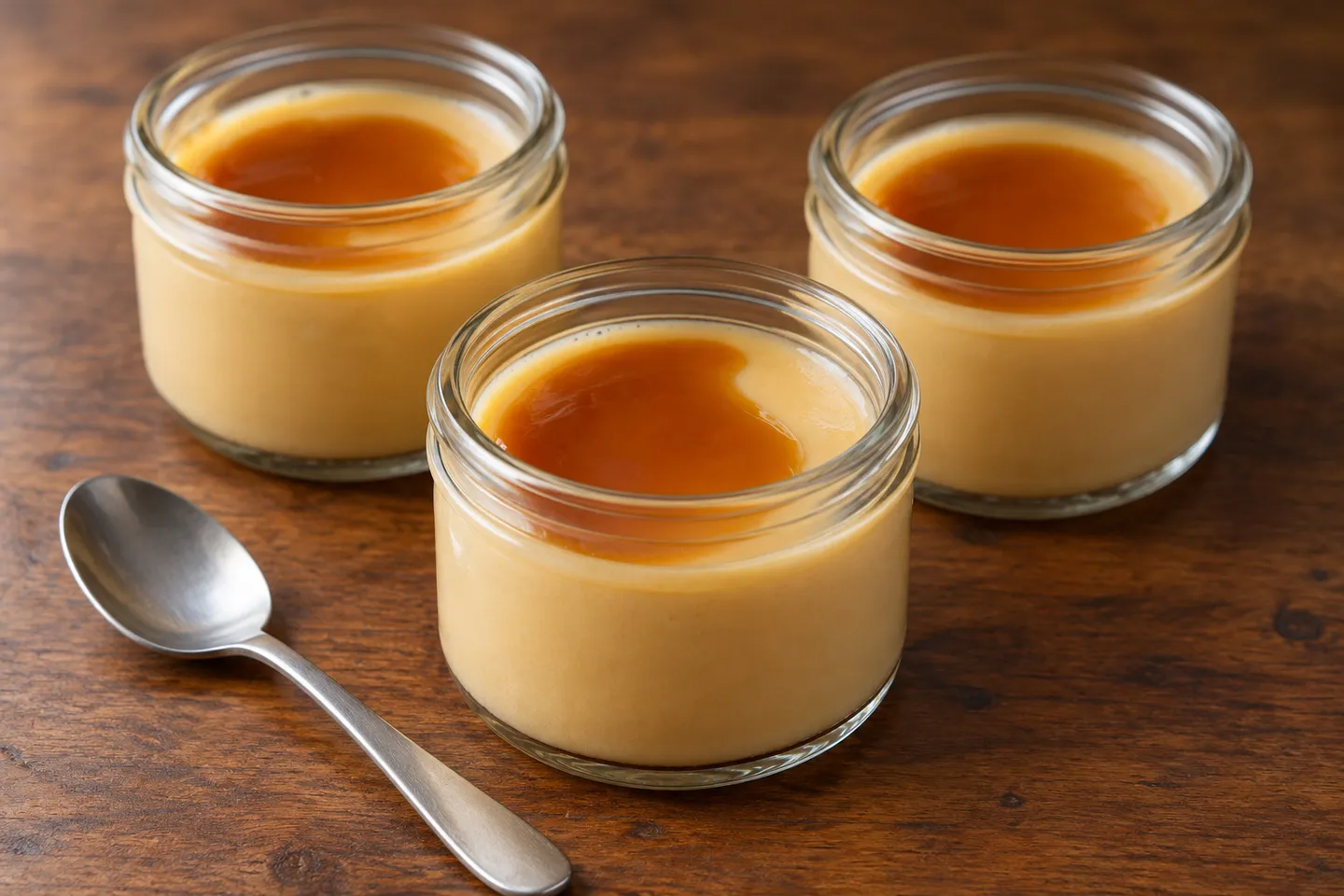
Sous-Vide Caramel Custard, Adapted from Farmer's 1918 Recipe
A spoonable milk-and-whole-egg custard with caramel dissolved throughout, cooked in small jars and served with separate caramel sauce.
- Original yieldYield
- 8 small jar custards8 small jar custards
- PrepPrep time
- CookCook time
- TotalTotal time
Allow about 7½ hours including bath heating, 2 hours at the target temperature, brief cooling and at least 4 hours of refrigeration. Make the sauce during the bath stage. Overnight chilling also works.
Published
Original recipe: 8 small jar custards
The story behind the recipe
Caramel runs through this custard, not underneath it. Fannie Merritt Farmer's 1918 recipe dissolves browned sugar in hot milk before the eggs go in, giving the dessert its light tan color. A separate caramel sauce finishes it. That small difference from a familiar flan is the reason to keep both the custard and its sauce in view.
A spoon is the right way in
Milk and whole eggs make a softer dessert than a cream-heavy pot or a firmly molded flan. Individual jars suit it: the custard can stay in its cooking vessel, and a spoonful of sauce goes on top when it's cold. There's no need to persuade a delicate dessert to stand unaided on a plate.
An immersion circulator gives the jars a steady water bath instead of relying on the oven setting. It controls that heating stage; the caramel still needs attention in the pan, and the custard still needs chilling.
Read more about this recipe
What Farmer was asking the cook to watch
The caramel recipe points back to Farmer's baked custard, where the mold sits in a pan of hot water in a slow oven. She warns against letting the surrounding water boil, because the custard can separate. Heat is doing two jobs at once: setting the eggs and threatening the smooth texture if the cooking goes too far.
Her next page distinguishes cup custards from larger molded ones. Four eggs to four cups of milk are enough for cups; six are called for when a large custard needs to turn out. The caramel formula has five eggs. Serving it from a jar takes the pressure off that middle ground and lets the milk remain the main ingredient.
Control the heat, keep the flavor
The balance here stays close to Farmer's milk, whole eggs and sugar. Sous-vide jars replace her buttered mold and oven water bath, with the sauce kept separate. Extra yolks or cream would make a richer dessert, but would also move it away from the milk custard that made this recipe worth revisiting. Read Tuning Classic Recipes: When Modern Cooking Methods Help for the reasoning behind this method.
Uniform small portions matter. A shallow fill heats differently from a large jar, so changing the vessel is more than changing the presentation. Use jars intended for hot-water cooking and leave space around them for circulation. A row of matching jars also makes it easier to compare their set at the end.
The color comes before the bath
Sugar moves from a clear melt to pale gold, amber and then a much darker brown. Farmer specifies a light-brown syrup. Stop there for the custard: a bitter caramel would be spread through every spoonful once it dissolves in the milk.
Hot milk added to caramel can bubble up sharply. A pan with room above the sugar, small additions and a careful hand are worth more than trying to hurry. Any hardened caramel can dissolve again in the warm milk before the mixture reaches the eggs.
Straining catches pieces that would interrupt the texture. Gentle mixing helps too; a foamy mixture carries bubbles into the jars. The water bath won't remove everything that was whisked into it.
Finish cold, with the sauce separate
Chilling gives the custard time to firm and makes serving simple. The sauce should pour in a thin amber layer over the top, where it adds a more concentrated caramel flavor to the softer milk dessert beneath.
Make both components ahead and keep them separate until serving. If the sauce thickens in the refrigerator, loosen it with a little hot water and cool it again. Pour only a small amount at first; leave the rest for anyone who wants more caramel.
Read the original wording
Historical reference only. Follow the ingredients and cooking steps below when cooking.
Historical ingredients
- Caramel Custard: 4 cups scalded milk; 5 eggs; ½ cup sugar; ½ teaspoon salt; 1 teaspoon vanilla.
- Caramel Sauce: ½ cup sugar; ½ cup boiling water. Miss Parloa.
- Baked Custard: 4 cups scalded milk; 4 to 6 eggs; ½ cup sugar; ¼ teaspoon salt; Few gratings nutmeg.
Historical method
Caramel Custard: Put sugar in omelet pan, stir constantly over hot part of range until melted to a syrup of light brown color. Add gradually to milk, being careful that milk does not bubble up and go over, as is liable on account of high temperature of sugar. As soon as sugar is melted in milk, add mixture gradually to eggs slightly beaten; add salt and flavoring, then strain in buttered mould. Bake as custard. Chill, and serve with Caramel Sauce.
Caramel Sauce: Melt sugar as for Caramel Custard, add water, and boil ten minutes; cool before serving.
Baked Custard: Beat eggs slightly, add sugar and salt, pour on slowly scalded milk; strain in buttered mould, set in pan of hot water. Sprinkle with nutmeg, and bake in slow oven until firm, which may be readily determined by running a silver knife through custard; if knife comes out clean, custard is done. During baking, care must be taken that water surrounding mould does not reach boiling-point, or custard will whey. Always bear in mind that eggs and milk in combination must be cooked at a low temperature. For cup custards allow four eggs to four cups milk; for large moulded custard, six eggs; if less eggs are used custard is liable to crack when turned on a serving dish.
Make it your wayOriginal: 8 servings · Makes 8 small jar custards
Original recipe: 8 small jar custards
Ingredients
For 8 small jar custards. Quantities are shown as written.
Source measurement convention: Metric. Explicit unit definitions take precedence; unconfirmed measures must be checked before conversion.
Original quantities for 8 small jar custards.
Custard
- Whole milk950 ml
- Large eggs5
- Granulated sugar100 g
- Fine salt1/2 metric tsp
- Vanilla extract1 metric tsp
Separate caramel sauce
- Granulated sugar100 g
- Boiling water, plus a little extra hot water if needed to loosen the cooled sauce120 ml
Water bath
- Warm water, as needed to surround the jars and meet the circulator's fill limits
Measurement notes
- fine salt, vanilla extract: tsp: 1 = 5 ml.
Measurement notes
Original ingredients
- 950 ml whole milk
- 5 large eggs
- 100 g granulated sugar
- 1/2 tsp fine salttsp: 1 = 5 ml.
- 1 tsp vanilla extracttsp: 1 = 5 ml.
- 100 g granulated sugar
- 120 ml boiling water, plus a little extra hot water if needed to loosen the cooled sauce
- Warm water, as needed to surround the jars and meet the circulator's fill limits
Equipment
 Sous-vide immersion circulator and a water-bath container large enough for eight jars
 Eight 250 ml wide-mouth canning jars with two-piece lids, suitable for hot-water cooking
 Food thermometer
 Fine-mesh strainer
 Small saucepan
Instructions
Prepare the jars and warm bath
Check the jars for chips or cracks and wash them and their lids. Set up the circulator in a suitable water-bath container with warm water within its fill limits. Leave room for eight jars and for water to circulate between them; don't heat the empty bath to its final temperature yet.
Dissolve caramel in hot milk
Heat the milk in a saucepan until steaming, without boiling, and keep it hot. In another saucepan, melt the 100 g custard sugar over medium-low heat, swirling or stirring gently as needed, until it becomes a light amber syrup. Remove from the heat. Carefully add the hot milk in small portions, standing back from bubbling and steam. Return to low heat and stir until any hardened caramel has dissolved.
Temper the eggs and fill the jars
Beat the eggs gently with the salt and vanilla, avoiding foam. Gradually whisk in the hot caramel milk in a thin stream so the eggs don't scramble. Strain the mixture and skim off surface foam. Let it cool briefly until warm rather than piping hot, then divide evenly among the jars, about 150–160 ml in each, leaving at least 1.3 cm (½ inch) headspace.
Load the jars and heat the bath
Fit the two-piece lids and tighten the bands only until fingertip resistance, so air can escape during heating. Place the warm filled jars upright in the warm bath, on a suitable rack if the appliance requires one, with water above the custard level and the jars clear of the circulator inlet and outlet. Keep the water within the device's limits. Set the bath to 82°C (180°F); start the 2-hour cooking timer when the bath reaches that temperature.
Cook and check the custards
During cooking, keep the jars upright and check that the water remains above the custard level. Add warm water if evaporation lowers it, without dropping the bath below its working level. After 2 hours, lift one jar carefully and check for a softly set custard with a gentle wobble, not liquid sloshing. Open it carefully and check that the center has reached at least 160°F (71°C). If it hasn't, or is still liquid, refit the lid, continue cooking in 15-minute intervals and check again.
Make the separate caramel sauce
While the custards cook, make the separate sauce. Melt its 100 g sugar in a clean saucepan to an amber caramel, then remove from the heat and carefully add the 120 ml boiling water in small portions. Return to low heat, stir until dissolved and simmer gently for about 10 minutes, until a pourable syrup forms. Let it cool; if it becomes too thick to pour, stir in a little extra hot water and cool again.
Cool and refrigerate the custards
Lift out the cooked jars and stand them on a dry heatproof surface, away from drafts. Let them cool for about 20–30 minutes, then refrigerate in a single layer with space between them for at least 4 hours, until thoroughly cold and softly set. Don't put hot glass directly into ice water. Refrigerate the cooled sauce separately. Get both into refrigeration within 2 hours of finishing cooking.
Top with sauce and serve
Remove the lids and spoon a little cold or room-temperature caramel sauce onto each custard just before serving. Serve directly from the jars; keep the remaining sauce separate.
Estimated calories 170 kcal
Nutrition portion: 1/8 of recipe · Original yield: 8 small jar custards
Source & assumptions
Ingredient-based estimate using CoFID 2021, USDA SR Legacy (2018). About 170 kcal per nutrition portion (1/8 of the recipe). Custard only: excludes the separately prepared caramel serving sauce, whose topping quantity is not specified. Includes the caramel sugar dissolved in the milk, eggs and vanilla. A sauce portion would add calories. Actual ingredients and preparation affect the estimate.
Recipe notes
When adjusting quantities
Scale by adding or removing identical small jars with the same fill depth. Keep space for circulation and maintain the bath water level. Larger jars need a separately established schedule; do not scale the bath temperature or cooking time arithmetically.
Original recipe notes
These notes describe the original recipe. Quantities mentioned here do not change when you adjust servings.
These are soft spoon custards. Larger jars, a deeper fill or changes to the milk or eggs can change how the custard heats and sets. Use the specified small jars and check the center of a portion; the water temperature alone doesn't tell you the custard's temperature.
If the sauce hardens when water is added, keep it over gentle heat until the caramel dissolves. If it tastes burnt, start again with fresh sugar. Dilution will thin the sauce but won't remove bitterness.
USDA guidance for cooked egg dishes is refrigeration at 40°F (4°C) or below and use within 3–4 days. Keep these custards and their sauce refrigerated, with the sauce in a separate container. Their lids are for cooking and storage; keep the jars in the refrigerator even if a lid seals as it cools.
Read the scaling guide. Times, temperatures and equipment need their own consideration. Open the recipe tool to review and correct individual amounts.
Sources and attribution
Adapted from Fannie Merritt Farmer, The Boston Cooking-School Cook Book, revised edition, 1918, Caramel Custard and Caramel Sauce, p. 415; Baked Custard, p. 414.
Recipe details
- Recipe tradition
- Vintage
- Course or meal
- Dessert
- Cuisine
- American
- Source decade
- 1910s
- Difficulty
- Intermediate
- Cooking method
- Stovetop
- Main ingredient
- Eggs
- Occasion
- Entertaining
- Browse category
- Baking & Desserts