
- Vintage
- Cooking techniques
- Modern adaptations
Tuning Classic Recipes: When Modern Cooking Methods Help
What slow cooking, sous vide and pressure cooking change in three classic dishes, why those changes help, and which details to preserve.
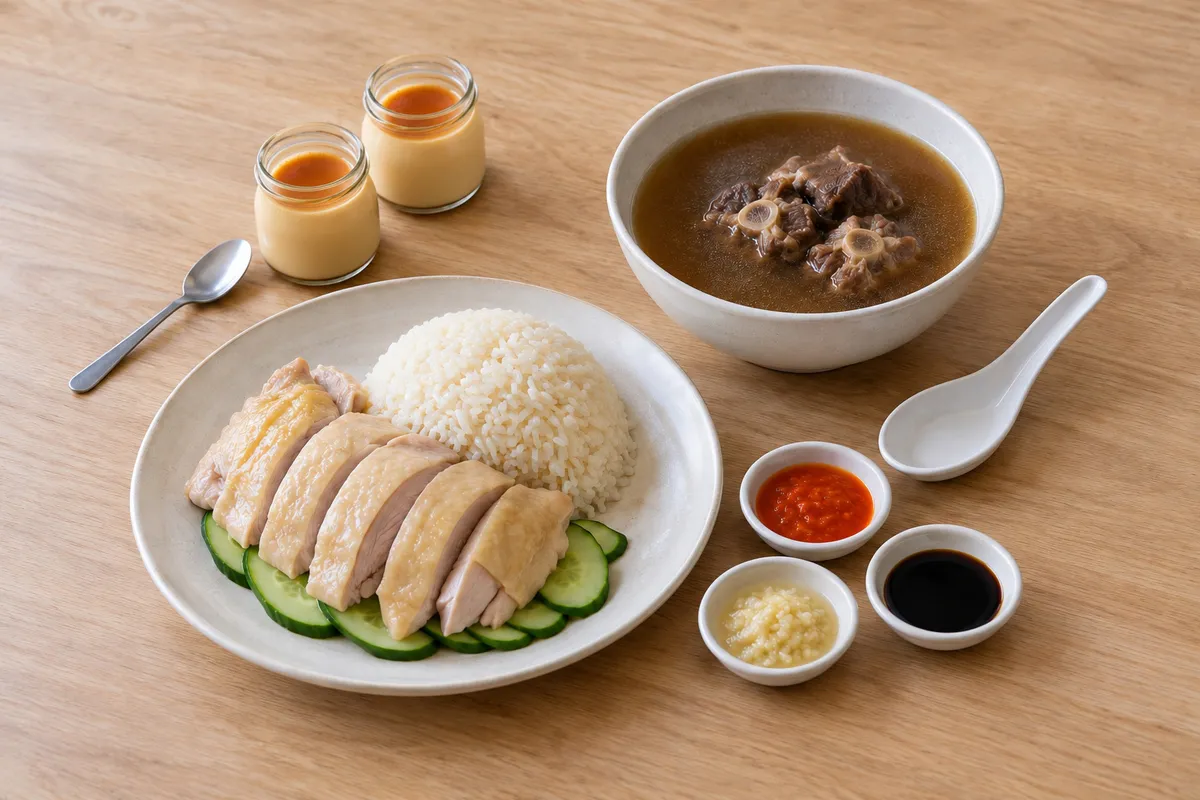
A recipe that calls for a “slow oven” leaves today’s cook with a question before the first egg is cracked. What temperature? An oxtail soup that needs four hours of simmering presents a different problem: finding four hours when someone can keep an eye on the stove.
Making an older recipe usable often begins with translation. We untangle the measurements, identify an unfamiliar ingredient and turn a terse instruction into something a home cook can follow. Tuning the heat can matter just as much. The aim is to reduce attention, control a delicate texture or shorten a long cook while keeping the dish recognizable.
A slow cooker, an immersion circulator or a pressure cooker can offer another way in. The worthwhile change is the one that preserves what draws us to the food: fragrant chicken rice, a smooth caramel custard, a deep bowl of oxtail soup. Each asks something different of the equipment. Each also has a part worth leaving alone.
Modernizing more than the ingredient list
Replacing a hard-to-find ingredient can bring a dish within reach. So can rewriting a historical measure in grams. Those changes help us assemble the recipe; changing the technique can help us actually cook it.
Think about what makes the original difficult. Is it the attention needed to maintain a gentle simmer? The uncertainty of an oven setting? A long wait for a tough cut of meat to soften? These are different obstacles, and an appliance that solves one may do little for another.
There can be a cultural and practical cost to changing too much at once. Put chicken, rice and sauces into a single pot and you may gain convenience, but lose the separate textures that made chicken rice appealing. Enrich a milk custard with large amounts of cream and extra yolks, and you’ve changed more than its cooking temperature.
A good starting question is: what should still be recognizable on the plate? Once that’s clear, choose which part of the work to hand over. You don’t have to surrender the whole recipe to the machine.
| Classic | Technique to explore | Main opportunity | Keep your attention on |
|---|---|---|---|
Singapore-style Hainanese chicken rice |
Slow cooker, with rice cooked separately | Less attention during the chicken or stock stage | Chicken doneness and fragrant, separate rice grains |
Caramel custard |
Sous-vide water bath | More precise control of a delicate custard | The milk-and-egg balance, caramel and chilling |
Victorian oxtail soup |
Pressure cooker | A shorter tenderizing stage | Browning, broth concentration and the final seasoning |
Traditional Singapore-style Hainanese chicken rice (海南鸡饭)
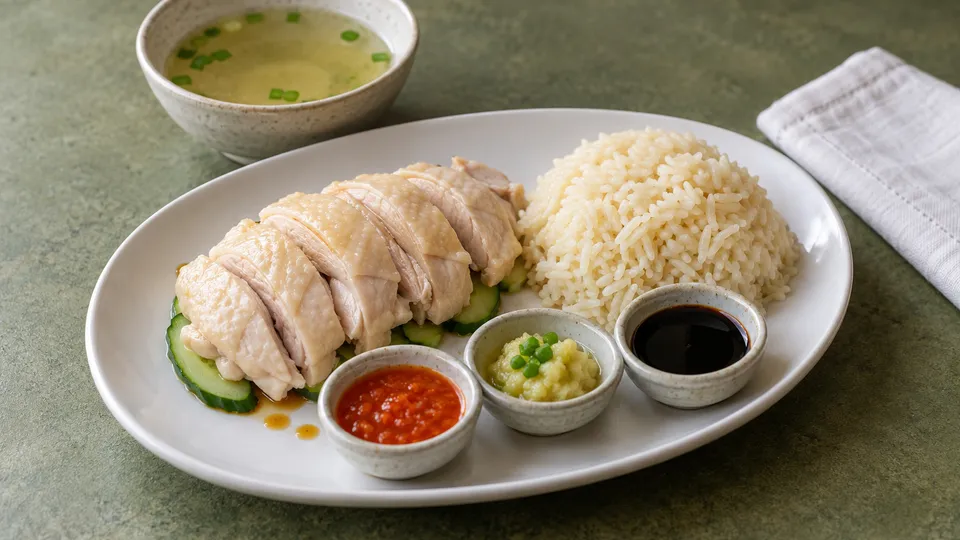 Cook this recipe: Singapore-style Hainanese chicken rice.
The rice is a reason to make this dish, not simply something to put beside the chicken. Jasmine rice takes on the flavor of chicken stock, ginger, garlic and rendered chicken fat. The chicken is gently cooked, the sauces bring heat and sharpness, and cucumber gives a cool bite between mouthfuls.
Those elements make a satisfying meal without asking every component to taste the same. Chili sauce can be bright with calamansi or lime; ginger sauce brings a more direct aromatic warmth. A little soy-sesame dressing seasons the chicken, while thick sweet dark soy is available at the table. The diner chooses the balance.
For a modern adaptation, a slow cooker could take over the chicken stage while the rice keeps its own method. The chicken cooks with ginger, scallions and stock. Separately, the rice is coated in aromatic chicken fat before it goes into a rice cooker or covered saucepan with the poaching liquid and pandan.
Keeping that frying step is worth the extra pan. It carries the dish’s characteristic fragrance into the rice. Cooking the rice separately also lets you judge its liquid needs without tying them to the time a whole bird needs to cook.
Convenience has a texture trade-off
A slow cooker gives you a longer stretch when the pot needs less attention. It doesn’t give you the temperature precision of a sous-vide bath, and a whole chicken isn’t something to leave cooking indefinitely. The breast and skin can suffer while the appliance carries on with its work.
Use a fully thawed bird and check doneness with a thermometer: the thickest part of the breast and the innermost thigh and wing must reach 165°F (74°C), with the probe clear of bone. Once it’s cooked, continuing for another hour just to match a printed timetable offers no advantage. The clock is a guide to when to check, not permission to stop looking at the chicken.
For cooks most interested in the delicate texture of the traditional dish, there’s another attractive hybrid: use the slow cooker to prepare a stock with chicken bones and aromatics, then poach the whole bird gently on the stove. The same stock goes into the rice and the small bowl of broth served alongside it.
That approach adds a stock-making stage. It makes sense when you can prepare the stock ahead, or when broth is what you want to develop. Slow-cooking the bird itself is the more convenient option; preparing the stock separately leaves more control over the chicken. Pick the version that solves your actual difficulty.
Caramel custard: steady heat for a delicate dessert
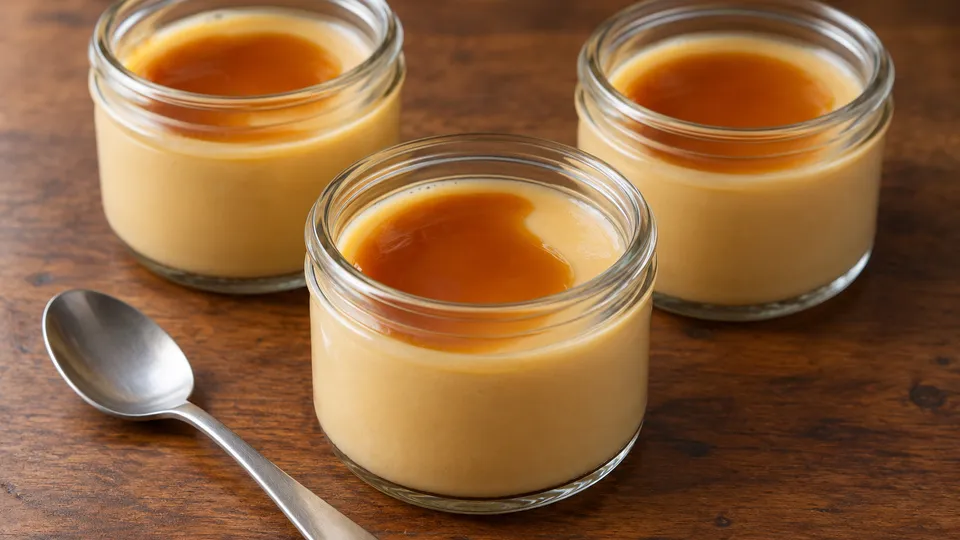 Cook this recipe: Caramel custard.
Fannie Merritt Farmer’s caramel custard has an appealing surprise. The caramel goes into the milk before the eggs are added. The finished custard gets a separate caramel sauce. It’s a caramel-flavored dessert throughout, not the familiar pale flan with caramel waiting underneath.
In the 1918 edition of The Boston Cooking-School Cook Book, the recipe directs you back to the baked-custard method. There, Farmer warns that the surrounding water mustn’t boil or the custard will separate. Her instruction to cook eggs and milk gently points straight to the difficulty a modern water bath can address.
An immersion circulator heats and circulates the water while maintaining a chosen temperature. For individual custards in suitable lidded jars, that offers a more controlled environment than judging a “slow oven” and watching a pan of water inside it. Sammic’s sous-vide flan method demonstrates the approach with a milk-and-egg custard, although the right cooking schedule still depends on the particular formula and vessel.
The proposed adaptation keeps Farmer’s caramelized milk, whole eggs and vanilla, along with the separate sauce. Its aim is a smooth, evenly set dessert. Adding more cream wouldn’t be a necessary part of the change; the interesting comparison is what controlled heat can do with the character of the original intact.
Let the serving dish change if it helps
A small jar can be the cooking vessel and the serving dish. Spoon caramel sauce over the chilled custard and eat it from there. That removes the extra demand of turning out a delicate milk-rich custard in one clean piece.
If you want an unmolded dessert, firmness matters as much as smoothness. Farmer herself distinguishes between the egg amounts needed for cup custards and larger molded ones. A formula suited to eating with a spoon shouldn’t automatically be expected to stand neatly on a plate.
Sous vide also leaves the caramel-making and chilling to you. The sugar still needs its color judged, and the dessert still needs time to cool. Plan it ahead so the water bath is finished with its work before you need the custard for dinner. A cold jar and a spoonful of sauce make an easy final course.
Victorian oxtail soup: shorten the long simmer
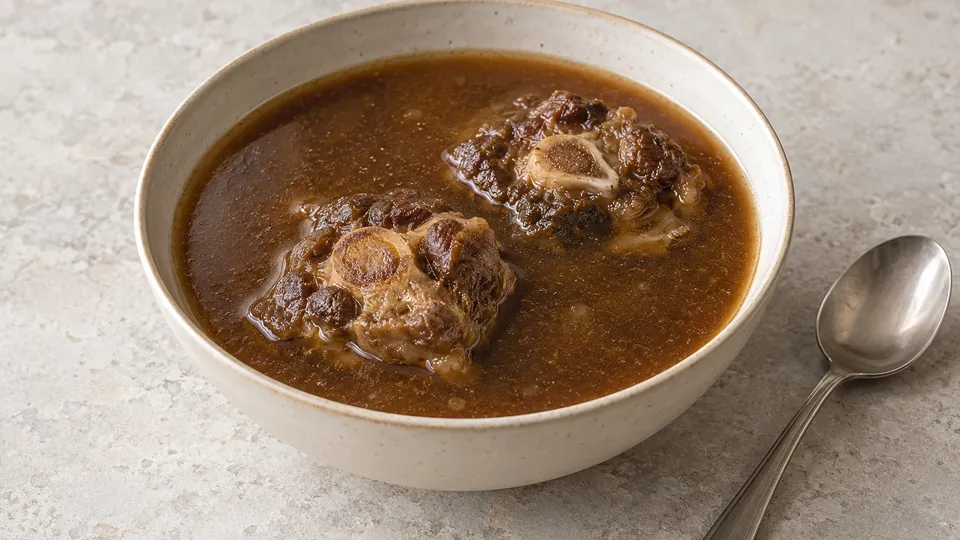 Cook this recipe: Victorian oxtail soup.
In Isabella Beeton’s 1861 Book of Household Management, oxtail soup is a substantial undertaking. Recipe 177 brings together oxtails, ham, vegetables, herbs and spices. The tails simmer gently for four hours or until tender, and the soup is strained, thickened and finished with ketchup and port. She allows four and a half hours in total. The companion recipe uses mushroom ketchup for that finish.
The pressure cooker has a clear opportunity here. Cooking under pressure can shorten the long stage needed to soften the oxtail. Namiko Hirasawa Chen’s pressure-cooker oxtail soup shows the practicality of that approach in a different, tomato-based soup, with another cooking stage for the potatoes.
For a Victorian-style adaptation, keep the aromatic vegetables and the port finish. Browning the oxtail first would be a deliberate addition to Beeton’s method, giving the modern soup a browned flavor base before the lid is closed. The pressure stage then handles the longer tenderizing work.
Soup still needs finishing. Straining and skimming let you assess the broth without fat obscuring it. Taste before deciding how much reduction or thickening it needs, then add the finishing seasonings. If the final bowl includes fresh pieces of carrot or turnip, give those their own shorter cooking stage so they keep some shape.
For a closer look at the finishing stage, Why Soup Gets Thick: Beans, Crackers and Flour compares flour-thickened broth with beans and crackers.
A sealed pot changes the liquid, too
An open simmer loses water. A pressure cooker retains much more of it. Copying the original water quantity into the new appliance can therefore give you tender meat in a broth that needs further concentration.
This is a separate decision from scaling the servings. The cooker’s minimum liquid and fill limits matter, as does the quantity of soup you want at the end. Our guide to scaling a recipe explains why equipment and method need their own review after the ingredient arithmetic.
The advertised pressure time isn’t the full time from a cold pot to dinner, either. Allow for preparation, the cooker reaching pressure, release and finishing. Those extra stages belong in the plan even when the long simmer has become much shorter.
Pressure cooking is especially attractive when the obstacle is fitting oxtail into an ordinary cooking day. It can make a slow dish more approachable without requiring a different cut of meat or replacing the port-scented soup with a generic stew.
Choose what you want to change
Before adapting a favorite, name the part you’d like to make easier. “I want to cook this while I get on with other things” suggests a different choice from “I keep overcooking this custard.” A long braise calls for another answer again.
Then keep enough of the original to judge the change. With chicken rice, pay attention to the rice fragrance, chicken texture and balance of sauces. With custard, compare firmness and smoothness as well as the sweetness of the caramel. With oxtail soup, look at both the meat and the body of the broth. A new appliance setting isn’t much of a success if it improves one part and weakens the part you most enjoy.
The same approach works when returning to a handwritten family recipe or an old cookbook. First make sense of the dish. Decide which ingredients, textures and finishing touches give it its appeal. Then consider whether a different way of applying heat can make it easier to cook again.
Start with the equipment you already have. A pressure cooker may put a long-simmered soup within reach on a day when the stove can’t be watched for hours. A circulator may help with an egg custard whose texture has always been difficult to judge. A slow cooker may let you prepare the chicken-rice stock the day before.
And if the modern appliance is best at only one stage, use it for that stage. Fry the rice in the pan. Make the caramel on the stove. Finish the soup with the lid off. The recipe can move between old and new methods as comfortably as the cook moves between the stove and the counter.
Sources and further reading
The caramel custard and its water-bath guidance are from Fannie Merritt Farmer’s The Boston Cooking-School Cook Book, revised edition, 1918, pp. 414–415. Beeton’s oxtail soup is recipe 177, p. 92, in the 1861 Book of Household Management. The modern custard and pressure-cooker examples linked above illustrate those techniques; they use different formulas from the historical recipes discussed here.
Where the appliances take over
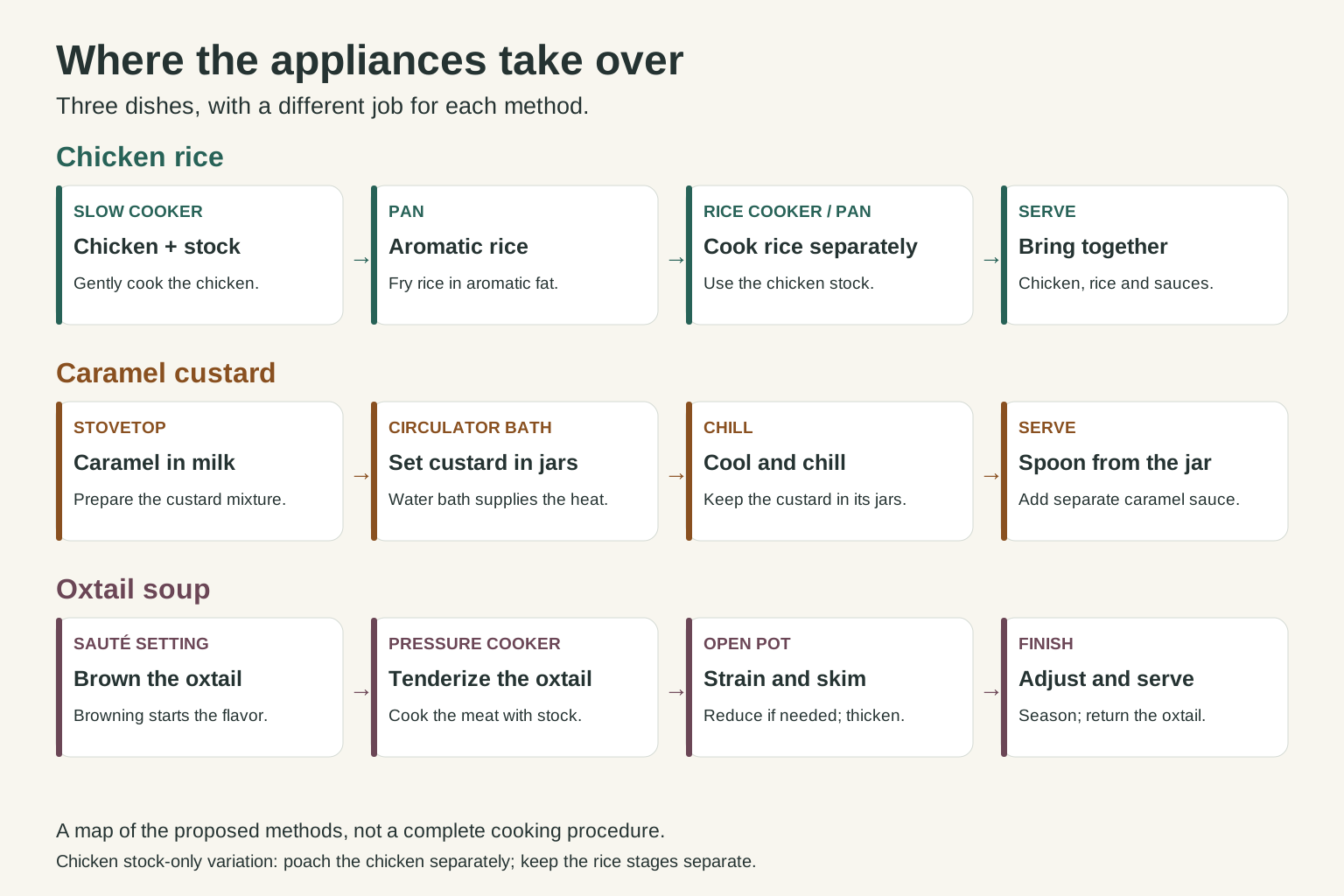
Read the cooking stages
Chicken rice
- Slow cookerChicken + stock
Gently cook the chicken.
- PanAromatic rice
Fry rice in aromatic fat.
- Rice cooker / panCook rice separately
Use the chicken stock.
- ServeBring together
Chicken, rice and sauces.
Caramel custard
- StovetopCaramel in milk
Prepare the custard mixture.
- Circulator bathSet custard in jars
Water bath supplies the heat.
- ChillCool and chill
Keep the custard in its jars.
- ServeSpoon from the jar
Add separate caramel sauce.
Oxtail soup
- Sauté settingBrown the oxtail
Browning starts the flavor.
- Pressure cookerTenderize the oxtail
Cook the meat with stock.
- Open potStrain and skim
Reduce if needed; thicken.
- FinishAdjust and serve
Season; return the oxtail.
This is an overview. Follow the complete recipe for quantities, temperatures and doneness checks. For the chicken stock-only variation, poach the chicken separately and keep the rice stages separate.