
- Cooking techniques
- Soup
- Ingredients
- Measuring
Why Soup Gets Thick: Beans, Crackers and Flour
Follow three soups from pot to bowl to see how mashed beans, softened crackers and a cooked flour slurry change their texture and what to measure.
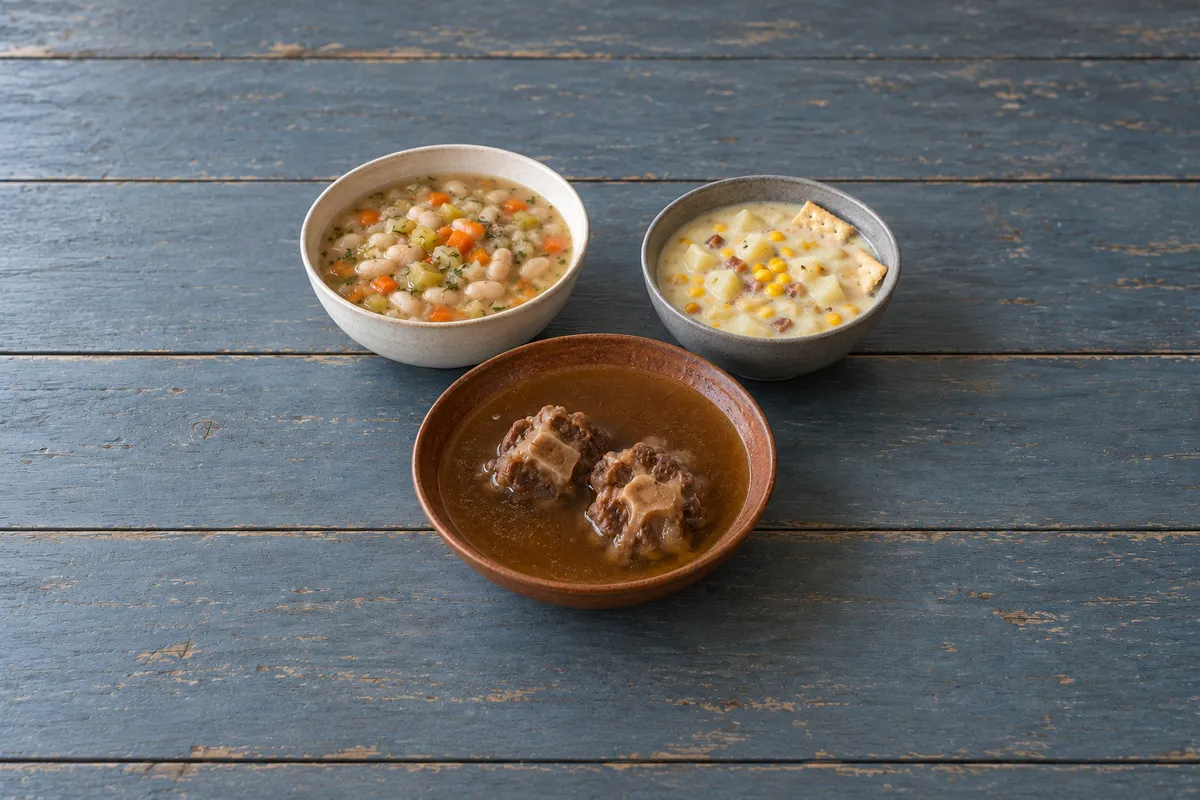
The pot isn’t the last place a soup gets thicker. In our corn chowder, two crackers go into each bowl before the hot broth. They soften as you eat, so the last spoonful has a different texture from the first.
White bean soup takes another route: a little of the cooked soup is mashed and stirred back in. Victorian oxtail soup is strained first, then lightly thickened with flour mixed into cold water. These three recipes put the texture change in different places: the pot, the finishing broth and the serving bowl. That tells you what to measure, when to judge the result and how much work still remains after the meat or vegetables are tender.
A full bowl and a thick broth are different things
A spoon can be crowded with whole beans, potato pieces and corn while the liquid around them stays quite fluid. Breaking up some of those solids changes the balance. The broth now contains smaller particles, and the spoonful feels fuller even though the recipe hasn’t acquired another ingredient.
That’s useful when deciding what you actually want to change. If the vegetables are tender but the soup seems too smooth, adding more flour won’t restore their shape. If the broth tastes weak, making it thicker won’t supply the flavor it lacks. Texture, the amount of food in each serving and the strength of the liquid deserve separate attention.
Each measurement below belongs to one of these recipes and its particular texture.

Complete text alternative
Three separate recipe comparisons, not a sequence.
IN THE POT
White bean soup 720 g cooked, drained beans + 1 liter stock About 250 ml of mixed soup is taken out, mashed and returned. Measure soup with broth AND solids, not 250 g of beans.
IN THE FINISHING BROTH
Oxtail soup 15 g flour / about 1 liter strained broth Cold-water flour slurry is cooked into the strained broth. Broth volume is measured before slurry water, port, ketchup and returned meat.
IN THE SERVING BOWL
Corn chowder 2 crackers per bowl Hot chowder is ladled over the crackers; they soften in each serving. 8 crackers across 4 bowls. Keep the count tied to servings.
These are recipe-specific quantities, not universal thickener replacement ratios.
| Soup | Where the texture changes | Quantity to keep in view |
|---|---|---|
| White Bean and Rosemary Soup | Some cooked soup is mashed and returned to the pot | 720 g cooked, drained beans and 1 liter of stock; about 250 ml of mixed soup is taken out to mash |
| Potato and Corn Milk Chowder | Crackers soften beneath the soup in each bowl | Eight crackers across four servings, or two per bowl |
| Victorian Oxtail Soup | A cold flour slurry is cooked into the strained broth | 15 g flour for about 1 liter of strained, flavorful broth before the slurry, port and ketchup finish |
Mash a portion, keep the rest whole
The white bean soup starts with beans that are already cooked. Its 720 g means beans weighed after draining and rinsing, ready to simmer with the vegetables and stock. The liquid in a can isn’t included in that bean weight.
After the carrots have softened, about 250 ml of soup is ladled out, including plenty of beans. That is a volume of mixed soup, with broth and solids together. It doesn’t mean 250 g of beans, and it isn’t a request to weigh out a quarter of the beans from the pot.
Mashing that portion breaks up tender beans before they are stirred back through the rest. Most remain whole, with pieces of carrot and celery still visible. The method gives you both a fuller liquid and recognizable ingredients, rather than a completely pureed soup.
There is a practical reason to wait until this stage. The soup has had its simmer, and the carrots can be checked directly. Cooked beans are already tender when they enter the pot; their softness can’t tell you whether a larger carrot piece is done.
The lemon goes in at the end. It brightens the flavor of the bean mixture, but it isn’t the thickening step. Keep those decisions separate when tasting: a soup may need its specified fresh finish even when its consistency is already right.
Let the bowl finish the chowder
The chowder’s crackers are listed ingredients, not a casual garnish. At the original yield, eight are divided among four warm bowls before the soup is ladled over them. Each serving gets its own portion of the texture change.
That matters if dinner is staggered. You can ladle one bowl over its crackers and leave the other crackers dry until their bowls are needed. Putting the whole batch into the soup pot would change the serving method and soften them all at once.
The chowder itself contains diced potatoes, corn, pork, onion, water and milk. Its method doesn’t begin with flour cooked in fat, and no flour is added later. The notes offer another small adjustment within that mixture: crushing a few tender potato pieces against the pot before the milk goes in. That changes some of the potatoes’ form while leaving the rest in cubes.
Watch the corn weight as well. The recipe’s 300 g includes the kernels and their packing liquid. Draining the corn would remove part of the listed ingredient, including liquid that belongs in this version. A can, a drained weight and a volume of kernels aren’t automatically three names for the same amount.
Serve the chowder at its intended gentle heat and ladle it over the crackers when you’re ready to eat. You don’t have to make the whole pot thick enough to account for what will happen in the bowl.
Strain the oxtail broth before judging it
Oxtail soup has a long cooking stage, but the flour belongs near the end. The pressure cooker tenderizes the jointed meat with stock and aromatics. Then the meat is lifted out, the broth is strained and the spent vegetables, ham, herbs and spices are removed.
The liquid left after that work is the basis for the finish. The recipe asks for about 1 liter of flavorful strained broth. If it tastes weak, it is simmered uncovered to concentrate it before the flour is added. Thickening comes after that judgment, so the cook isn’t using flour to disguise an underdeveloped broth.
The flour is mixed with cold water until smooth, then whisked into the simmering broth and cooked. This is a slurry. A roux would involve cooking flour in fat first; the butter used earlier with the aromatics doesn’t turn this later cold-water mixture into one.
Flour contains starch that thickens a liquid as it is heated. The Institute of Food Science and Technology’s explanation of starch thickening describes that swelling and water absorption. In this soup, mixing the flour with cold water first helps distribute it, and the subsequent simmer is part of the method. Stirring it in and immediately serving would skip that cooking stage.
The intended result is light body around tender oxtail, with soup that still flows from the ladle. The mushroom ketchup and port are added afterward, and the meat returns for the final heating. Their flavor contribution belongs to that finish; they aren’t substitutes for checking the broth before thickening.
Match the measurement to the stage
Suppose you’re planning eight bowls of bean soup. Doubling its ingredient quantities gives 1,440 g cooked, drained beans and 2 liters of stock. To retain the same planned proportion of mashed soup, the comparable portion would be about 500 ml of the mixed soup, still including beans. That is a cooking decision about the larger batch, not a gram conversion for the ladleful. Check that the pot has room, and judge tenderness and texture rather than doubling the simmer time.
For eight bowls of chowder, the cracker calculation is simpler: sixteen crackers, still two per bowl. The relevant count follows the number of servings. How long they sit under hot soup is a separate serving choice.
The oxtail finish needs a different starting measurement. Its 15 g flour is related to about 1 liter of strained broth, not to a liter of finished soup containing meat, slurry water, port and ketchup. If a larger batch leaves 1.5 liters of broth at that stage, the same recipe-specific flour proportion would be 22.5 g. That arithmetic doesn’t establish a general soup-thickening rate or tell you to multiply every finishing ingredient by the broth volume.
Check the liquid before deciding the finish. The cooker may have retained more stock than an open pot would, and the broth may have been reduced after straining. The amount poured into the cooker at the beginning isn’t necessarily the amount waiting in the saucepan at the end.
Recipe and source notes
The comparisons use the linked TuneMyRecipe recipes at their published quantities and methods. Consult the full recipes for cooking, equipment, scaling and storage guidance.
The brief starch explanation uses the Institute of Food Science and Technology resource linked above.