
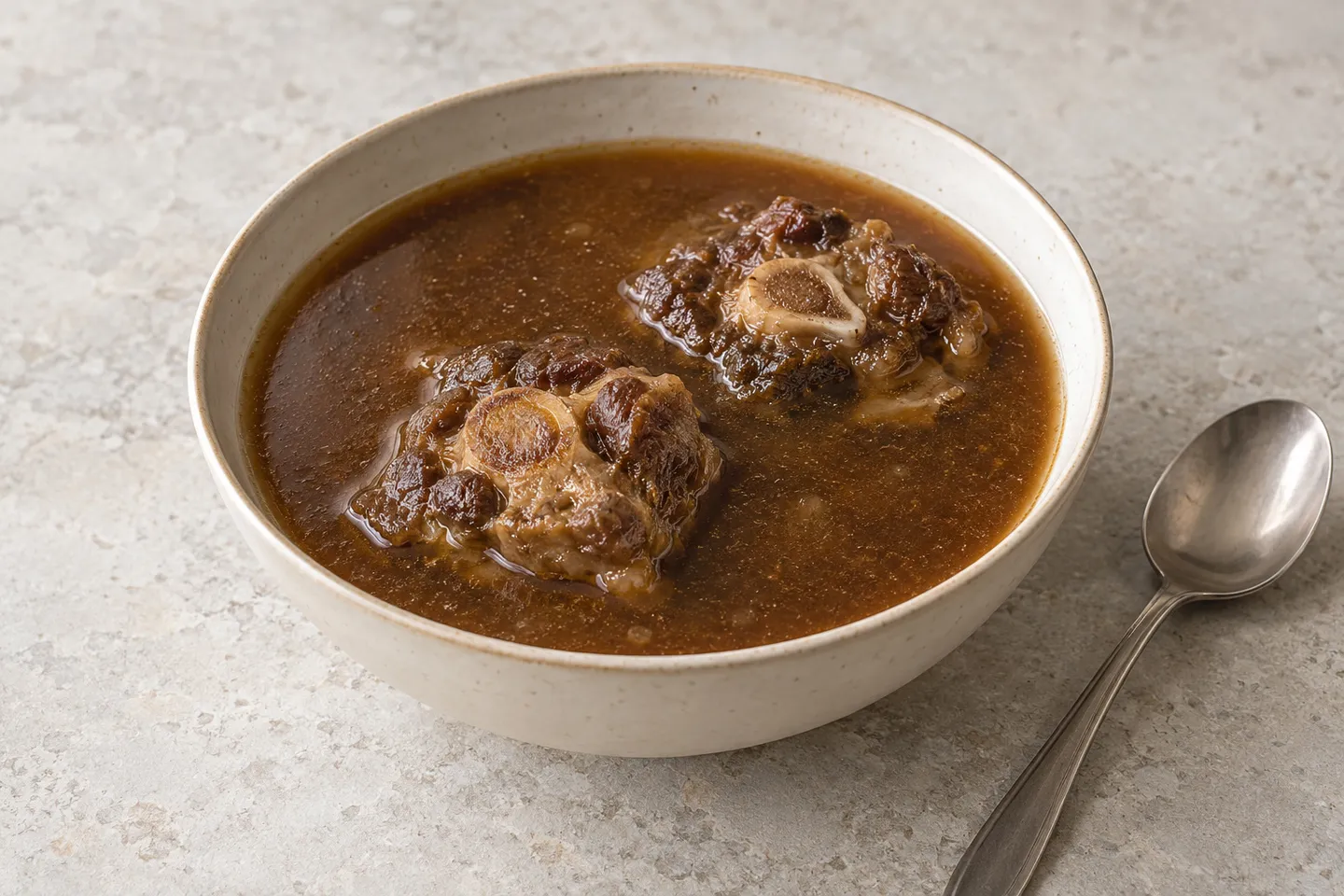
Victorian Oxtail Soup, Adapted for a Pressure Cooker
A brown oxtail soup adapted from Beeton's 1861 recipe, with strained aromatic broth, light flour thickening, mushroom ketchup and port.
- Original yieldYield
- 4 substantial servings4 substantial servings
- PrepPrep time
- CookCook time
- TotalTotal time
Allow 2½–3 hours: preparation and browning, 15–25 minutes to pressurize, 60 minutes at pressure, full natural release and finishing. Large pieces may need another 10–15 minutes at pressure.
Published
Original recipe: 4 substantial servings
The story behind the recipe
Beeton's oxtail soup ends with a decision that's easy to miss: take out the meat, strain the liquid, then build the finished soup from that broth. The vegetables have flavored it, but they don't stay in the bowl. A little flour, ketchup and port finish a brown soup with pieces of tender oxtail returned to it.
Four hours, shortened at one stage
In her 1861 recipe, the oxtails simmer gently for four hours or until tender. An electric pressure cooker takes over that long tenderizing stage here. Browning comes first, and straining, skimming and seasoning still happen afterward. The faster route works best when those finishing decisions keep their place. Read Tuning Classic Recipes: When Modern Cooking Methods Help for the reasoning behind this method.
Read more about this recipe
Buy a mixture of joints
Oxtail is the tail of cattle, sold in sections with a bone through the center. Pieces from the wider end carry more meat; narrow pieces contribute relatively little meat for their weight. Ask for a mixture with some substantial joints, especially when the soup is intended to feed four people.
It also brings connective tissue and fat. Long moist cooking softens the meat and gives the broth body. That helps explain the old recipe's patient simmer and why this cut suits pressure cooking. A packet of lean diced beef would make a different soup, even if it happened to cost less.
Size matters more than a tidy count of pieces. Very thick joints can need another cooking interval after smaller ones have softened. Look for meat that yields readily at the bone. If a piece still resists, it needs more tenderizing, not a more forceful knife at the table.
Brown first, finish later
Beeton begins with butter, vegetables and a little water over a sharp fire to draw out their juices. Dry browning is an addition here, along with a smaller, weight-based batch and unsalted stock suited to a closed cooker. It supplies a browned-meat flavor before the pressure stage begins.
Give the oxtail space in the hot pot and work in batches. The brown material left on the base belongs in the broth once it's loosened with stock. Burned material doesn't; don't carry a bitter patch into the whole batch for the sake of color.
A closed pot also loses much less liquid than an uncovered pan. Pressure cooking can tenderize the meat while leaving a broth that still needs concentration. Tasting after straining tells you whether to reduce it. Adding flour immediately would thicken a weak broth without fixing its flavor.
Ketchup meant more than tomatoes
The soup recipe says ketchup without specifying its kind. Elsewhere in the same book, Beeton gives recipes for mushroom and walnut ketchups. Mushroom ketchup is the choice here: a dark savory seasoning, quite different from the sweet tomato condiment most people reach for today.
Check the bottle before pouring. Mushroom ketchup can be salty, and the soup already includes ham. Unsalted stock leaves room for both. Season the finished broth after the ketchup has gone in, so an early pinch of salt doesn't become an excess once the liquid reduces.
Port belongs near the end. Its wine flavor meets the browned meat and savory broth without spending the entire pressure stage in the pot. A short final simmer brings the ingredients together while leaving the seasoning open to one last taste.
A light body, not a heavy gravy
Flour is Beeton's finishing thickener, but she doesn't give an amount. Here a modest measured addition gives the soup a little body while leaving it fluid enough to eat with a spoon. Whisking it first with cold water helps it disperse evenly into the hot broth.
Skim the fat before thickening. If you're making the soup ahead, chilling the strained broth makes that easier: the fat firms on the surface and can be lifted off. Return the oxtail for serving and divide the larger, meatier joints fairly among the bowls.
Read the original wording
Historical reference only. Follow the ingredients and cooking steps below when cooking.
Historical ingredients
- 177. INGREDIENTS.—2 ox-tails, 2 slices of ham, 1 oz. of butter, 2 carrots, 2 turnips, 3 onions, 1 leek, 1 head of celery, 1 bunch of savoury herbs, 1 bay-leaf, 12 whole peppercorns, 4 cloves, a tablespoonful of salt, 2 tablespoonfuls of ketchup, ½ glass of port wine, 3 quarts of water.
Historical method
Mode.—Cut up the tails, separating them at the joints; wash them, and put them in a stewpan, with the butter. Cut the vegetables in slices, and add them, with the peppercorns and herbs. Put in ½ pint of water, and stir it over a sharp fire till the juices are drawn. Fill up the stewpan with the water, and, when boiling, add the salt. Skim well, and simmer very gently for 4 hours, or until the tails are tender. Take them out, skim and strain the soup, thicken with flour, and flavour with the ketchup and port wine. Put back the tails, simmer for 5 minutes, and serve.
Time.—4½ hours. Average cost, 1s. 3d. per quart. Seasonable in winter. Sufficient for 10 persons.
Make it your wayOriginal: 4 servings · Makes 4 substantial servings
Original recipe: 4 substantial servings
Ingredients
For 4 substantial servings. Quantities are shown as written.
Source measurement convention: Metric. Explicit unit definitions take precedence; unconfirmed measures must be checked before conversion.
Original quantities for 4 substantial servings.
Oxtail and aromatic broth
- Bone-in oxtail, cut through the joints into roughly 4–5 cm pieces, thawed1.2 kg
- Neutral oil1 metric tbsp
- Unsalted butter15 g
- Cooked ham, diced50 g
- Large onion , roughly chopped1Author measures: about 200 g.
- Medium carrot , roughly chopped1Author measures: about 100 g.
- Small turnip , roughly chopped1Author measures: about 100 g.
- Small leek (about 100 g trimmed), cleaned and roughly sliced1
- Celery, roughly chopped2 stalksAuthor measures: about 100 g.
- Parsley4 sprigs
- Thyme2 sprigs
- Bay leaf1
- Black peppercorns6
- Cloves2
- Unsalted beef stock1 l
- Extra unsalted stock or water, use up to this amount only as needed for finishing or the cooker's liquid minimum250 ml
- Fine salt to taste
To finish
- All-purpose flour15 g
- Cold water3 metric tbsp
- Mushroom ketchup, plus more to taste2 metric tbsp
- Ruby port50 ml
Measurement notes
- neutral oil, cold water, mushroom ketchup, plus more to taste: tbsp: 1 = 15 ml.
Measurement notes
Original ingredients
- 1.2 kg bone-in oxtail, cut through the joints into roughly 4–5 cm pieces, thawed
- 1 tbsp neutral oiltbsp: 1 = 15 ml.
- 15 g unsalted butter
- 50 g cooked ham, diced
- 1 large onion (about 200 g), roughly chopped
- 1 medium carrot (about 100 g), roughly chopped
- 1 small turnip (about 100 g), roughly chopped
- 1 small leek (about 100 g trimmed), cleaned and roughly sliced
- 2 celery stalks (about 100 g), roughly chopped
- 4 parsley sprigs
- 2 thyme sprigs
- 1 bay leaf
- 6 black peppercorns
- 2 whole cloves
- 1 liter unsalted beef stock
- 250 ml extra unsalted stock or water, use up to this amount only as needed for finishing or the cooker's liquid minimum
- Fine salt to taste
- 15 g all-purpose flour
- 3 tbsp cold watertbsp: 1 = 15 ml.
- 2 tbsp mushroom ketchup, plus more to tastetbsp: 1 = 15 ml.
- 50 ml ruby port
Equipment
 Electric pressure cooker (6 liters, with a sauté setting)
 Fine-mesh strainer
 4-liter saucepan or Dutch oven
 Whisk
Instructions
Brown the oxtail in batches
Pat the thawed oxtail dry. Set the 6-liter electric pressure cooker to sauté and heat the neutral oil. Brown the oxtail in batches for about 3–4 minutes per broad side, then transfer to a plate. Work within the manufacturer's guidance for sautéing with the lid off.
Cook the aromatics and deglaze
Reduce the sauté heat if needed. Add the butter, ham, onion, carrot, turnip, leek and celery; cook for about 5 minutes, stirring. Pour in about 200 ml of the measured stock and scrape the base completely clean of browned bits. If any patch has burned black, discard it and clean the pot before continuing.
Add the stock and seasonings
Return the oxtail and any collected juices. Add the remaining measured stock, parsley, thyme, bay leaf, peppercorns and cloves. Check the manufacturer's minimum-liquid and maximum-fill limits; add some of the extra stock or water only if required. Keep all flour, ketchup and port out of the cooker at this stage.
Pressure-cook and release naturally
Lock the lid and cook on HIGH pressure for 60 minutes, counting from when pressure is reached. Allow the pressure to release naturally until the indicator has dropped completely; expect about 20–30 minutes or longer. Don't force the lid open or use a quick release for this soup.
Check tenderness and extend if needed
Open according to the appliance instructions and test a larger piece: the meat should yield readily to a fork and loosen at the bone. If still tough, cook for another 10–15 minutes at HIGH pressure with enough thin liquid remaining to meet the appliance's minimum, then allow full natural release again.
Strain, skim and adjust the broth
Lift the tender oxtail out carefully. Strain the broth through a fine-mesh strainer into a saucepan and discard the ham, spent vegetables, herbs and spices. Skim off surface fat. Taste the broth and, if weak, simmer uncovered to concentrate it; aim for about 1 liter of flavorful broth. If it has reduced too far, add a little of the extra unsalted stock or water.
Thicken the soup lightly
Whisk the flour with the 3 tbsp cold water until smooth. Bring the broth to a gentle simmer and whisk in the mixture. Simmer for 5–8 minutes, stirring, until lightly thickened and the flour tastes cooked.
Finish with ketchup and port
Add the mushroom ketchup and port, then return the oxtail. Simmer gently for about 5 minutes, until the meat is hot throughout. Taste and adjust with salt or a little more mushroom ketchup. Divide the meat and soup among four bowls and serve.
Estimated calories 240 kcal
Nutrition portion: 1/4 of recipe · Original yield: 4 substantial servings
Source & assumptions
Rough ingredient-based estimate per one-fourth batch, including all returned oxtail meat. Uses published edible-meat and boiling-retention factors, a low-fat stock substitute and a thorough-skimming model; actual bone yield, fat removal and broth extraction vary. This is a modeled estimate, not a measured result.
Recipe notes
When adjusting quantities
Never exceed the pressure cooker's fill limit or reduce liquid below its specified minimum. For larger quantities, cook in separate batches. Keep the piece size and pressure setting consistent; cooking time does not multiply with servings. Judge the finishing broth before scaling the flour.
Original recipe notes
These notes describe the original recipe. Quantities mentioned here do not change when you adjust servings.
Mushroom ketchup is a chosen interpretation of the source's unspecified ketchup. Use a product sold as mushroom ketchup, not tomato ketchup. If you can't find it, leave it out and season the soup to taste; the finish will lose that ingredient's savory character. This recipe doesn't assume that a spoonful of another sauce is equivalent.
The pressure schedule is for an electric cooker and joint-cut oxtail. Appliance pressure and piece size affect tenderness. Check the meat before finishing the broth, and keep the full natural-release time in your meal planning.
To make ahead, stop after straining and cool the broth and meat promptly in shallow containers. Refrigerate separately; skim the firm fat from the broth, then reheat and complete the flour, ketchup and port finish. USDA guidance is refrigeration within 2 hours, or 1 hour above 90°F (32°C), use within 3–4 days, and reheat leftovers to 165°F (74°C).
Read the scaling guide. Times, temperatures and equipment need their own consideration. Open the recipe tool to review and correct individual amounts.
Sources and attribution
Adapted from Isabella Beeton, The Book of Household Management, 1861, recipe 177, Ox-Tail Soup, p. 92.
Recipe details
- Recipe tradition
- Vintage
- Cuisine
- British
- Difficulty
- Intermediate
- Cooking method
- Pressure cookerStovetop
- Main ingredient
- Beef
- Occasion
- Comfort food
- Browse category
- Main Dishes