
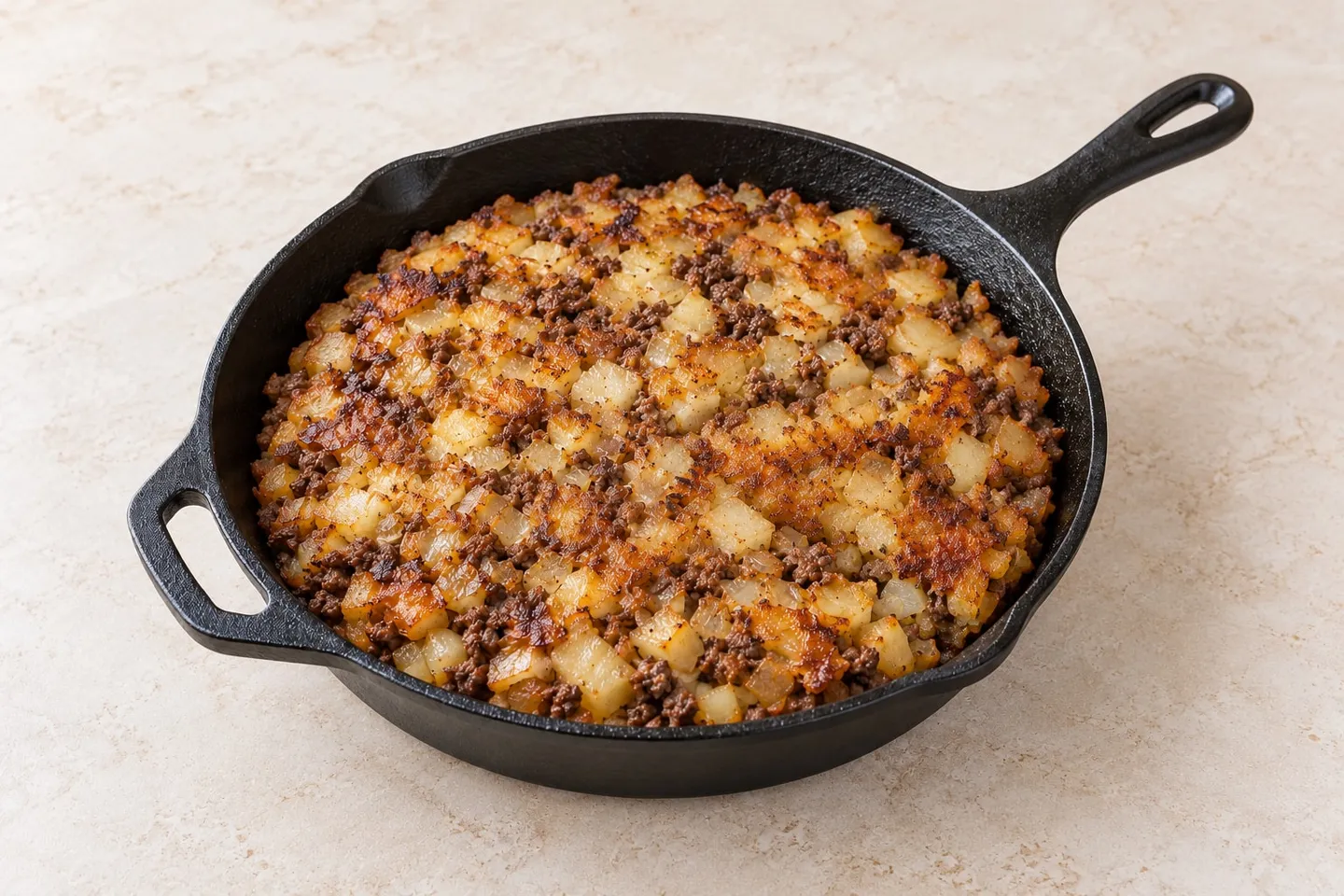
Browned Potato and Meat Hash (1934)
Crispy cast-iron skillet hash made from boiled potatoes and cooked beef, with twice as much potato as beef by weight.
- Original yieldYield
- 4 servings4 servings
- PrepPrep time
- CookCook time
- TotalTotal time
Published Updated
Original recipe: 4 servings
The story behind the recipe
The best part of this hash is out of sight until you lift an edge. Cooked potatoes, beef and onion sit in a compact layer while the underside browns. Stirring would turn it into another sort of skillet dinner; waiting gives it the crust that makes browned hash worth the wait.
Dinner from ingredients already cooked
The USDA Bureau of Home Economics included Browned Hash in Meat Dishes at Low Cost in 1934. Both meat and potatoes start cooked. Among our Depression-era dinners, this is the one to consider when those ingredients are already waiting. The recipe offers a new shape and a browned finish for ingredients that might otherwise return to the table much as they were.
Read more about this recipe
Cakes or a whole pan
The original offers two forms. Chopped potatoes, meat and onion can be shaped into flat cakes and browned on both sides, or spread in one layer in a greased frying pan. It also allows a food chopper instead of chopping the ingredients separately.
Those choices suggest quite different plates of hash. Small cakes have their own edges; a whole skillet holds a broad crust underneath. We follow the second route, keeping the potatoes in little cubes and the beef finely chopped. The pieces remain recognizable when a wedge is lifted out.
The pan version also asks for restraint. There is little arranging to do after the mixture has been pressed into place. You are waiting for the surface in contact with the skillet to change, rather than tossing the potatoes to brown them on every side. A folded portion or a wedge carries that crisp face to the plate.
More potato than beef
Potatoes are the main ingredient by weight in this adaptation, with twice as much as beef. The source likewise uses more potato than meat, but measures them by volume. Our weights describe the modern mixture, not an exact conversion of its historical proportions. Broth or water is another modern addition, moistening the chopped ingredients before frying.
Cooked beef gives the hash its savory direction without making it a roast-beef dinner with potatoes beside it. Canned corned beef is the alternative, bringing its own seasoning. Onion runs through the mixture, and the chosen skillet fat can be tallow, bacon drippings or butter. That choice changes the flavor around the potato crust.
Chilled waxy potatoes are useful here because the recipe asks them to keep a diced shape. They begin firm enough to chop, then heat through in the pan. Raw potatoes or raw ground meat would require another method; the short estimate below starts after their earlier cooking has been done.
Give the crust its space
A larger batch needs enough pan surface. Piling the mixture much deeper would change the balance between the browned underside and the warm interior. Keep the layer shallow when making more hash, and cook in batches if needed.
The source's economical idea still makes an appealing meal: a small amount of meat throughout the potatoes, with one generous browned surface to divide among the plates.
Make it your wayOriginal: 4 servings
Original recipe: 4 servings
Ingredients
For 4 servings. Quantities are shown as written.
Source measurement convention: Metric. Explicit unit definitions take precedence; unconfirmed measures must be checked before conversion.
Original quantities for 4 servings.
- Boiled waxy potatoes (chilled and diced into 1 cm cubes)600 g
- Cooked beef (or canned corned beef, chopped fine)300 g
- Yellow onion (approx. 1 medium, finely diced)120 g
- Beef tallow (or bacon drippings or unsalted butter)30 gAuthor measures: about 2 metric tbsp (1 metric tbsp = 15 ml).
- Fine salt1/2 metric tsp
- Freshly ground black pepper1/4 metric tsp
- Beef broth (or water, to moisten)60 ml
Measurement notes
- fine salt, freshly ground black pepper: tsp: 1 = 5 ml.
Measurement notes
Original ingredients
- 600 g boiled waxy potatoes (chilled and diced into 1 cm cubes)
- 300 g cooked beef (or canned corned beef, chopped fine)
- 120 g yellow onion (approx. 1 medium, finely diced)
- 30 g beef tallow (or bacon drippings or unsalted butter, approx. 2 tbsp)
- 1/2 tsp fine salttsp: 1 = 5 ml.
- 1/4 tsp freshly ground black peppertsp: 1 = 5 ml.
- 60 ml beef broth (or water, to moisten)
Equipment
 Heavy cast-iron skillet (10 or 12-inch)
Instructions
Combine potatoes, beef and onion
In a large mixing bowl, combine the chilled boiled waxy potatoes, chopped cooked beef, and diced yellow onion.
Season and moisten the hash
Sprinkle with the fine salt and freshly ground black pepper, then drizzle the beef broth over the mixture. Toss gently with a spoon so the potatoes are lightly moistened without crushing them.
Heat the skillet fat
Place a heavy cast-iron skillet over medium heat and melt the beef tallow (or bacon drippings, or unsalted butter), swirling the pan so the bottom and lower sides are coated.
Press the hash into the skillet
Add the potato and beef mixture to the hot skillet. Using a flat metal spatula, press the mixture down firmly into an even, compact layer across the entire pan.
Cook the underside undisturbed
Reduce the heat to medium-low and cook undisturbed for 12 to 15 minutes, listening for a steady sizzle as the bottom forms a thick, golden crust.
Check the crust and portion
Gently slide your spatula under one edge to check browning. When the underside is deeply browned and crisp, cut the hash into wedges or fold it over like an omelet.
Serve hot and crisp
Slide onto a warm platter and serve immediately while hot and crisp.
Estimated calories 370 kcal
Nutrition portion: 1/4 of recipe · Original yield: 4 servings
Source & assumptions
Ingredient-based estimate using CoFID 2021, USDA SR Legacy (2018), representative labels for Kotányi ground black pepper. About 370 kcal per nutrition portion (1/4 of the recipe). Uses cooked roast beef, beef tallow and prepared beef broth. The corned beef, bacon-fat, butter and water alternatives are excluded. Actual ingredients and preparation affect the estimate.
Recipe notes
When adjusting quantities
Scale ingredients proportionally. To achieve a proper crust, cook in batches if your skillet cannot hold the ingredients in a single compact layer about 2 cm deep.
Original recipe notes
These notes describe the original recipe. Quantities mentioned here do not change when you adjust servings.
Preparation begins with previously boiled, thoroughly chilled potatoes. Waxy varieties like Yukon Gold hold their shape during dicing and frying better than starchy russets.
Do not stir the hash while it cooks in the skillet. Pressing it down firmly once and allowing it to brown undisturbed is essential for forming the bottom crust.
The broth is a modern addition to moisten the mixture. Check the heat if the bottom begins to darken before the hash is hot through.
Read the scaling guide. Times, temperatures and equipment need their own consideration. Open the recipe tool to review and correct individual amounts.
Sources and attribution
Adapted from USDA Bureau of Home Economics, Meat Dishes at Low Cost (1934), p. 10
USDA Bureau of Home Economics, Meat Dishes at Low Cost (1934), Browned Hash, p. 10. This version follows the single-pan alternative with modern weights, chilled diced potatoes and added moistening liquid.