
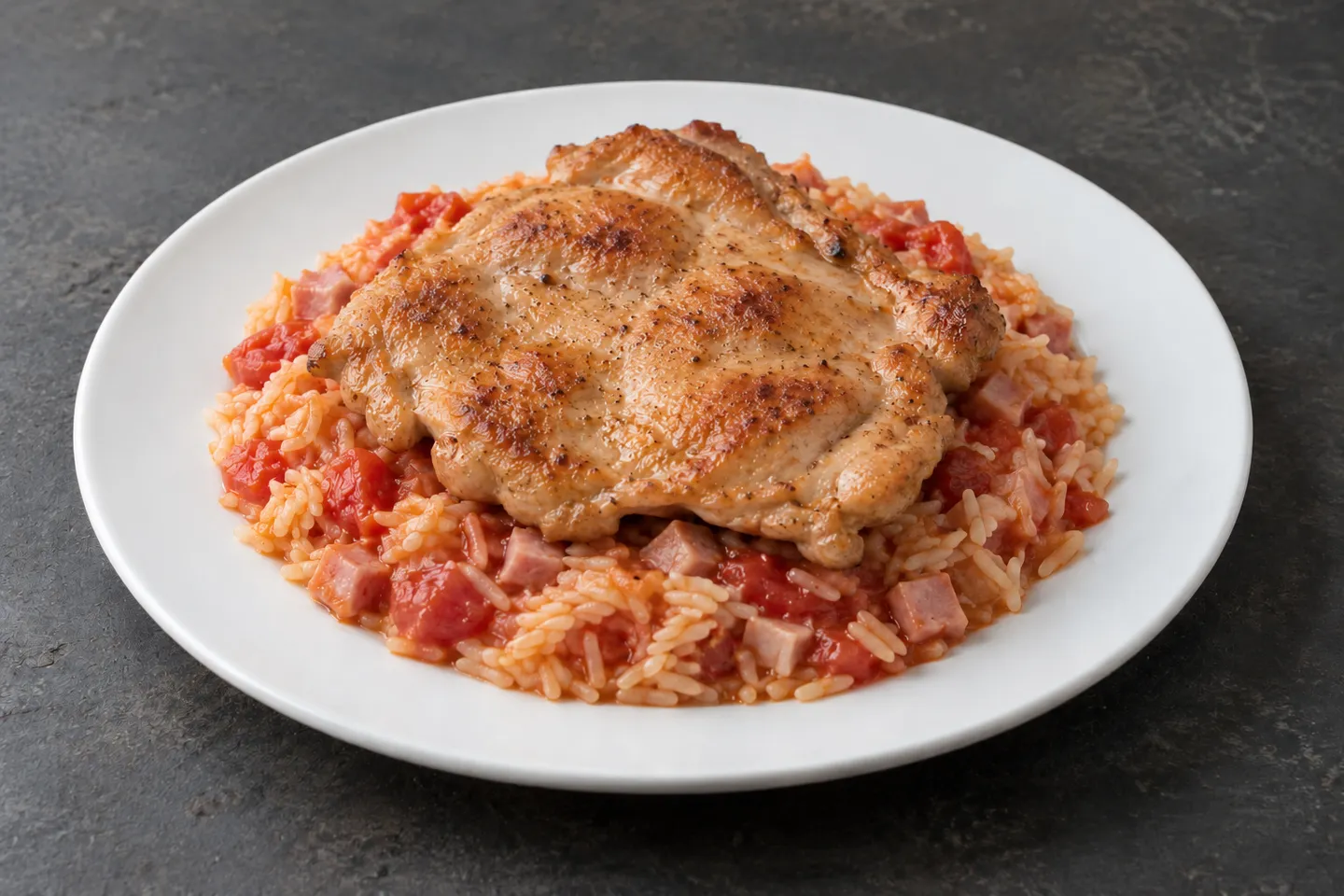
Abby Fisher's Chicken and Ham Jumberlie (1881)
Chicken thighs, cooked ham, and rice simmered with tomatoes and black pepper in a modern adaptation of Abby Fisher's Creole dish.
- Original yieldYield
- 4 main-dish servings4 main-dish servings
- PrepPrep time
- CookCook time
- TotalTotal time
Planning estimate includes tomato preparation, up to 50 minutes of cooking, and a 10-minute covered rest. Follow the rice and chicken checks if cooking takes longer.
Published Updated
Original recipe: 4 main-dish servings
The story behind the recipe
Abby Fisher ends her Jumberlie recipe with an instruction that makes a modern rice cook pause: no water is to be added. Chicken, rice, sweet ham, and peeled tomatoes share the pot. The tomatoes bring their juice along with their flavor, so choosing them is part of choosing the dish's cooking liquid.
A Creole dish in Fisher's words
Fisher calls Jumberlie a Creole dish in her 1881 cookbook. Her whole chicken is cut at the joints and cooked with washed rice, tomatoes, and sweet ham, generously seasoned with salt and pepper. The spelling is hers; the chicken-and-rice combination is easy to recognize across the years.
Our version adds stock and a small reserved-water allowance for rice that needs more liquid. That changes Fisher's explicit no-water instruction.
Read more about this recipe
What goes into the rice
The rice absorbs tomato juice and seasoning as it cooks alongside the chicken, so the grains carry those flavors rather than relying on sauce spooned over them at the table. Keep the tomatoes' juice when peeling and chopping them: it is part of the rice's cooking liquid.
Our version uses boneless thighs and fully cooked ham, with an initial browning stage. The shared pot, peeled tomatoes, rice, ham, and pepper keep the dish close enough to recognize, while the measured liquid makes this home preparation its own version.
Ham can carry considerable salt. A mild cooked ham and the listed initial seasoning are a better starting point than assuming every piece needs the same generous pinch. Country ham requiring preparation or raw pork would introduce another cooking task; neither is the ingredient specified here.
The target is moist rice with distinct grains and tender chicken. Those need separate checks. A pot can contain cooked chicken and rice that still has a hard center, or tender rice beneath meat that needs longer. The written method gives room to respond to either, without treating one timer as proof that dinner is ready.
A book made through dictation
Fisher signs her preface as formerly of Mobile, Alabama, and describes more than thirty-five years of cooking experience. Friends and patrons in San Francisco and Oakland encouraged her to put that knowledge into a book. She explains that she couldn't read or write; the recipes reached print through dictation.
Published in San Francisco in 1881, What Mrs. Fisher Knows About Old Southern Cooking ranges well beyond pot dinners. Awards for pickles, sauces, jellies, and preserves appear on its title page. Our feature on Fisher's Southern Table pairs this savory dish with corn fritters, stuffed eggplant, and an orange-scented sweet potato pie.
Jumberlie makes a substantial dinner on its own. If adding corn fritters, keep the portions modest so frying doesn't become a second large project. A green salad is the simpler companion. After the covered rest, fluff the rice gently: there's no need to stir a pot of finished grains into a paste.
Make it your wayOriginal: 4 servings · Makes 4 main-dish servings
Original recipe: 4 main-dish servings
Ingredients
For 4 main-dish servings. Quantities are shown as written.
Source measurement convention: Metric. Explicit unit definitions take precedence; unconfirmed measures must be checked before conversion.
Original quantities for 4 main-dish servings.
- Boneless, skinless chicken thighs (left whole)600 g
- Fully cooked ham (cut into 1 cm cubes)125 g
- Uncooked long-grain white rice300 g
- Ripe tomatoes (weight after peeling and removing the stem cores; chopped, with their juice retained)650 g
- Unsalted chicken stock300 ml
- Hot water (reserved; add only if the rice needs more liquid)120 ml
- Neutral cooking oil1 metric tbsp
- Fine salt1/2 metric tsp
- Freshly ground black pepper1 metric tsp
Measurement notes
- neutral cooking oil: tbsp: 1 = 15 ml.
- fine salt, freshly ground black pepper: tsp: 1 = 5 ml.
Measurement notes
Original ingredients
- 600 g boneless, skinless chicken thighs (left whole)
- 125 g fully cooked ham (cut into 1 cm cubes)
- 300 g uncooked long-grain white rice
- 650 g ripe tomatoes (weight after peeling and removing the stem cores; chopped, with their juice retained)
- 300 ml unsalted chicken stock
- 120 ml hot water (reserved; add only if the rice needs more liquid)
- 1 tbsp neutral cooking oiltbsp: 1 = 15 ml.
- 1/2 tsp fine salttsp: 1 = 5 ml.
- 1 tsp freshly ground black peppertsp: 1 = 5 ml.
Equipment
 4-liter heavy Dutch oven
 Food thermometer
Instructions
Blanch, peel and chop the tomatoes
Bring a saucepan of water to a boil. Score a shallow cross in the base of each tomato, lower the tomatoes into the water for 30–60 seconds until the skins loosen, then lift them out and cool briefly in cold water. Peel, remove the stem cores, and weigh out the prepared tomato amount in the ingredient list, including its juice. Chop, keeping all the juice.
Rinse the rice and season the chicken
Rinse the rice in a sieve until the water runs mostly clear, then drain well. Pat the chicken thighs dry and season them with the salt and black pepper.
Brown the chicken
Heat the oil in the Dutch oven over medium-high heat. Brown the chicken for 3–4 minutes on each side, then transfer it to a plate. It will finish cooking with the rice.
Cook the ham and tomatoes
Reduce the heat to medium, add the ham, and stir for 1 minute. Add the chopped tomatoes and their juice, scraping up the browned bits. Simmer uncovered for 8–10 minutes, until the tomatoes soften and the mixture thickens slightly while remaining juicy.
Add the rice, stock and chicken
Stir in the drained rice and chicken stock. Bring to a gentle boil, spread the rice evenly, and nestle the chicken and any juices from the plate on top. Cover with a tight-fitting lid and reduce the heat to low.
Cook and check the rice and chicken
Cook for 25 minutes without stirring. Check that the rice is tender and that the thickest part of each chicken thigh reaches at least 165°F (74°C). If the rice is firm and the bottom looks dry, add a little of the reserved hot water around the edges, just enough to moisten the dry rice, cover, and cook for another 5 minutes. Repeat only as needed, without exceeding the listed water allowance; stop adding water once the rice is tender. If the rice is still wet, cook uncovered over low heat for a few minutes. If the chicken needs longer, keep cooking until it reaches the stated temperature.
Rest and fluff the rice
Remove the pot from the heat, cover, and rest for 10 minutes. Lift out the chicken, gently fluff the rice, and return the chicken to the pot to serve.
Estimated calories 560 kcal
Nutrition portion: 1/4 of recipe · Original yield: 4 main-dish servings
Source & assumptions
Ingredient-based estimate using CoFID 2021, identified manufacturer information. Approximately 560 kcal per nutrition portion. Uses representative cooked ham and unsalted chicken stock. Rice is weighed dry and all pan juices remain. Ingredients, brands and preparation affect values.
Recipe notes
When adjusting quantities
Use a wide pot that holds the chicken in one layer. For a double batch, use two pots; keep the cooking temperatures and doneness checks unchanged.
Original recipe notes
These notes describe the original recipe. Quantities mentioned here do not change when you adjust servings.
Tomatoes: The specified weight includes their juice. Very firm, dry tomatoes may need more of the reserved water. That listed amount is a ceiling for this batch, not a target to add: use small additions according to the rice and liquid in the pot. Keep the pot at a gentle simmer to avoid scorching the rice.
Ham: Use fully cooked ham, not raw pork or country ham that requires cooking. Its salt level varies, so start with the listed salt and taste the rice before adding more at the table.
Read the scaling guide. Times, temperatures and equipment need their own consideration. Open the recipe tool to review and correct individual amounts.
Sources and attribution
Adapted from Abby Fisher, What Mrs. Fisher Knows About Old Southern Cooking (1881), recipe 119, pp. 57–58.
Fisher, recipe 119, pp. 57–58.
Recipe details
- Recipe tradition
- Vintage
- Course or meal
- DinnerMain course
- Cuisine
- American
- Difficulty
- Intermediate
- Occasion
- Comfort food
- Browse category
- Main Dishes