
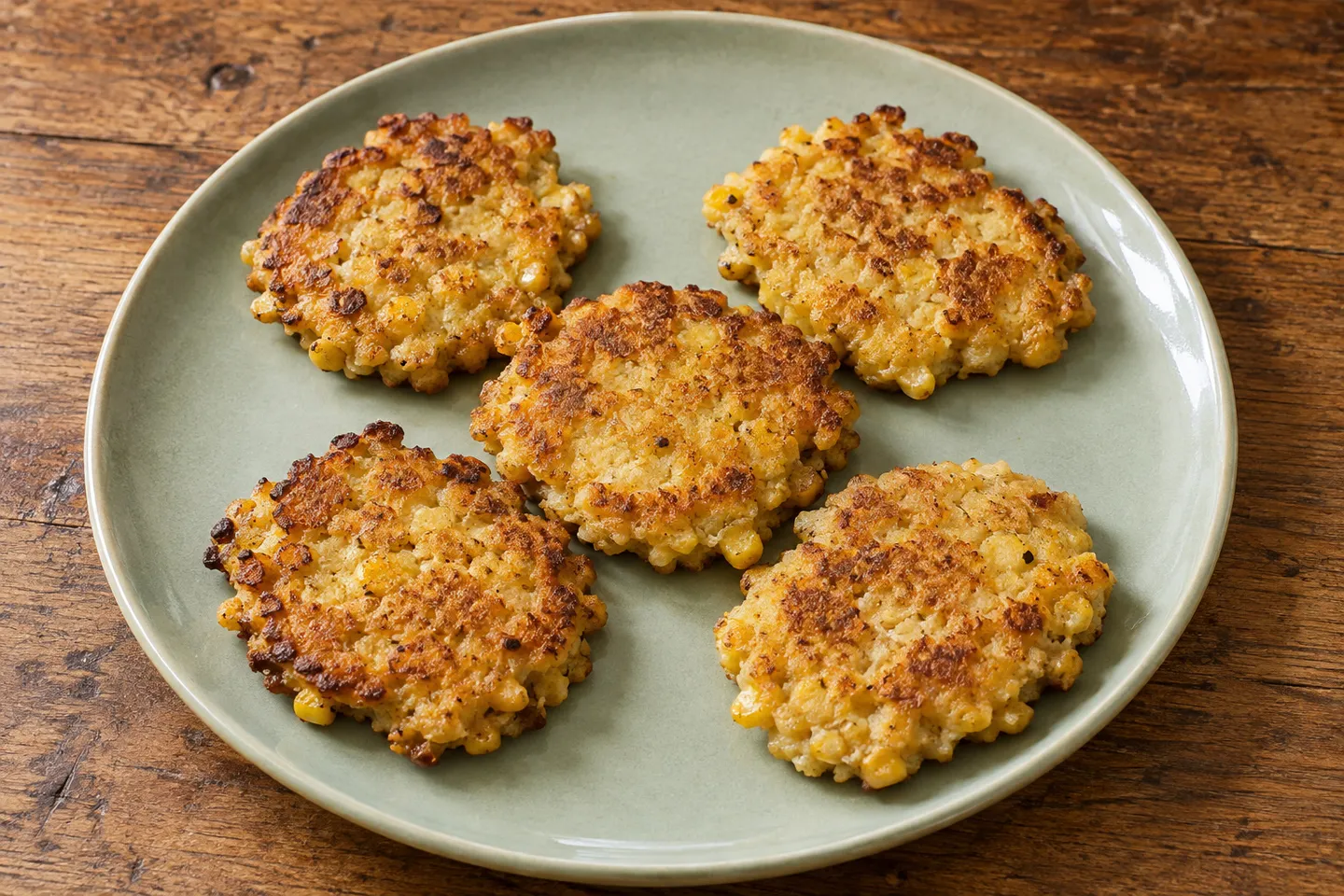
Abby Fisher's Fresh Corn Fritters (1881)
Small skillet-fried corn fritters made with fresh kernels and scraped corn pulp, adapted from Abby Fisher's 1881 cookbook.
- Original yieldYield
- About 24 small fritters; 6 side-dish servingsAbout 24 small fritters6 side-dish servings
- PrepPrep time
- CookCook time
- TotalTotal time
Planning estimate allows four frying batches. Smaller pans or additional batches will take longer.
Published Updated
Original recipe: About 24 small fritters; 6 side-dish servings
The story behind the recipe
The distinctive part of these corn fritters happens before the oil is hot. Cut through only part of each kernel, then scrape the remaining corn from the cob. Soft pulp and juice join the small cut pieces in the batter. Abby Fisher wanted more from an ear of corn than a clean sweep of kernels.
The corn left on the cob
Fisher's 1881 recipe asks for young, tender corn and tells the cook to cut lightly before scraping the remainder clean. The detail is easy to miss in a short recipe, yet it explains why fresh ears matter here. Drained canned kernels would leave out the pulp gathered by that second pass of the knife.
Read more about this recipe
Crackers in the batter
Powdered crackers, flour, milk, and eggs accompany the corn in Fisher's directions. The crumbs and flour are both present in our batter too; this isn't a flour pancake with a few kernels scattered through it. Fine crumbs blend into the wetter pulp while the cut pieces remain visible.
Buy plain unsalted crackers and crush them finely. A flavored cracker would season the entire batter, and coarse broken pieces would have a different presence from the powder Fisher describes. The short standing time in the modern method lets the crumbs take up moisture before the first spoonful reaches the pan.
Fisher begins with a dozen ears, three eggs, and a spoonful of flour. We've chosen a smaller weighed batch with different proportions and neutral oil in place of her lard or butter. The cut-and-scrape preparation stays. Weigh the pulp and kernels together: the suggested ear count is for shopping, since six generous ears and eight smaller ones can leave very different amounts in the bowl.
A cook who notices small things
What Mrs. Fisher Knows About Old Southern Cooking was published in San Francisco in 1881. In its preface Fisher describes more than thirty-five years of cooking experience, names the people who encouraged the book, and explains that she dictated the recipes because she couldn't read or write. Its title page advertises awards for pickles, sauces, jellies, and preserves.
The corn fritter recipe offers another view of that knowledge. Fisher doesn't spend a paragraph persuading anyone that corn is delicious. She tells the cook which corn to choose and how much of each kernel to cut. Those observations are enough to give a brief passage a recognizable dish.
Fry a little at a time
The source drops batter from the end of a spoon. Small fritters keep the corn in manageable portions, with browned faces and enough room to turn them without disturbing the next one. Warm oil should set the underside before the batter is moved; turning too soon can leave a spoonful falling apart in the pan.
These are best served warm, when the fried surface still contrasts with the softer corn inside. A few can accompany Fisher's chicken and ham Jumberlie, though they don't require a second historical dish to make a meal. A crisp salad gives the plate another texture without competing with the corn.
Make it your wayOriginal: 6 servings · Makes About 24 small fritters; 6 side-dish servings
Original recipe: About 24 small fritters; 6 side-dish servings
Ingredients
For About 24 small fritters; 6 side-dish servings. Quantities are shown as written.
Source measurement convention: Metric. Explicit unit definitions take precedence; unconfirmed measures must be checked before conversion.
Original quantities for About 24 small fritters; 6 side-dish servings.
- Fresh sweet corn kernels and scraped pulp (from about 6–8 medium ears; see method)600 g
- Large eggs2
- Plain unsalted cracker crumbs (finely crushed)60 g
- All-purpose flour30 g
- Whole milk30 ml
- Fine salt1/2 metric tsp
- Ground black pepper1/4 metric tsp
- Neutral cooking oil (for shallow frying; used in batches)120 ml
Measurement notes
- fine salt, ground black pepper: tsp: 1 = 5 ml.
Measurement notes
Original ingredients
- 600 g fresh sweet corn kernels and scraped pulp (from about 6–8 medium ears; see method)
- 2 large eggs
- 60 g plain unsalted cracker crumbs (finely crushed)
- 30 g all-purpose flour
- 30 ml whole milk
- 1/2 tsp fine salttsp: 1 = 5 ml.
- 1/4 tsp ground black peppertsp: 1 = 5 ml.
- 120 ml neutral cooking oil (for shallow frying; used in batches)
Equipment
 Heavy cast-iron skillet (10 or 12-inch)
 Whisk
Instructions
Cut and scrape the corn
Stand each husked ear of corn securely on its end. Cut down the cob, taking about half the depth of the kernels. Scrape the remaining pulp and juice from the cob with the back of the knife. Collect the kernels, pulp, and juice and weigh out 600 g.
Mix and rest the batter
Whisk the eggs until frothy. Stir in the corn, cracker crumbs, flour, milk, salt, and black pepper until evenly combined. Let the batter stand for 5 minutes so the crumbs absorb some moisture; it should form a soft mound on a spoon rather than pour freely. If it looks loose, give it another 5 minutes to stand before frying.
Heat the frying oil
Heat about 80 ml of the oil in the skillet over medium heat, keeping the remaining 40 ml for later batches. The oil should form a thin, continuous layer. Drop in a small dab of batter; it should sizzle steadily without darkening immediately.
Fry the fritters in batches
Add heaped tablespoonfuls of batter, spreading each gently to about 5–6 cm across. Leave space between them and fry about six at a time. Cook for 2–3 minutes on the first side, until the undersides are golden and the edges look set, then turn carefully and cook for another 2–3 minutes. The centers should be set, with no wet egg batter; lower the heat if the outsides brown too quickly.
Drain and serve warm
Transfer the cooked fritters to a plate lined with paper towels. Repeat with the remaining batter, adding the reserved oil between batches as needed and allowing it to heat before adding more batter. Serve warm.
Estimated calories 230 kcal
Nutrition portion: 1/6 of recipe · Original yield: About 24 small fritters; 6 side-dish servings
Source & assumptions
Ingredient-based estimate using CoFID 2021, USDA SR Legacy and published household cooking factors. About 230 kcal per nutrition portion (1/6 of the recipe). Frying oil is estimated with a pancake/fritter category model of 7 g absorbed fat per 100 g batter; actual uptake and draining vary. The frying-oil bath is not counted as fully consumed.
Recipe notes
When adjusting quantities
Keep the fritters about 5–6 cm across and fry in uncrowded batches. More batter means more batches, not larger fritters or a shorter frying time.
Original recipe notes
These notes describe the original recipe. Quantities mentioned here do not change when you adjust servings.
Corn: Fresh, tender sweet corn is central to this method. The ear count is a shopping estimate; use the measured 600 g of kernels, pulp, and juice as the recipe baseline.
Frying: A first small fritter is a useful heat check. Adjust the burner so the batter cooks through before the edges become dark. Do not crowd the skillet or turn the fritters before the undersides have set.
Read the scaling guide. Times, temperatures and equipment need their own consideration. Open the recipe tool to review and correct individual amounts.
Sources and attribution
Adapted from Abby Fisher, What Mrs. Fisher Knows About Old Southern Cooking (1881), recipe 134, pp. 62–63.
Abby Fisher, What Mrs. Fisher Knows About Old Southern Cooking (1881), recipe 134, pp. 62–63. The smaller batch, frying fat, and cooking guidance are modern adaptations. Our introduction to Fisher's book follows three more of her dishes.
Recipe details
- Recipe tradition
- Vintage
- Cuisine
- American
- Difficulty
- Intermediate
- Cooking method
- Stovetop
- Main ingredient
- Vegetables
- Browse category
- Snacks & Dips