
Compost (Medieval-Inspired Spiced Root Pickle)
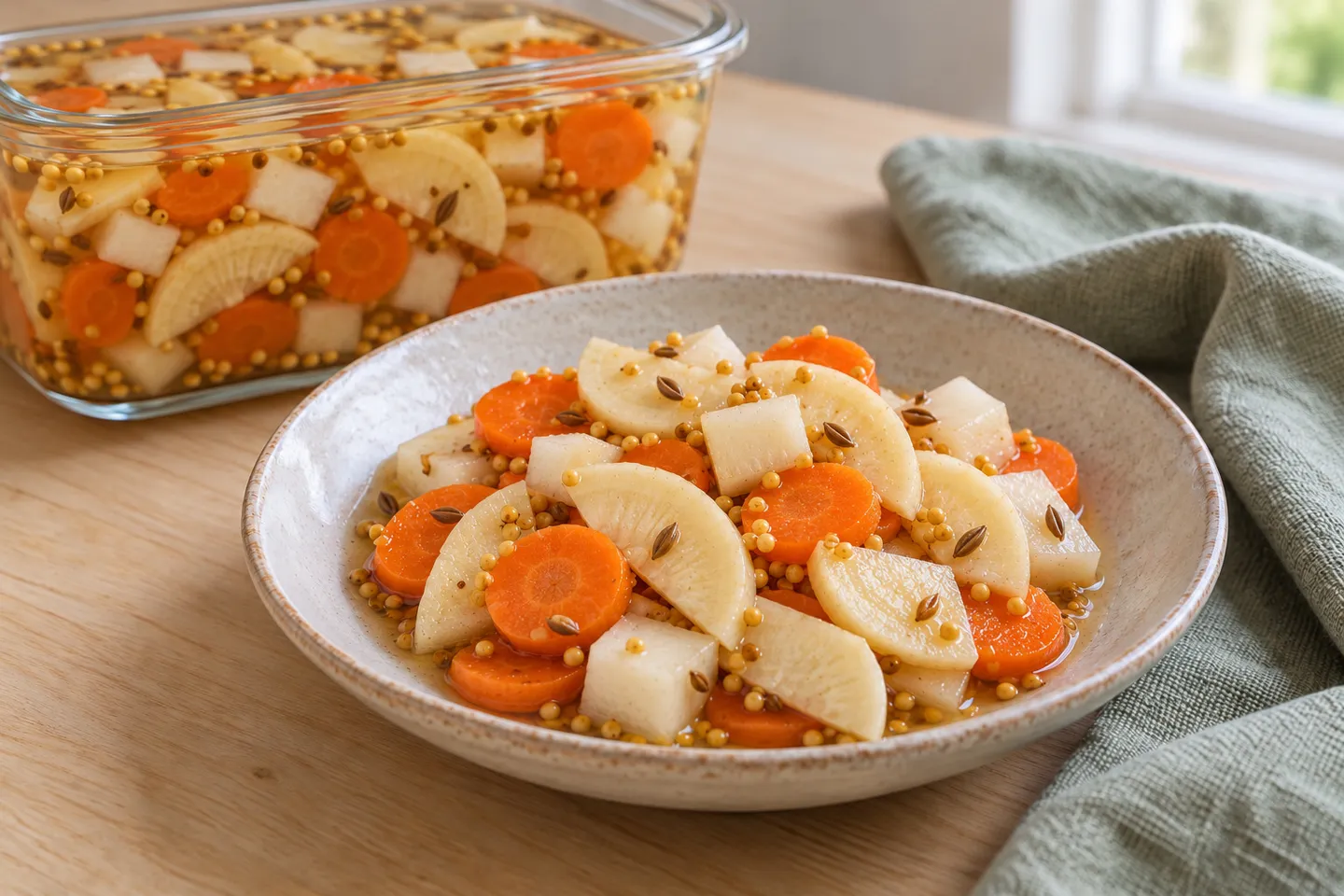
Carrots, parsnips, and turnips in a honeyed cider-vinegar dressing with mustard and anise, a refrigerator adaptation of medieval compost.
- Original yieldYield
- 6 relish servings (100 g vegetables each, plus dressing)6 relish servings (100 g vegetables each, plus dressing)
- PrepPrep time
- CookCook time
- TotalTotal time
Published Updated
Original recipe: 6 relish servings (100 g vegetables each, plus dressing)
The story behind the recipe
Compost is an unexpected name for a bowl of spiced roots, but in The Forme of Cury it belongs firmly in the kitchen. Our relish puts carrots, parsnips, and turnips into a sharp honeyed dressing with mustard and anise. A little is intended beside a savory dish, where sweetness and vinegar can cut across the richer food.
The old assortment
The source includes more than roots. Parsley roots and an uncertain root phrase join turnips and cabbage; pears enter during cooking. Once lifted out and cooled, the vegetables and fruit spend an overnight or all-day interval with salt, vinegar, spices, and saffron.
Read more about this recipe
Seasoning in stages
Greek wine, clarified honey, Lombard mustard, whole currants, cinnamon, sweet spice powder, anise, and fennel seed enter the final mixture. The order is striking. This isn't simply a list of things to put in a jar: the cooking, cooling, vinegar rest, and final seasoning are separate parts of the dish.
The collection is associated with Richard II's master cooks and was compiled around 1390. Pegge glosses pasturnakes elsewhere as parsnips or carrots, while questioning this recipe's fuller root phrase. Carrots and parsnips are our interpretation for the shopping list, with turnips completing the assortment.
Our smaller assortment leaves out parsley root, cabbage, pears, wine, currants, saffron, fennel, and several seasonings. Whole yellow mustard seeds replace prepared Lombard mustard, ground ginger is our seasoning choice, and commercial honey needs no separate clarification. The dressing comes together in one hot stage before prompt refrigeration. All quantities are chosen for this simplified relish.
Mustard seeds among the roots
The seeds remain distinct pieces in the dressing, unlike a prepared mustard dispersed through it. Anise and ginger add other points of interest beside honey and cider vinegar. The roots should be tender but intact, with recognizable shapes that can be lifted from the liquid.
Cutting them evenly helps, though different vegetables may still soften at different rates. Check the pieces themselves as they cook. A turnip cube needn't stay in the water because a thicker parsnip piece requires another minute.
The amount of dressing also deserves room. This batch has prepared vegetables and more than half a liter of vinegar and honey; forcing it into a one-liter jar would leave little space for coverage or handling. The wide container specified below accommodates both parts of the dish.
Tomorrow's relish
The refrigerator rest makes this a preparation to start before the day you serve it. It counts within the short storage period, rather than beginning a new clock afterward. This is refrigerated cooked vegetables in dressing, not a fermented pickle or a tested canned preserve.
Our medieval collection article pairs the relish with Tart de Bry as a modern lunch idea. A small portion also works beside cheese or roast meat. Lift out a few pieces and leave excess dressing in the container, so the relish supplies contrast without soaking the rest of the plate.
Make it your wayOriginal: 6 servings · Makes 6 relish servings (100 g vegetables each, plus dressing)
Original recipe: 6 relish servings (100 g vegetables each, plus dressing)
Ingredients
For 6 relish servings (100 g vegetables each, plus dressing). Quantities are shown as written.
Source measurement convention: Metric. Explicit unit definitions take precedence; unconfirmed measures must be checked before conversion.
Original quantities for 6 relish servings (100 g vegetables each, plus dressing).
- Carrots, weighed after peeling, sliced into 5-mm rounds250 g
- Parsnips, weighed after peeling and coring, sliced into 5-mm half-moons200 g
- Turnip, weighed after peeling, cut into 1-cm cubes150 g
- Commercial apple cider vinegar labeled 5% acidity500 ml
- Additional 5% apple cider vinegar, only if needed to cover100 ml
- Honey60 ml
- Whole yellow mustard seeds10 g
- Whole anise seeds1 metric tsp
- Fine salt3 g
- Ground ginger1/2 metric tsp
Measurement notes
- whole anise seeds, ground ginger: tsp: 1 = 5 ml.
Measurement notes
Original ingredients
- 250 g carrots, weighed after peeling, sliced into 5-mm rounds
- 200 g parsnips, weighed after peeling and coring, sliced into 5-mm half-moons
- 150 g turnip, weighed after peeling, cut into 1-cm cubes
- 500 ml commercial apple cider vinegar labeled 5% acidity
- 100 ml additional 5% apple cider vinegar, only if needed to cover
- 60 ml honey
- 10 g whole yellow mustard seeds
- 1 tsp whole anise seedstsp: 1 = 5 ml.
- 3 g fine salt
- 1/2 tsp ground gingertsp: 1 = 5 ml.
Equipment
 3-liter heavy saucepan
 Colander
- Airtight glass container
Instructions
Simmer the root vegetables
Bring 1.5 liters of unsalted water to a boil in a 3-liter saucepan. Add the carrots, parsnips, and turnip. Simmer for about 6 to 10 minutes, checking the different pieces: they should be easily pierced but still hold their shape. Remove tender pieces first if needed.
Drain and transfer the vegetables
Drain thoroughly. Put the vegetables in a clean, wide heatproof glass container of at least 1.5 liters capacity. Warm the glass with warm water and dry it first; use only a container intended for hot food.
Simmer the spiced vinegar dressing
In the emptied saucepan, combine 500 ml 5% cider vinegar, the honey, mustard seeds, anise seeds, fine salt, and ginger. Bring to a simmer and stir for about 2 minutes, until the honey and salt dissolve.
Cover the vegetables with dressing
Pour the hot dressing over the vegetables. Settle the pieces gently so liquid reaches between them. If they are not covered, add only enough of the measured additional 5% vinegar to cover, up to 100 ml. Do not dilute with water. Leave headspace below the lid; use a second small container if needed.
Refrigerate and rest before serving
Let the immediate heat dissipate for about 20 minutes, then cover and refrigerate at 40°F (4°C) or below. Do not wait for the whole batch to become room temperature. Refrigerate within 2 hours of cooking, or 1 hour above 90°F (32°C). Leave for 24 hours before serving, with a clean utensil to lift portions from the dressing.
Estimated calories 80 kcal
Nutrition portion: 1/6 of recipe · Original yield: 6 relish servings (100 g vegetables each, plus dressing)
Source & assumptions
Rough ingredient-based estimate per one-sixth batch of roots with 15 g dressing. Uses published carrot sugar-transfer data as a substitute for the honey pickle, with declared boiling and liquid-partition assumptions; actual uptake and drained weight vary. This is a modeled estimate, not a measured result.
Recipe notes
Original recipe notes
These notes describe the original recipe. Quantities mentioned here do not change when you adjust servings.
Planning: Allow 20 minutes preparation, approximately 15 minutes cooking, 20 minutes before refrigeration, and a 24-hour refrigerator rest: 1,495 minutes, or about 24 hours 55 minutes, from starting to serving. The refrigerator rest is passive time.
Capacity and yield: The baseline has 600 g prepared vegetables plus at least 560 ml vinegar and honey. Use a wide heatproof 1.5-liter or larger container, not a tightly packed 1-liter jar. Six relish portions each contain roughly 100 g vegetables; dressing is additional and final absorbed/drained weight is not established.
Storage: Treat this as refrigerated cooked vegetables, not a canned preserve or fermented pickle. Keep at 40°F (4°C) or below and use within 3 days of preparation, including the 24-hour rest. No longer shelf life or room-temperature storage has been established for this formula. Do not water-bath can it. The vinegar amount is a modern flavor and coverage choice, not a validated canning ratio.
Read the scaling guide. Times, temperatures and equipment need their own consideration. Open the recipe tool to review and correct individual amounts.
Sources and attribution
Compost, recipe 100, pp. 49–50 in Pegge's 1780 The Forme of Cury, composed around 1390. The smaller assortment and combined seasoning stages are adaptations. The original sour liquid is vinegar, not verjuice.
Curious about the drinks of the period? Our sister site, Forgotten Drink, explores medieval beer, water and the evidence behind them.
Recipe details
- Recipe tradition
- Vintage
- Course or meal
- Side dishSauce / condiment
- Cuisine
- British
- Historical period
- Medieval
- Browse category
- Snacks & Dips