
Tart de Bry (Medieval-Inspired Brie and Saffron Tart)
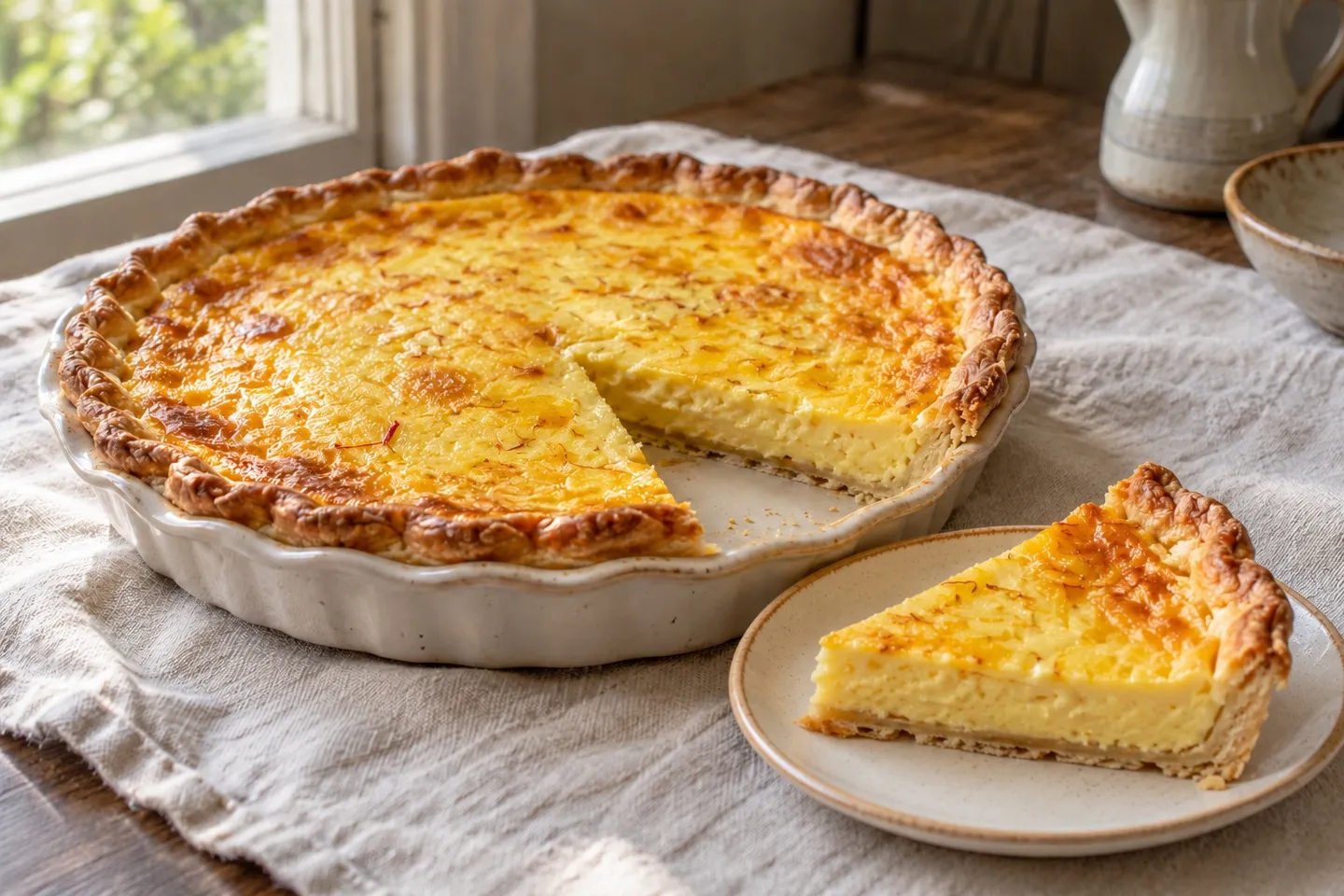
A golden cheese-and-egg-yolk tart with saffron and ginger, adapted from Tart de Bry in The Forme of Cury.
- Original yieldYield
- 8 small wedges8 small wedges
- PrepPrep time
- CookCook time
- TotalTotal time
Published Updated
Original recipe: 8 small wedges
The story behind the recipe
Our cheese tart has a Brie-and-yolk filling seasoned with ginger, saffron, sugar and salt. The soft cheese leaves a little texture inside the pastry. A small golden wedge can sit on a savory plate even though its seasoning crosses the usual sweet-and-savory boundary.
A crust an inch deep
The medieval directions begin with a crust an inch deep in a baking vessel. Cheese and raw yolks are mixed together, the seasonings added, and the tart baked and served. The shape of the crust and the filling's ingredients carry most of the description.
Read more about this recipe
A cheese name with a question mark
Tart de Bry belongs to The Forme of Cury, compiled around 1390 and associated with Richard II's master cooks. In the consulted 1780 edition, Samuel Pegge asks whether the cheese wording, “chese ruayn,” could refer to Rouen. He separately queries Brie in the title.
Those notes make Brie an inviting interpretation, but they don't settle what cheese the medieval cook intended. We use it as an accessible soft cheese, with the yolks, ginger, sugar, saffron, and salt preserving the passage's recognizable filling. Our collection article explores that uncertainty beside several clearer ingredient instructions.
Saffron through the filling
The saffron is steeped in a little warm water so it can spread through the egg mixture. Ginger adds warmth beside the cheese. The restrained sugar amount doesn't turn this version into a sweet pie; the finished wedges are intended for a savory meal.
Cream is added to help combine the finely chopped Brie and yolks. Neither cream nor saffron water appears in the original, and all quantities are modern choices. Some cheese pieces can remain. A perfectly smooth dairy custard would be a different expectation from the chopped-cheese filling described here.
Trim the rind as specified and chop the cheese finely. Large lumps would leave the small wedges with very uneven bites of cheese and egg. The filling is modest in depth, leaving room below the rim of the nine-inch plate.
Pastry gets a head start
Ready-made shortcrust keeps the work focused on the filling. The modern method partly bakes the shell, then finishes the filled tart at a lower temperature. The source simply says to bake; this version adds pan size, oven stages, times, and a safe-temperature check.
Check the center as well as the surface. A golden top can look inviting while the egg mixture underneath still needs time. Let the tart rest before cutting so the first wedge isn't expected to hold together straight out of the oven.
For lunch, a sharp salad gives the cheese and pastry some contrast. A small portion of compost root relish does the same in a modern meal drawn from the collection. If also serving macrows, keep the portions small: there will already be butter and cheese in both dishes.
Make it your wayOriginal: 8 servings · Makes 8 small wedges
Original recipe: 8 small wedges
Ingredients
For 8 small wedges. Quantities are shown as written.
Source measurement convention: Metric. Explicit unit definitions take precedence; unconfirmed measures must be checked before conversion.
Original quantities for 8 small wedges.
- Ready-made shortcrust pastry230 g
- Brie cheese, weighed after trimming the rind, finely chopped300 g
- Large egg yolks4
- Heavy cream60 ml
- Saffron threads0.1 g
- Warm water15 ml
- Ground ginger1/2 metric tsp
- Fine salt2 g
- Granulated sugar4 g
Measurement notes
- ground ginger: tsp: 1 = 5 ml.
Measurement notes
Original ingredients
- 230 g ready-made shortcrust pastry
- 300 g Brie cheese, weighed after trimming the rind, finely chopped
- 4 large egg yolks
- 60 ml heavy cream
- 0.1 g saffron threads
- 15 ml warm water
- 1/2 tsp ground gingertsp: 1 = 5 ml.
- 2 g fine salt
- 4 g granulated sugar
Equipment
 9-inch pie plate
 Whisk
 Food thermometer
Instructions
Heat the oven and line the pastry shell
Heat a conventional oven to 375°F (190°C). Fit the shortcrust pastry into a 9-inch pie plate at least 1 inch deep. Chill while the oven heats if the pastry softens. Line the shell with baking paper and fill with pie weights or dried beans.
Blind-bake the pastry
Bake for 15 minutes. Remove the weights and paper, then bake for 5 minutes more until the base looks dry. Reduce the oven to 350°F (180°C). Set the plate aside while finishing the filling.
Steep the saffron and mix the cheese filling
While the shell bakes, crumble the saffron threads into the warm water and leave for 5 minutes. Mash the finely chopped Brie with the heavy cream using a fork, then whisk in the egg yolks, saffron and its water, ground ginger, fine salt, and sugar. Small pieces of cheese are fine; do not expect a perfectly smooth mixture.
Fill and bake the tart
Pour the filling into the partly baked shell. Bake at 350°F (180°C) for 25 to 30 minutes, until the edges are set, the center has only a slight wobble, and a thermometer inserted into the center of the filling reads at least 160°F (71°C). Continue baking if needed to reach that endpoint.
Rest, slice and serve
Rest for 15 minutes before cutting into 8 wedges. Serve warm, or refrigerate promptly if serving later.
Estimated calories 320 kcal
Nutrition portion: 1/8 of recipe · Original yield: 8 small wedges
Source & assumptions
Ingredient-based estimate using CoFID 2021. Approximately 320 kcal per nutrition portion. Uses representative ready-made shortcrust pastry, rind-trimmed Brie and heavy whipping cream. Ingredients, brands and preparation affect values.
Recipe notes
Original recipe notes
These notes describe the original recipe. Quantities mentioned here do not change when you adjust servings.
Pan and pastry: The baseline is a 9-inch pie plate at least 1 inch deep. The approximately 450 ml filling leaves room below its rim. Buy enough pastry to line your plate; this recipe assumes 230 g ready-made pastry, not homemade dough preparation.
Timing: Allow 20 minutes for preparation and oven heating, up to 50 minutes for the two baking stages, and a 15-minute rest. Filling preparation overlaps the blind bake. Oven and pastry instructions may require longer; the temperature endpoint takes precedence.
Storage: Refrigerate in a shallow covered container within 2 hours, or 1 hour above 90°F (32°C). Keep at 40°F (4°C) or below and use within 3 days. Reheat slices to 165°F (74°C), rather than relying on a fixed number of minutes.
Read the scaling guide. Times, temperatures and equipment need their own consideration. Open the recipe tool to review and correct individual amounts.
Sources and attribution
Tart de Bry, recipe 166, pp. 74–75 in Pegge's 1780 The Forme of Cury, composed around 1390. Brie, cream, measured quantities, saffron water, and staged baking are adaptations.
Curious about the drinks of the period? Our sister site, Forgotten Drink, explores medieval beer, water and the evidence behind them.
Recipe details
- Recipe tradition
- Vintage
- Cuisine
- British
- Historical period
- Medieval
- Browse category
- Baking & Desserts