
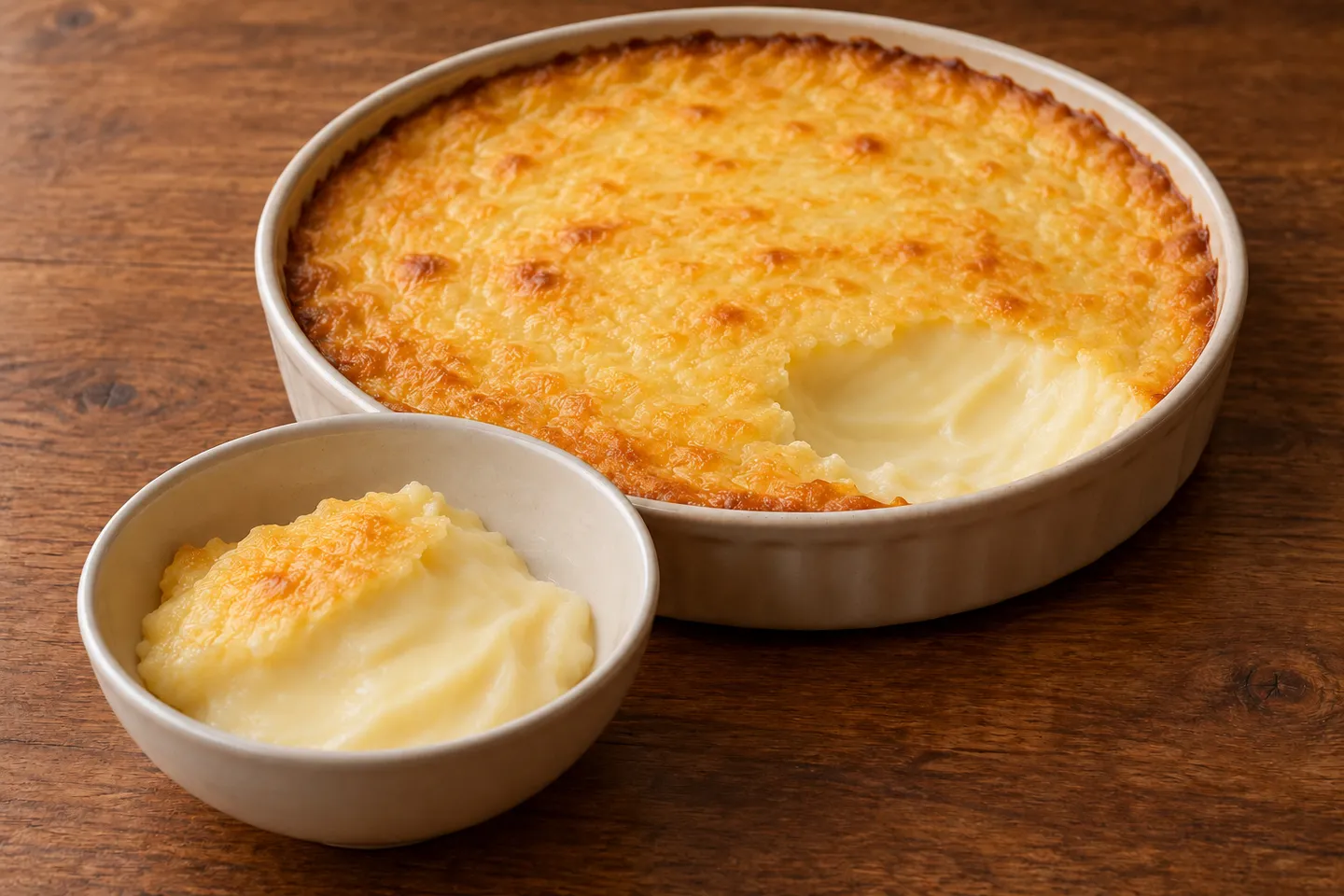
Baked Ground-Rice Pudding with White Rice Flour, Adapted from Beeton (1861)
A lemon-scented baked egg pudding made with plain white rice flour, following the baked branch of Beeton's ground-rice pudding.
- Original yieldYield
- 6 dessert portions6 dessert portions
- PrepPrep time
- CookCook time
- TotalTotal time
Estimated: 15 minutes preparation, 10 minutes heating and thickening, up to 30 minutes cooling, 50 to 60 minutes baking and 10 minutes standing. Preheat toward the end of cooling.
Published Updated
Original recipe: 6 dessert portions
The story behind the recipe
Three spoonfuls for the oven, six for the boiling basin. Beeton's ground-rice pudding changes its rice quantity when the cooking method changes, while keeping all four eggs and the full amount of milk. The baked version is the one followed here, with plain white rice flour as the defined modern ingredient.
Lemon in the milk
The milk is flavored with lemon peel before it reaches the rice mixture. The finished pudding is an egg-and-milk dessert thickened with milled rice, with a citrus aroma rather than the acidity of lemon juice. Buy plain white rice flour for this version; the ingredient name matters more than the word pudding on an old page.
Read more about this recipe
The eggs aren't part of the halving instruction
Recipe 1353 begins as a boiled pudding. Its list gives six tablespoonfuls of ground rice, two pints of milk and four eggs. Only later does the baked alternative appear, directing the cook to halve the ground rice and keep the other ingredients unchanged.
It's an easy instruction to miss when copying a list into a notebook. Halving the entire formula would produce a smaller batch of the boiled mixture, rather than the baked formula Beeton describes. Here the eggs remain four.
That distinction also separates this pudding from her plain baked rice pudding. In that recipe, intact grains go uncooked into milk. Here, the milled rice is heated with milk first, and the eggs are added after the mixture has cooled. The flour isn't a shortcut for the same dish.
A flour with one rice ingredient
Use plain, finely milled white rice flour. Check the ingredient list for white rice; a white-and-brown blend is a different product. Sweet or glutinous rice flour is made from sticky rice and is not the flour specified here. Sweet in that name describes the rice rather than added sugar.
Check other brands just as carefully. Some products named rice flour blend white and brown rice. Others are sold as a coarser ground rice. A familiar-looking bag doesn't establish that its contents match this recipe's flour, and the historical wording doesn't supply a missing modern specification.
Peel, spice or leaf
Beeton offers several flavorings: lemon rind, nutmeg, bitter almonds or bay leaf. They are alternatives, not an instruction to put every one into the saucepan. Lemon is the choice here, so the milk is scented with peel and strained before the pudding is finished.
The suggestion to serve either version with fruit is equally practical. Her list includes stewed fruit, preserves and marmalade. A spoonful beside the pudding would add a separate fruit flavor; it doesn't require changing the milk base or treating lemon peel as a source of juice.
A spooned pudding
This version is served from its baking dish. Let it settle briefly before spooning, and check the center as well as the top when deciding whether it's done. Browned milk on the surface can't establish that an egg mixture underneath has finished cooking.
Keep the dish shallow when making more. A deeper center would have farther to heat even if the ingredient arithmetic were correct. For a larger table, two dishes preserve the intended depth and give you two puddings to check separately.
Make it your wayOriginal: 6 servings · Makes 6 dessert portions
Original recipe: 6 dessert portions
Ingredients
For 6 dessert portions. Quantities are shown as written.
Source measurement convention: Metric. Explicit unit definitions take precedence; unconfirmed measures must be checked before conversion.
Original quantities for 6 dessert portions.
- Plain white rice flour30 g
- Whole milk, divided1.1 l
- Granulated sugar50 g
- Large eggs4
- Lemon, peel only1/2
- Fine salt1/8 tsp
- Unsalted butter, for greasing5 g
Measurement notes
- fine salt: US tsp: 1 = 4.9289 ml (rounded).
Measurement notes
Original ingredients
- 30 g plain white rice flour
- 1.1 liters whole milk, divided
- 50 g granulated sugar
- 4 large eggs
- 1/2 lemon, peel only
- 1/8 US tsp fine saltUS tsp: 1 = 4.9289 ml (rounded).
- 5 g unsalted butter, for greasing
Equipment
 2-liter round shallow ceramic baking dish (about 23 cm internal diameter and 5 cm deep)
 Medium saucepan (2-quart)
 Whisk
 Fine-mesh strainer
 Food thermometer
Instructions
Heat the milk with lemon peel
Remove the peel from the half lemon in broad strips, taking as little white pith as possible. Put three-quarters of the whole milk (825 ml at the original yield) in a medium 2-quart saucepan with the peel. Heat gently until the milk reaches the boiling point, then take it off the heat.
Whisk the flour and strain in hot milk
In a large heatproof bowl, whisk the plain white rice flour with the remaining quarter of the milk (275 ml at the original yield) until smooth. Strain the hot lemon milk into this mixture a little at a time, whisking constantly, and discard the peel.
Simmer the rice mixture
Return the mixture to the saucepan. Stir over medium-low heat, scraping the bottom and corners, until it reaches a gentle simmer and begins to thicken. Continue stirring at a gentle simmer for 2 to 3 minutes; it should be lightly thickened rather than a stiff paste. Transfer to a clean heatproof bowl.
Cool the base promptly
Set the bowl in cold water, keeping water out of the mixture, and stir occasionally until it is below 104°F (40°C). Refresh the cooling water as needed and aim to finish cooling within 30 minutes. Don't leave it standing for hours or prepare this base ahead; add the eggs and bake promptly after cooling.
Heat the oven and grease the dish
Toward the end of cooling, heat the oven to 325°F (160°C), conventional heat. Grease a 2-liter round, shallow ceramic baking dish, about 23 cm internal diameter and 5 cm deep, with the unsalted butter.
Add sugar and beaten eggs
Whisk the granulated sugar into the cooled rice mixture. In another bowl, beat the eggs with the fine salt just until combined, then whisk them into the rice mixture. Pour into the baking dish; the filling should be about 3 to 3.5 cm deep.
Bake until set and safely cooked
Bake on the middle shelf for about 50 to 60 minutes. The edges should be set and the center should move gently as one mass when the dish is nudged, without a liquid ripple. Check the center with a food thermometer: it must reach at least 160°F (71°C). Continue baking if it hasn't reached that temperature and set; cover loosely with foil if the top colors too quickly.
Rest and serve
Let stand for 10 minutes, then spoon into bowls. Follow the storage note promptly if saving any pudding.
Estimated calories 220 kcal
Nutrition portion: 1/6 of recipe · Original yield: 6 dessert portions
Source & assumptions
Ingredient-based estimate using CoFID 2021. Approximately 220 kcal per nutrition portion. Includes all measured greasing butter; lemon peel is removed after infusing the milk. Ingredients, brands and preparation affect values.
Recipe notes
When adjusting quantities
Keep the same dish material and approximately 3 to 3.5 cm filling depth. Use additional dishes for a larger batch. Times and temperatures do not scale. For fractional eggs, beat them together and weigh the required fraction before adding.
Original recipe notes
These notes describe the original recipe. Quantities mentioned here do not change when you adjust servings.
Adapted from the baked branch of Beeton's Baked or Boiled Ground Rice Pudding, no. 1353, p. 681, in the 1861 book. That branch uses three source tablespoonfuls of ground rice with the full two pints of milk and four eggs. This recipe chooses 30 g plain white rice flour and 1.1 liters milk as a modern baseline, specifies large eggs, and fixes her sugar-to-taste at 50 g. The flour weight isn't an exact conversion of the historical spoons. The dish, oven setting, cooling method and temperature check are modern guidance; lemon is one of her listed flavorings.
Use finely milled plain white rice flour, with white rice as its sole ingredient. Sweet or glutinous rice flour, a white-and-brown blend, coarser ground rice and cornstarch aren't automatic substitutions for this formula. It contains milk, eggs and butter.
The center-temperature check follows FoodSafety.gov's guidance for egg dishes. For leftovers, use the conservative rice-storage approach in the NHS guidance: cool quickly in shallow portions, refrigerate within 1 hour and eat within 24 hours. Don't leave the pudding to cool overnight in its baking dish.
Storage
If saving leftovers, divide into shallow containers, cool quickly and refrigerate within 1 hour of cooking. Eat within 24 hours. Reheat only once, until steaming hot throughout.
Read the scaling guide. Times, temperatures and equipment need their own consideration. Open the recipe tool to review and correct individual amounts.
Sources and attribution
Isabella Beeton, The Book of Household Management (London: S. O. Beeton, 1861), Baked or Boiled Ground Rice Pudding, no. 1353, p. 681; baked branch.
Recipe details
- Recipe tradition
- Vintage
- Cuisine
- British
- Cooking method
- Oven
- Browse category
- Baking & Desserts