
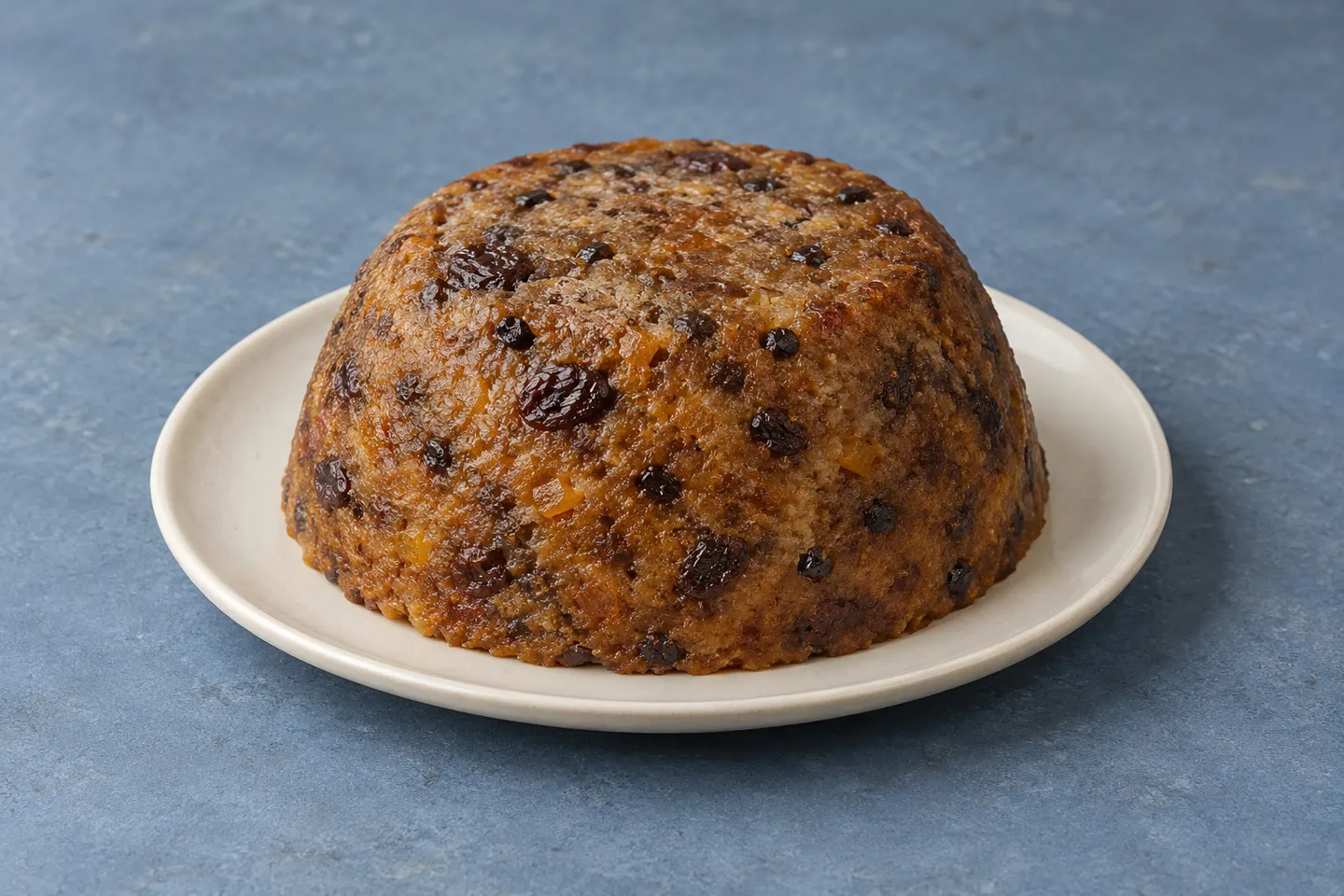
Small Carrot-and-Potato Plum Pudding, Adapted from Beeton (1861)
A small eggless suet pudding with raisins, dried currants, candied citrus peel and plain mashed carrot and potato, cooked in a covered basin.
- Original yieldYield
- One small pudding in a 1-liter basin, divided into 4 dessert portionsOne small pudding in a 1-liter basin, divided into 4 dessert portions
- PrepPrep time
- CookCook time
- TotalTotal time
Planning estimate from already cooked, drained, cooled and mashed vegetables; allow extra time to prepare them from raw. Includes 15 minutes resting. Four hours is the source-based steaming baseline; continue if the center is not set.
Published
Original recipe: One small pudding in a 1-liter basin, divided into 4 dessert portions
The story behind the recipe
The carrot and potato in this pudding go into the bowl already cooked and mashed. They sit among raisins, currants and finely chopped suet, with two kinds of candied citrus peel. There are no eggs to beat and no milk to pour. It is a fruit pudding assembled around ingredients that already carry moisture.
The vegetables belong in the mixture
Beeton calls recipe 1325 an excellent plum pudding made without eggs. Its mashed vegetables are measured ingredients, rather than optional leftovers stirred into a familiar batter. This smaller preparation keeps them alongside the flour, sugar, suet and fruit.
Read more about this recipe
A small batch with the fruit intact
Most of the source quantities are weights. Here they are halved: four ounces of flour, three ounces each of raisins and currants, and two ounces each of suet, sugar, prepared carrot and prepared potato. Keeping those weights makes the smaller batch easy to follow without guessing how tightly a cup of mashed vegetables was filled.
The fruit still has several forms. Raisins are the larger dried grapes; the currants are the small dried grapes sold as Zante or Corinth currants. Fresh red or black currants aren't substitutes for that ingredient. Candied lemon peel and candied citron have separate places in Beeton's list, and this version keeps both, chopped into small pieces that can be distributed through the mixture.
Beeton's brief method doesn't explicitly name the raisins or citron when it tells the cook what to mix. Their quantities are clear in the ingredient list, so both are included in the dry mixture here.
Plain mash, plain suet
Carrot and potato need to arrive without the additions that might accompany a dinner mash. Butter, milk and stock aren't part of their preparation here. Cook the vegetables until soft, drain them well and mash them plain; weigh the stated quantities after they have cooled. Raw purchase weights would describe a different stage of preparation.
The fat deserves a similar look when shopping. Plain beef suet is different from packaged shredded suet containing added flour. Adding a flour-containing product by the same weight would change both the fat and flour in the pudding. Finely chopped plain suet keeps that choice clear. The pudding is eggless, but the suet means it isn't vegetarian.
Black treacle is the selected syrup for this adaptation. The measured 7.5 milliliters is a modern choice for this small batch, rather than an exact interpretation of Beeton's historical spoon. The source's no-added-liquid direction stays: the mixture gets no separate milk, water or fruit-soaking liquor.
Room in the basin, time in the pot
A basin is one of the vessels Beeton herself permits. This version uses a small heatproof basin, with a pleated cover and space above the mixture. The empty space matters; a smaller household doesn't need a basin filled to its rim.
The four-hour cooking baseline is retained from the source. Reducing ingredient quantities doesn't supply a shorter time by arithmetic, and the center still needs to be fully cooked and set. The rest before unmolding gives the cook a pause between handling the steaming basin and serving the pudding.
Our existing Titanic-inspired plum pudding follows a different Beeton formula with bread crumbs, eggs and milk. This one keeps its own vegetable-and-fruit mixture. Serve it warm in small portions, with the candied peel and dried fruit visible in each slice, rather than expecting the crumb of an egg-raised cake.
Compare the ingredient and cooking choices in Eggs, Milk or Neither? Reading Old Pudding Recipes.
Make it your wayOriginal: 4 servings · Makes One small pudding in a 1-liter basin, divided into 4 dessert portions
Original recipe: One small pudding in a 1-liter basin, divided into 4 dessert portions
Ingredients
For One small pudding in a 1-liter basin, divided into 4 dessert portions. Quantities are shown as written.
Source measurement convention: Imperial (UK). Explicit unit definitions take precedence; unconfirmed measures must be checked before conversion.
Original quantities for One small pudding in a 1-liter basin, divided into 4 dessert portions.
- All-purpose flour4 oz
- Seedless raisins3 oz
- Dried currants, the small Zante or Corinth raisins3 oz
- Plain beef suet, connective tissue removed and fat finely chopped2 oz
- Brown sugar2 oz
- Plain mashed carrot, weighed after cooking, draining and cooling2 oz
- Plain mashed potatoes, weighed after cooking, draining and cooling2 oz
- Black treacle7.5 ml
- Candied lemon peel, finely chopped0.5 oz
- Candied citron, finely chopped0.5 oz
- Unsalted butter, for greasing the basin5 g
Measurement notes
Measurement notes
Original ingredients
- 4 oz all-purpose flour
- 3 oz seedless raisins
- 3 oz dried currants, the small Zante or Corinth raisins
- 2 oz plain beef suet, connective tissue removed and fat finely chopped
- 2 oz brown sugar
- 2 oz plain mashed carrot, weighed after cooking, draining and cooling
- 2 oz plain mashed potatoes, weighed after cooking, draining and cooling
- 7.5 ml black treacle
- 1/2 oz candied lemon peel, finely chopped
- 1/2 oz candied citron, finely chopped
- 5 g unsalted butter, for greasing the basin
Equipment
 1-liter heatproof pudding basin
 Large deep pot with lid, sized to fit the pudding basin
 Stable trivet for the steaming pot
Instructions
Prepare and weigh the plain vegetable mash
Start with the plain mashed carrot and plain mashed potatoes already cooked, well drained and cooled. If preparing them from raw, peel and cook the vegetables separately in unsalted water until soft, drain well, mash without milk or butter, and cool before weighing the required 2 oz of each. Allow that extra preparation time before starting the pudding.
Check and grease the basin
Check that the 1-liter heatproof basin fits inside the deep pot on its stable trivet, with room for water around it and the pot lid able to close. Grease the basin with the 5 g butter. Bring a kettle of water to a boil for the steaming pot.
Mix flour, fruit, suet and sugar
Mix the flour, raisins, dried currants, finely chopped suet, brown sugar, candied lemon peel and candied citron, breaking up any clumps of fruit or sugar.
Combine the vegetables and treacle
Add the weighed carrot and potato, then the black treacle. Stir and press together until no loose pockets of flour remain. Do not add water, milk or soaking liquid, and do not taste the uncooked flour mixture.
Fill and cover with expansion room
Transfer the mixture to the greased basin and level it gently, leaving at least one-third of the basin empty. Cover with baking parchment topped by foil, making a generous pleat across both layers. Tie securely below the rim with kitchen string and trim loose covering so it cannot trail into the water.
Set up the simmering water bath
Set the covered basin on the trivet. Carefully add boiling water to come halfway up the basin, below its covered rim. Cover the pot and bring the water back to a gentle simmer.
Steam and maintain the water level
Maintain that gentle simmer for about 4 hours. Check the water level at least every hour, opening the lid away from you, and add boiling water as needed to restore the halfway level. Do not let the pot boil dry or leave it unattended.
Check the center and extend if needed
Using dry oven mitts and a secure grip, carefully lift out the basin and open the covering away from your face. The center should be set, and a skewer inserted into the center should come out without wet, uncooked flour mixture. If it is not set, re-cover, return to the simmering bath and check again after 20 minutes; continue until cooked through.
Rest, unmold and divide
Let the pudding stand in its basin for 15 minutes. Loosen the edge carefully, turn onto a serving plate and divide into four small dessert portions. Serve warm.
Estimated calories 440 kcal
Nutrition portion: 1/4 of recipe · Original yield: One small pudding in a 1-liter basin, divided into 4 dessert portions
Source & assumptions
Ingredient-based estimate using CoFID 2021, USDA SR Legacy (April 2018), identified manufacturer information. Approximately 440 kcal per nutrition portion. Uses plain beef suet and representative candied citrus peel; includes the measured greasing butter. Ingredients, brands and preparation affect values.
Recipe notes
When adjusting quantities
Keep at least one-third of the basin empty. Larger quantities need separate basins or a separately reviewed vessel and cooking plan. Ingredients scale; basin size, water level, method and four-hour planning baseline do not.
Original recipe notes
These notes describe the original recipe. Quantities mentioned here do not change when you adjust servings.
Prepared weights: the 2 oz carrot and 2 oz potato refer to plain cooked, drained, cooled mash. Make enough to weigh those amounts and keep any surplus separately. Do not substitute an equal raw weight or use mash containing milk, butter or stock.
Ingredients: use plain beef suet and the specified dried grapes and candied peels. Flour-containing packaged suet, fresh currants, soaked fruit, golden syrup and added spices change this baseline; no equivalent results are claimed for those substitutions.
Basin and timing: this is a half-weight adaptation with a deliberately roomy 1-liter basin. Keep the one-third headroom and halfway water level. The four-hour baseline follows the source; use the center check rather than shortening cooking in proportion to servings.
Storage: this is a freshly cooked pudding, not a shelf-stable or hanging pudding. Refrigerate leftovers promptly in shallow containers within 2 hours, or within 1 hour above 32°C (90°F), and use within 3 to 4 days. Reheat leftovers to 74°C (165°F), following USDA leftover guidance. The source's overnight mixing recommendation is not used here.
Read the scaling guide. Times, temperatures and equipment need their own consideration. Open the recipe tool to review and correct individual amounts.
Sources and attribution
Adapted from Isabella Beeton, The Book of Household Management (London: S. O. Beeton, 1861), recipe 1325, p. 665.
Isabella Beeton, The Book of Household Management, 1861, recipe 1325, p. 665. Basin preparation, greasing, portion plan and present-day handling are specified for this version. The source's brandy sauce isn't included.
Recipe details
- Recipe tradition
- Vintage
- Cuisine
- British
- Cooking method
- Stovetop
- Main ingredient
- Fruit
- Browse category
- Baking & Desserts