
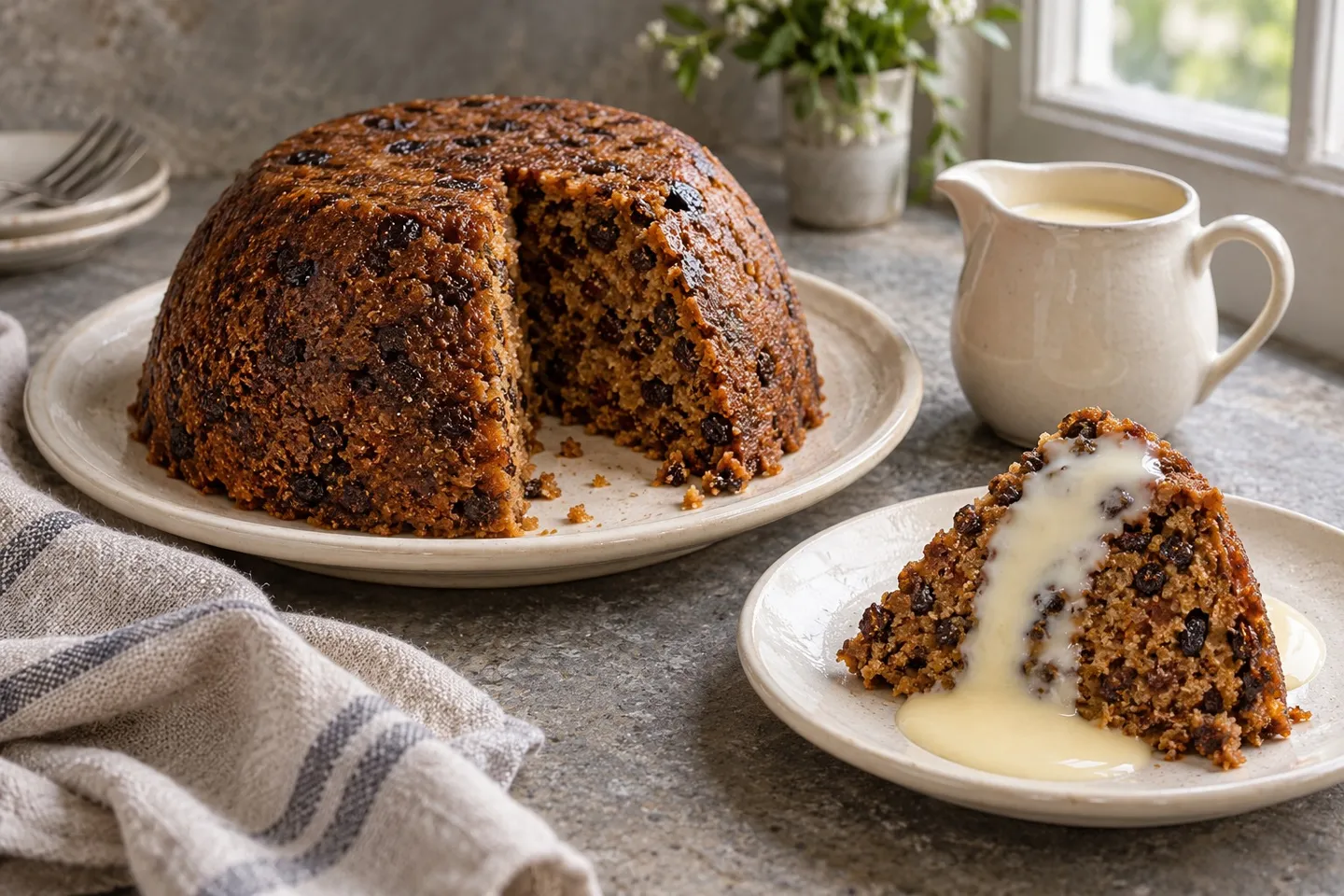
Plum Pudding with Sweet Sauce (Titanic Third-Class Menu, 1912)
A steamed pudding of raisins, dried currants, bread crumbs, and suet, served with a warm lemon milk sauce, inspired by Titanic's third-class dinner menu.
- Original yieldYield
- 8 dessert servings from one 3-liter pudding basin8 dessert servings from one 3-liter pudding basin
- PrepPrep time
- CookCook time
- TotalTotal time
Includes 15 minutes standing before unmolding. Make the sauce during the final 15 minutes of pudding cooking. Five hours is a planning baseline; continue if the center is not set.
Published Updated
Original recipe: 8 dessert servings from one 3-liter pudding basin
The story behind the recipe
The fruit in this plum pudding is raisins and dried currants, not fresh plums. Titanic's third-class menu dated April 14, 1912, names plum pudding with sweet sauce. The menu gives no formula, so our home version adapts Beeton's pudding and sweet milk sauce.
Dinner on the daily card
The menu puts plum pudding and sweet sauce under dinner beside roast beef, gravy, and vegetables. Separate headings cover breakfast, tea, and supper. Dinner here is the main midday meal; the word doesn't turn the pudding into an evening-menu claim.
Read more about this recipe
A pudding from before the voyage
The card names the dish but gives no formula. Isabella Beeton's 1861 Book of Household Management supplies the period recipes used for our pudding and sauce. They are cooking references, not evidence of what the ship's cooks put into this exact dessert.
Beeton calls the selected pudding A Plain Christmas Pudding for Children.
Flour, bread crumbs, raisins, currants, chopped suet, eggs, candied peel, allspice, and milk form the pudding. We halve its main quantities; two eggs are half of Beeton's upper figure of four. The milk allowance, eight dessert servings, covered basin, and handling guidance are modern choices. Beeton boils it in a floured cloth for at least five hours; our basin retains that long cooking period.
Three shopping distinctions
Plain beef suet is the ingredient here. Packaged shredded suet often contains flour and isn't the same weight of pure fat. Adding it without considering the label would change both parts of the mixture at once.
The currants are small dried grapes, also sold as Zante or Corinth currants, not fresh red or black currants. Fresh soft bread crumbs are distinct from dry toasted crumbs too. Those similar names can lead to different ingredients in the bowl, with different amounts of moisture and fat.
Our Titanic article puts the pudding beside second-class chicken curry. This dessert is the longer project. Halving its ingredients doesn't halve the time needed for the center to set, and the basin needs headroom and a maintained water level during cooking.
What melted butter means in the sauce
Beeton's Sweet Sauce for Puddings refers to a milk-based melted-butter preparation: a flour-thickened milk sauce, not a bowl of pure melted fat. Sugar joins it, with lemon rind, nutmeg, or cinnamon offered for flavoring.
Our lemon sauce changes the butter and flour balance as well as the batch size. It uses 30 g butter and 15 g flour in 400 ml milk; Beeton's base calls for 2 oz butter and one teaspoonful of flour in one-third pint of milk. The optional bitter-almond infusion and holly decoration are omitted. Pudding and sauce remain separate preparations, which also makes them easier to store separately after the meal.
Start well ahead of serving. The five-hour cook is a commitment, even with a smaller pudding. Cut modest slices and offer the warm sauce alongside; ordinary refrigerated leftover handling applies, with no assumption that the pudding can hang at room temperature for weeks.
Make it your wayOriginal: 8 servings · Makes 8 dessert servings from one 3-liter pudding basin
Original recipe: 8 dessert servings from one 3-liter pudding basin
Ingredients
For 8 dessert servings from one 3-liter pudding basin. Quantities are shown as written.
Source measurement convention: Metric. Explicit unit definitions take precedence; unconfirmed measures must be checked before conversion.
Original quantities for 8 dessert servings from one 3-liter pudding basin.
- All-purpose flour, for the pudding225 g
- Fresh fine white bread crumbs225 g
- Seedless raisins170 g
- Dried currants, the small Zante or Corinth raisins170 g
- Plain beef suet, connective tissue removed and fat finely chopped170 g
- Large eggs, beaten2
- Candied citrus peel, finely chopped30 g
- Ground allspice1/2 metric tsp
- Fine salt1/8 metric tsp
- Whole milk, for the pudding250 ml
- Whole milk, reserved for the pudding only if needed50 ml
- Butter, for greasing the basin5 g
- Whole milk, for the sweet sauce400 ml
- Butter, for the sweet sauce30 g
- All-purpose flour, for the sweet sauce15 g
- Granulated sugar, for the sweet sauce30 g
- Finely grated lemon zest, for the sweet sauce1/2 metric tsp
Measurement notes
- ground allspice, fine salt, finely grated lemon zest, for the sweet sauce: tsp: 1 = 5 ml.
Measurement notes
Original ingredients
- 225 g all-purpose flour, for the pudding
- 225 g fresh fine white bread crumbs
- 170 g seedless raisins
- 170 g dried currants, the small Zante or Corinth raisins
- 170 g plain beef suet, connective tissue removed and fat finely chopped
- 2 large eggs, beaten
- 30 g candied citrus peel, finely chopped
- 1/2 tsp ground allspicetsp: 1 = 5 ml.
- 1/8 tsp fine salttsp: 1 = 5 ml.
- 250 ml whole milk, for the pudding
- 50 ml whole milk, reserved for the pudding only if needed
- 5 g butter, for greasing the basin
- 400 ml whole milk, for the sweet sauce
- 30 g butter, for the sweet sauce
- 15 g all-purpose flour, for the sweet sauce
- 30 g granulated sugar, for the sweet sauce
- 1/2 tsp finely grated lemon zest, for the sweet saucetsp: 1 = 5 ml.
Equipment
 3-liter heatproof pudding basin
 Large deep pot with lid, sized to fit the pudding basin
 Stable trivet for the steaming pot
 Small 1.5-liter saucepan
 Whisk
 Food thermometer
Instructions
Prepare the pudding
Check and grease the pudding basin
Check that the 3-liter heatproof basin fits inside the deep pot on its trivet, with room around the sides for water and the lid able to close. Grease the basin with the 5 g butter. Bring a kettle of water to a boil for the steaming pot.
Mix the dry pudding ingredients
Mix the 225 g flour, fresh bread crumbs, raisins, dried currants, beef suet, candied peel, allspice, and salt in a large bowl, breaking up any clumps of fruit or suet.
Stir in the eggs and milk
Stir in the beaten eggs and 250 ml milk. The mixture should be thick and cohesive, falling heavily from a spoon. If dry ingredients remain loose, add the reserved milk a tablespoon at a time, using no more than the additional 50 ml and stopping once the mixture holds together. It should not be a pourable batter.
Fill and cover the basin
Spoon the mixture into the greased basin and level it gently. Leave at least one-third of the basin empty for expansion. Cover with a sheet of baking parchment topped by foil, with a generous pleat across both layers. Tie securely below the rim with kitchen string and trim excess covering so it cannot trail into the water.
Cook in the water bath
Set up the water bath and steam
Set the basin on the stable trivet in the pot. Carefully pour in boiling water until it comes halfway up the basin, keeping water below the covered rim. Cover the pot, bring the water back to a gentle simmer, and maintain that simmer for about 5 hours.
Check and replenish the water
Check the water level at least every hour, lifting the lid away from you to release steam. Add boiling water as needed to restore the level; do not let the pot boil dry. The basin must remain steady on its trivet.
Check the pudding center
After 5 hours, lift the basin out carefully and open the covering away from your face. A skewer inserted into the center should emerge without wet uncooked mixture, and the center must reach at least 74°C (165°F). If the crumb is not set, re-cover and return to the simmering bath, checking again after 20 minutes. Temperature alone does not replace the texture check.
Rest and unmold the pudding
Let the pudding stand in its basin for 15 minutes before loosening the edge with a knife and turning it onto a serving plate.
Make the sweet sauce
Make the sauce roux
During the pudding's final 15 minutes of cooking, melt the 30 g butter in the small saucepan over medium-low heat. Stir in the 15 g flour and cook, stirring, for 1 minute.
Whisk in milk and flavor the sauce
Whisk in the 400 ml milk gradually, keeping the sauce smooth. Bring to a gentle simmer and cook for 2 to 3 minutes, stirring, until it lightly coats a spoon. Stir in the sugar and lemon zest until the sugar dissolves. Keep warm over very low heat, stirring occasionally, or rewarm gently when the pudding is ready.
Slice and serve with sweet sauce
Cut the pudding into eight slices and serve warm with the sauce spooned over or offered separately.
Estimated calories 600 kcal
Nutrition portion: 1/8 of recipe · Original yield: 8 dessert servings from one 3-liter pudding basin
Source & assumptions
Ingredient-based estimate using CoFID 2021, USDA SR Legacy (April 2018), USDA SR28 (2015), identified manufacturer information. Approximately 600 kcal per nutrition portion. Includes the entire sweet sauce, plain beef suet and all measured greasing butter. Optional extra pudding milk is excluded. Ingredients, brands and preparation affect values.
Recipe notes
Original recipe notes
These notes describe the original recipe. Quantities mentioned here do not change when you adjust servings.
Suet and fruit: Use plain beef suet for this baseline. Packaged shredded suet often contains flour and should not be treated as an identical weight of pure fat. Dried currants here are the small dried grapes also sold as Zante currants, not fresh red or black currants. Fresh soft bread crumbs belong in the pudding; dry toasted crumbs absorb liquid differently.
Basin and timing: The larger basin provides headroom for this roughly 1.4 kg mixture; it need not be filled to the rim. Keep the basin size, headroom, and water level in mind when changing servings. A larger batch needs a suitable vessel and its own cooking checks. The five-hour baseline follows the source's long cooking rather than being shortened in proportion to the halved ingredients.
Make-ahead and leftovers: This version is a fresh cooked dessert. Cool leftovers promptly, with pudding and sauce stored separately, and refrigerate at 4°C (40°F) or below within two hours, or one hour above 32°C (90°F). Use within 3 to 4 days and reheat to 74°C (165°F). Do not hang it at room temperature for extended storage or treat it as shelf stable.
Read the scaling guide. Times, temperatures and equipment need their own consideration. Open the recipe tool to review and correct individual amounts.
Sources and attribution
Third-class menu, April 14, 1912; Beeton (1861), pudding 1327, p. 666; sauce 1360, pp. 683–684, and base 380, p. 186. A period-informed home version, not a shipboard formula.