
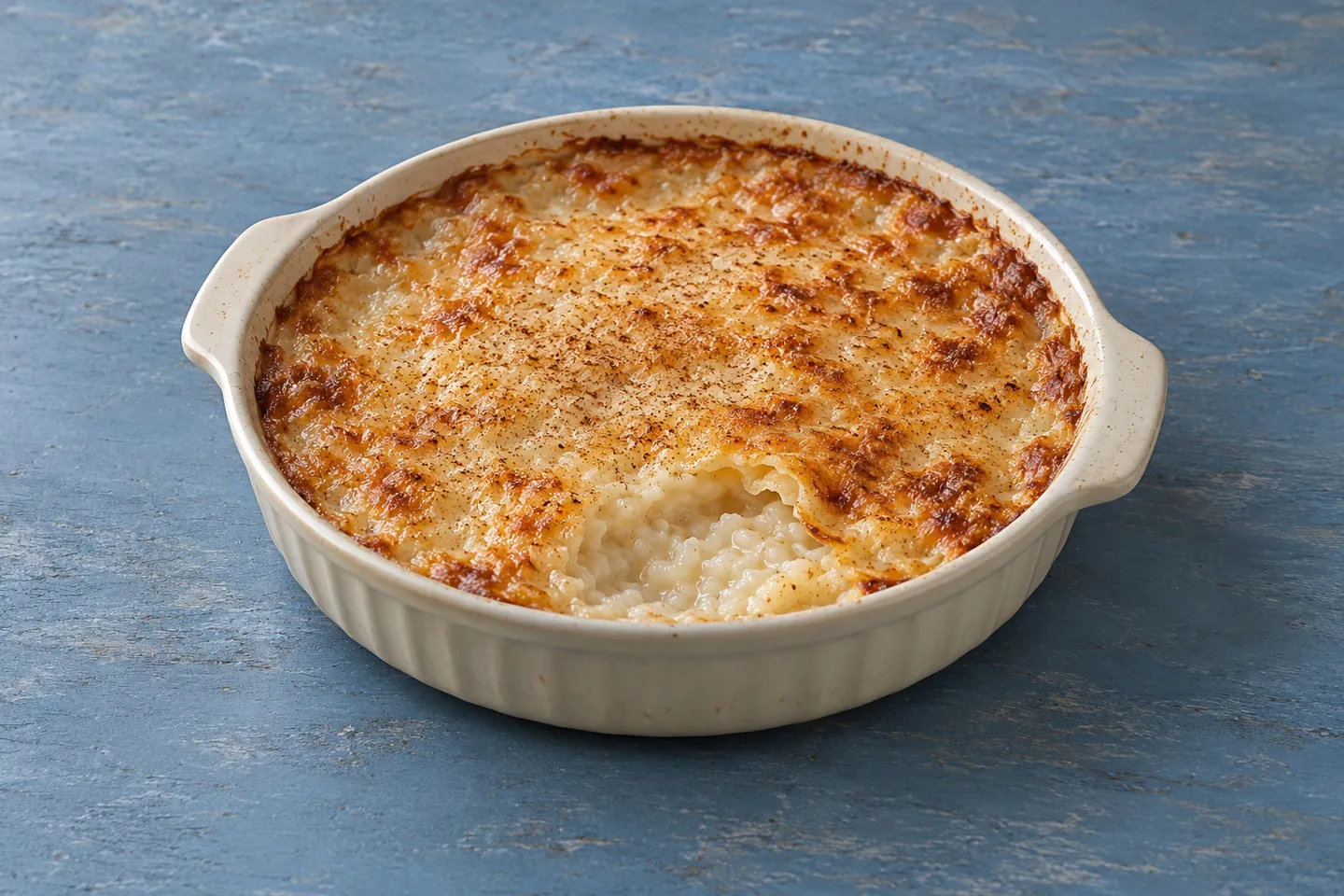
Plain Baked Rice Pudding, Adapted from Beeton (1861)
Short-grain white rice baked slowly in milk with brown sugar, butter and nutmeg, adapted from Beeton's plain and economical pudding.
- Original yieldYield
- 6 small dessert portions6 small dessert portions
- PrepPrep time
- CookCook time
- TotalTotal time
Estimated: 10 minutes preparation, 90 to 150 minutes baking and 10 minutes standing. Preheat during preparation. Rice tenderness, rather than the clock alone, determines the bake.
Published
Original recipe: 6 small dessert portions
The story behind the recipe
The nutmeg-speckled top is left undisturbed while the rice cooks underneath. Beeton's plain baked pudding starts with raw grains and milk in the same dish, for a soft, spoonable dessert rather than an egg-set custard.
Buy rice you can still recognize as rice
Use uncooked short-grain white pudding rice. The grains should be intact when they go into the dish; rice flour would turn this into a different preparation. Here, white describes the milled grain, not a flour. Brown rice, instant rice and sweet glutinous rice aren't the ingredients specified for this version.
Read more about this recipe
The economical pudding on page 676
Beeton labels recipe 1343 plain and economical, and describes it as a pudding for children. Her serving line counts five or six children rather than an unspecified crowd. A teacupful of rice is expected to stretch through a quart of milk, with two spoonfuls of moist sugar and a little fat.
The preceding pudding has eggs, currants, brandy and a pastry border. This simpler one relies on the rice swelling during a long bake. Beeton places the two side by side, so the contrast between them is right there on the page.
Butter was already one of the choices
The original offers butter or finely chopped suet. Butter is the branch followed here, dotted over the milk in small pieces.
Those small pieces can spread over the surface as they melt. Nutmeg is grated over the top rather than hidden inside a separate sauce. With such a short ingredient list, the milk, rice and spice account for most of what you'll taste; the brown sugar adds sweetness without turning the pudding into a caramel dessert.
Beeton's moist sugar isn't a sufficiently precise specification for a modern brand or packing method. Light brown sugar is the named choice in this recipe. Use the written weight rather than trying to reconstruct an old spoonful by sight.
The center matters more than the skin
A browned surface can look finished before the grains beneath it are tender. Beeton explicitly warns that the uncooked rice needs time to swell and become thoroughly done.
The useful check is a grain taken from the center. It should squash readily, with no hard core. The pudding should still be moist enough to spoon. A shallow dish exposes more surface than a deep bowl, which is why the pan and filling depth stay with the quantities below.
This isn't a risotto that needs repeated stirring. Leaving the top alone lets a skin form while the rice cooks below it. If the surface darkens before the center is ready, a loose covering protects it while the grains finish cooking.
Six small spooned portions
Serve the pudding warm in six small portions after a short stand, dividing the top along with the rice underneath.
The comparison with her ground-rice pudding is especially clear at serving time. This one keeps visible grains. The other starts with a milled ingredient and includes eggs.
Make it your wayOriginal: 6 servings · Makes 6 small dessert portions
Original recipe: 6 small dessert portions
Ingredients
For 6 small dessert portions. Quantities are shown as written.
Source measurement convention: Metric. Explicit unit definitions take precedence; unconfirmed measures must be checked before conversion.
Original quantities for 6 small dessert portions.
- Uncooked short-grain white pudding rice100 g
- Whole milk1.1 l
- Light brown sugar30 g
- Unsalted butter, cut into small pieces14 g
- Freshly grated nutmeg1/2 tsp
- Unsalted butter, for greasing5 g
- Whole milk, optional, for adjusting during baking100 ml
Measurement notes
- freshly grated nutmeg: US tsp: 1 = 4.9289 ml (rounded).
Measurement notes
Original ingredients
- 100 g uncooked short-grain white pudding rice
- 1.1 liters whole milk
- 30 g light brown sugar
- 14 g unsalted butter, cut into small pieces
- 1/2 US tsp freshly grated nutmegUS tsp: 1 = 4.9289 ml (rounded).
- 5 g unsalted butter, for greasing
- 100 ml whole milk, optional, for adjusting during baking
Equipment
 2-liter round shallow ceramic baking dish (about 23 cm internal diameter and 5 cm deep)
 Fine-mesh strainer
Instructions
Heat the oven and grease the dish
Heat the oven to 325°F (160°C), conventional heat. Grease a 2-liter round, shallow ceramic baking dish, about 23 cm internal diameter and 5 cm deep, with the 5 g unsalted butter.
Rinse the rice and mix with milk
Rinse the short-grain white pudding rice briefly in a fine-mesh strainer and drain well. Put it in the dish with the light brown sugar and whole milk. Stir to dissolve the sugar and spread the rice evenly over the bottom; the initial filling should be about 3 cm deep.
Add butter and nutmeg
Dot the surface with the 14 g unsalted butter and sprinkle over the nutmeg. Carefully place the dish on the middle shelf and bake uncovered without stirring.
Bake until the rice is tender
Begin checking after 90 minutes. Take a few grains from the center with a clean spoon: they should squash easily and have no hard core. Continue baking as needed, checking every 15 minutes, for up to about 2 1/2 hours in total. The top should be browned and the pudding beneath it moist and spoonable. If the top is getting too dark before the rice is tender, cover loosely with foil. If the rice is still firm but the milk has nearly dried up, heat the optional extra milk until steaming and add it around the edge in 50 ml portions, using no more than 100 ml at the original yield, then continue baking. Don't serve rice that still has a hard center.
Rest and serve
Let stand for 10 minutes, then spoon into small bowls, giving each portion some of the top. Follow the storage note promptly if saving any pudding.
Estimated calories 220 kcal
Nutrition portion: 1/6 of recipe · Original yield: 6 small dessert portions
Source & assumptions
Ingredient-based estimate using CoFID 2021, USDA household-measure references, the Norwegian Food Composition Table. About 220 kcal per nutrition portion (1/6 of the recipe). Includes all 19 g butter. Excludes the optional extra 100 ml milk, which can add about 11 kcal per portion. Actual ingredients and preparation affect the estimate.
Recipe notes
When adjusting quantities
Keep the same dish material and approximately 3 cm initial filling depth. For a larger batch, use additional dishes rather than a deeper pudding. Times and temperatures do not scale.
Original recipe notes
These notes describe the original recipe. Quantities mentioned here do not change when you adjust servings.
Adapted from Beeton's Baked Rice Pudding II, no. 1343, p. 676, in the 1861 book. The source gives a teacupful of unspecified rice, a quart of milk and two tablespoonfuls of moist sugar. This version chooses 100 g short-grain white rice, 1.1 liters milk and 30 g light brown sugar as a modern baseline, rather than claiming exact teacup or spoon conversions. The 14 g butter is the rounded equivalent of her half ounce; extra greasing butter, pan dimensions, oven setting and doneness checks are modern guidance. The bake may take longer than her stated 1 1/2 to 2 hours.
The recipe uses milk and butter. Its rice quantity is a dry weight; don't substitute cooked rice or rice flour. The optional 100 ml milk is a reserve for the tenderness check, in addition to the main 1.1 liters; use only as much as needed. When changing the batch size, keep the same filling depth and adjust this reserve with the ingredients.
For leftovers, follow the NHS guidance on cooling and storing cooked rice: refrigerate within 1 hour and eat within 24 hours. Divide into shallow portions for cooling rather than leaving the full baking dish on the counter.
Storage
If saving leftovers, divide into shallow containers, cool quickly and refrigerate within 1 hour of cooking. Eat within 24 hours. Reheat only once, until steaming hot throughout.
Read the scaling guide. Times, temperatures and equipment need their own consideration. Open the recipe tool to review and correct individual amounts.
Sources and attribution
Isabella Beeton, The Book of Household Management (London: S. O. Beeton, 1861), Baked Rice Pudding II, no. 1343, p. 676.
Recipe details
- Recipe tradition
- Vintage
- Cuisine
- British
- Cooking method
- Oven
- Browse category
- Baking & Desserts