
- Vintage recipes
- Historical ingredients
- Baking & desserts
Ground Rice, Rice Flour or Whole Rice? Reading the Ingredient Before You Shop
Use Victorian rice puddings and current product labels to distinguish whole grains, ground rice and rice flours before choosing an ingredient or substitution.
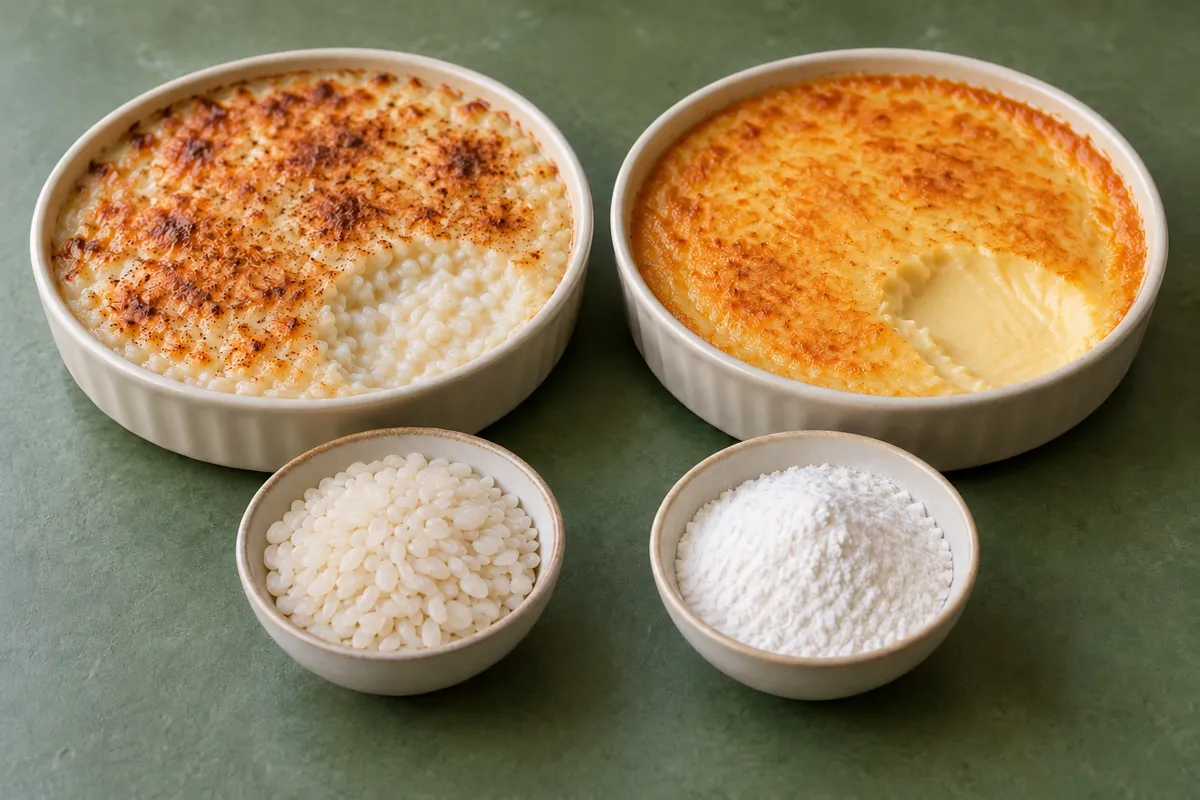
One rice pudding starts with a smooth mixture of ground rice and cold milk. A few pages earlier, another sends washed rice straight into a dish with milk and sugar, leaving the grains to swell in the oven. The shared name conceals two quite different desserts.
Choose the grain version if you want tender rice beneath a baked milk skin. Choose the ground-rice preparation if you want an egg pudding thickened with a milled ingredient. Then check the bag: an old recipe’s ground rice doesn’t tell you whether a modern flour is plain white rice, a white-and-brown blend or sweet glutinous rice.
Not necessarily. Ground rice describes a milled ingredient, but the name alone doesn’t establish the rice type or how finely it was ground. Check the recipe and package: plain white rice flour, sweet or glutinous rice flour, and whole rice grains aren’t automatic substitutes for one another.
Follow what happens to the rice
Isabella Beeton’s 1861 Book of Household Management gives a useful comparison. Recipe 1343, a plain and economical rice pudding, uses rice measured by the teacup. The cook washes it, combines it with milk and sugar in a pie dish, adds butter or finely minced suet, and bakes it slowly enough for the uncooked grains to swell.
The old measurements guide explains why the teacup needs its own source definition before you convert it.
Recipe 1353, Baked or Boiled Ground Rice Pudding, takes another route. Some cold milk is mixed with the ground rice to make a smooth batter. Hot flavored milk is strained into it, then the mixture is stirred over the fire until thick. Eggs enter later, after cooling.
The plain pudding lists no eggs; the ground-rice preparation uses four.
| Reading clue | Plain rice pudding, no. 1343 | Ground-rice pudding, no. 1353 |
|---|---|---|
| Ingredient named | Rice | Ground rice |
| First preparation | Wash the rice | Mix with cold milk until smooth |
| Where it first cooks | In the milk-filled baking dish | Stirred with milk over the fire |
| Eggs listed? | None | Four |
| What sets the preparation apart | Uncooked grains swell during baking | Milled rice thickens the milk before eggs and the final cooking stage |
One pudding, two quantities of ground rice
There is another easily missed distinction inside recipe 1353. Its ingredient list gives six tablespoonfuls of ground rice with two pints of milk. For the baked version, Beeton tells the cook to use half that ground-rice quantity while keeping the other ingredients the same.
That produces three source tablespoonfuls for baking, compared with six for boiling. The milk and eggs don’t halve with it. The adjustment comes after the boiled preparation’s instructions, so copying the ingredient list alone would miss it.
The modern baked adaptation uses 30 g plain white rice flour, four large eggs and 1.1 liters of milk. The flour weight and milk volume are chosen modern amounts, rather than exact reconstructions of Beeton’s vessels. Her teacup isn’t assigned a capacity here. Our cups-and-grams guide explains why ingredient form belongs beside a conversion.

The bag marked rice flour needs another look
Read the ingredient list as well as the product name. Rice flour can be made from white rice or from a blend of white and brown rice. Check which rice is listed and whether the package describes the grind.
Sweet or glutinous rice flour is made from sticky rice. Here, sweet identifies the rice type rather than added sugar. Treat it as a different ingredient from the plain white rice flour specified in our baked pudding.
Beeton doesn’t specify an exact grind or rice variety here. Choose the product named by the modern recipe you’re following rather than assuming any of these bags is an equal substitute.
| Wording you may see | What to establish before choosing it |
|---|---|
| Ground rice in an old recipe | Whether the method treats it as a milled ingredient; any grinding or sifting directions elsewhere in the book |
| White rice flour | The actual rice ingredient and any stated fineness or preparation |
| Rice flour made from white and brown rice | Whether the modern recipe was developed with that blend |
| Sweet or glutinous rice flour | Whether sticky rice flour is specifically intended, rather than ordinary white rice flour |
| Whole rice or pudding rice | The grain type and cooking directions, rather than assuming it replaces a milled ingredient |
A product photo helps you find the bag; its ingredient list and manufacturer’s description help you choose it. Look for the rice type, whether it’s a blend, and any description of the grind. Whole rice in this comparison means an intact grain, not necessarily brown wholegrain rice. The grain recipe here specifically uses white pudding rice.
Two puddings to choose between
Plain baked rice pudding: grains and a browned top
Beeton calls recipe 1343 plain and economical, and gives its yield as five or six children’s portions. The neighboring pudding is richer, with eggs, currants, brandy and a pastry border. The plain version has a shorter list: rice, milk, moist sugar, butter or suet, and nutmeg.
Our Plain Baked Rice Pudding uses 100 g short-grain white pudding rice, 1.1 liters of whole milk and 30 g light brown sugar, following the source’s butter option. It goes into a shallow ceramic dish. The rice isn’t precooked, and the modern method checks the grains in the center before declaring the pudding done.
Choose this one for visible rice grains and a spoonful of milk pudding under the skin. Allow a long bake. Browning on top doesn’t tell you whether the rice below has lost its hard center.
Baked ground-rice pudding: lemon-scented milk and eggs
The second adaptation follows the baked branch of recipe 1353. Plain white rice flour is mixed with cold milk before hot lemon-scented milk is added. The mixture cooks briefly on the stove, cools, and then receives the sugar and eggs before baking.
Lemon peel is one of Beeton’s flavoring choices; the source also offers nutmeg, bitter almonds or bay leaf. These are alternatives, rather than a shopping list to combine. The lemon version uses peel for aroma, without adding juice.
Choose Baked Ground-Rice Pudding with White Rice Flour for the milled-rice and egg preparation. Its center needs to set as an egg dish; the written recipe includes a thermometer check. It asks for more preparation before the oven than the grain pudding, even though its final bake is shorter.
A smooth result doesn’t prove the rice began as flour
Beeton offers an especially good twist just below the ground-rice entry: Iced Rice Pudding, recipe 1354. It starts with rice simmered in milk until soft enough to break into a smooth mass. The cook then beats it smooth, adds egg yolks and flavoring, and puts the rice custard into a freezing pot.
Iced here means a frozen preparation, not merely a pudding left to cool. The freezing pot is the clue. Simmering and beating have made the grains smooth before freezing; a smooth-looking rice dessert needn’t begin with flour.
The historical yolk-and-freezing sequence isn’t a modern cooking method to copy without an appropriate egg-safety review. Recipe 1354 is context here, rather than a third companion recipe.
Choose the recipe, then choose the product
For these two puddings, the shopping choice is specific: uncooked short-grain white pudding rice for the grain version, plain finely milled white rice flour for the egg pudding. A sweet rice flour, brown-and-white blend, coarse ground-rice product or cornstarch isn’t an automatic substitute in the second formula.
Keep the pan instructions with that choice. More ingredients may call for a second dish rather than a deeper pudding, and the oven time doesn’t multiply with the servings. Check rice tenderness in the first recipe and the set, safely cooked center in the second.
Sources
Isabella Beeton, The Book of Household Management, 1861, Baked Rice Pudding I, no. 1342, printed pp. 675–676; plain and economical version II, no. 1343, p. 676; Baked or Boiled Ground Rice Pudding, no. 1353, and Iced Rice Pudding, no. 1354, p. 681.