
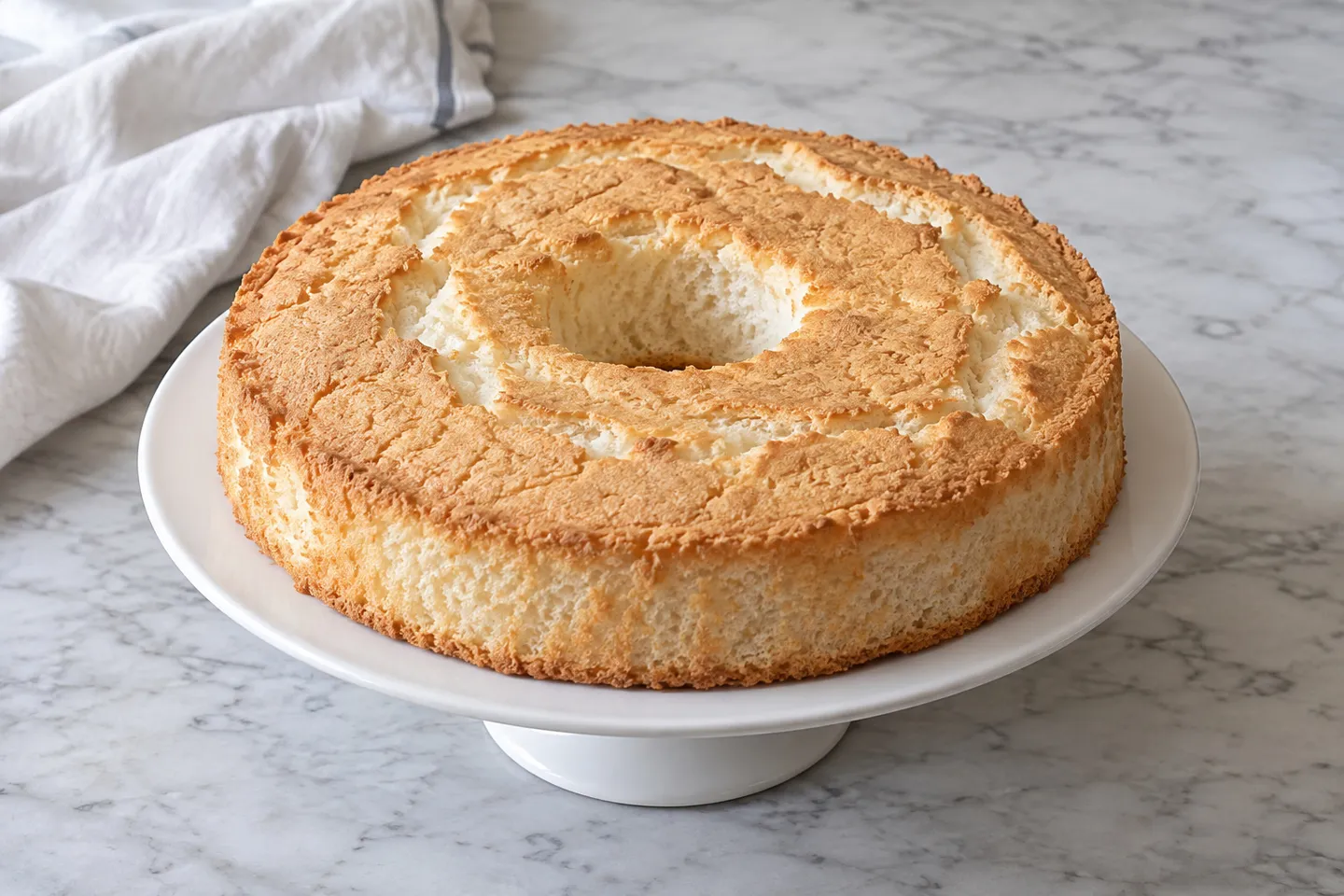
Angel Food Cake (1931)
A fat-free cake built on a cup of egg whites beaten stiff with cream of tartar, folded with sifted cake flour and sugar, baked in a slow oven and cooled upside down.
- Original yieldYield
- 1 tube cake (10-inch)1 tube cake (10-inch)
- PrepPrep time
- CookCook time
- TotalTotal time
Prep includes 30 minutes for the egg whites to stand. Total adds baking (about 35 to 45 minutes; judge by the doneness cues) and about 1 1/2 hours of cooling upside down in the pan.
Published
Original recipe: 1 tube cake (10-inch)
The story behind the recipe
Eight egg whites, beaten until they stand in stiff peaks, are the whole frame of this cake, since there is no butter, lard or oil anywhere in it. That white foam lifts the batter and then has to carry flour and sugar without falling. Angel food is the strictest of the fat-free cakes in the government's 1931 Home Baking, the one made with whites alone.
What the whites and the acid do
Charlotte Chatfield gives the eggs two jobs in these cakes: they supply the liquid, and they are the means of adding air for leavening. The cream of tartar has its own job. The acid, she writes, "affects the egg in such a way as to make the cake more tender," and every modern recipe we compared still includes it.
Read more about this recipe
Three cakes told apart by their eggs
Chatfield sets angel food in a small table beside sponge cake and sunshine cake, and the flour is the same for all three, a single cup. The defining distinction is the egg mixture. Sponge cake takes four or five whole eggs, sunshine cake six whites and three yolks, and angel food a cup of whites alone, which the table reckons at eight fairly large ones.
Sugar is the one open line for angel food, anywhere from one to one and a half cups. This version takes one and a quarter, the middle of that range and in step with the ratio of sugar to whites in current recipes. The bulletin also asks for fine, soft-wheat flour, which today means cake flour.
Why stirring is off the table
Because the foam is the leavening, anything that knocks air out of it costs the cake height. Only the folding motion should be used, Chatfield warns, "for stirring tends to release the air depended on for leavening." Even the flavoring waits until the mixture is partly blended, so the batter is never worked a second time just to carry the vanilla. For beating, she preferred a dover beater to a wire whisk because it saved time and energy, a job an electric mixer does now.
Fewer eggs, and eight spare yolks
The bulletin offers a thriftier route. It allows one or two of the eggs in the table to be replaced with two tablespoons of milk or water and half a teaspoon of baking powder for each egg left out, with the cake baked a little hotter, at about 340°F. Elsewhere it admits that cutting eggs makes a cheaper cake but a less desirable one. This version keeps every white.
It also has a use for the yolks left after separating the eggs. Chatfield notes that cooks can use whites or yolks in fancy white or yellow cakes, partly as an economy with eggs left over, counting two yolks roughly as one egg.
A slow oven and one whole batch
The oven figure is the bulletin's slow setting for sponge cakes, 325°F, with about an hour for a fairly large angel food. Its table quantities, though, were meant to make two medium-sized loaves. Baked as a single 10-inch tube cake, the whole batch is larger than either of those loaves and smaller than today's twelve-white cakes, which take 45 to 60 minutes at the same heat.
Modern wheat-flour recipes built on eight or nine whites in a 10-inch pan offer a useful comparison. Anna Olson's eight-white cake bakes at 325°F for 30 to 35 minutes. For our single tube cake, we use 35 to 45 minutes as a planning range and let the golden, springy top decide. Our guide to slow, moderate and hot ovens traces what the period oven terms meant in degrees.
Upside down for a reason
Chatfield wants a smooth, ungreased pan, and a tube pan because its center opening lets the mixture heat evenly. Her cooling rule follows from how fragile the cake is: fresh from the oven it is too soft and hot to handle, so the pan goes upside down until the cake firms, and the cake comes out before it reaches room temperature and starts to sweat.
Read the original wording
Historical reference only. Follow the ingredients and cooking steps below when cooking.
Historical ingredients
- Flour (soft wheat): 1 cup.
- Eggs: 1 cup whites (8 fairly large).
- Sugar: 1 to 1½ cups.
- Salt: ½ teaspoon.
- Flavoring and acid: 1 teaspoon flavoring.
- Flavoring and acid: 1 teaspoon cream of tartar.
Historical method
Angel food is mixed in a slightly different way than plain sponge cake. The sugar, flour, and half the salt are sifted together several times. The egg whites are beaten with the other half of the salt until they are frothy; then the cream of tartar is added and they are beaten until stiff. The dry ingredients are then folded carefully into the beaten egg whites, and when the mixture is partly blended the flavoring is added. Only the folding motion should be used in mixing, for stirring tends to release the air depended on for leavening. A smooth tube pan is best for baking angel food, and a fairly large cake will require about an hour in an oven at a temperature of 325° F. It may be tested in the same way as any other cake.
Make it your wayOriginal: 12 servings · Makes 1 tube cake (10-inch)
Original recipe: 1 tube cake (10-inch)
Ingredients
For 1 tube cake (10-inch). Quantities are shown as written.
Source measurement convention: US customary. Explicit unit definitions take precedence; unconfirmed measures must be checked before conversion.
Original quantities for 1 tube cake (10-inch).
- Egg whites (about 8 large eggs)1 cup
- Sifted cake flour1 cup
- Granulated sugar1 1/4 cups
- Fine salt, divided1/2 tsp
- Cream of tartar1 tsp
- Vanilla extract1 tsp
Measurement notes
- egg whites (about 8 large eggs), sifted cake flour, granulated sugar: US cup: 1 = 236.5882 ml (rounded).
- fine salt, divided, cream of tartar, vanilla extract: US tsp: 1 = 4.9289 ml (rounded).
Measurement notes
Original ingredients
- 1 cup egg whites (about 8 large eggs)US cup: 1 = 236.5882 ml (rounded).
- 1 cup sifted cake flourUS cup: 1 = 236.5882 ml (rounded).
- 1 1/4 cups granulated sugarUS cup: 1 = 236.5882 ml (rounded).
- 1/2 teaspoon fine salt, dividedUS tsp: 1 = 4.9289 ml (rounded).
- 1 teaspoon cream of tartarUS tsp: 1 = 4.9289 ml (rounded).
- 1 teaspoon vanilla extractUS tsp: 1 = 4.9289 ml (rounded).
Equipment
 10-inch tube pan, smooth and ungreased, not nonstick
 Fine-mesh sifter
 Stand mixer or handheld electric mixer
 Wire cooling rack
Instructions
Heat the oven and ready the pan
Set an oven rack in the lower third of the oven and heat the oven to 325°F (165°C); an oven thermometer confirms the setting. Have ready a clean, dry, ungreased 10-inch tube pan with a smooth surface.
Separate and measure the egg whites
Separate the eggs while they are cold, letting no trace of yolk fall into the whites, and measure 1 cup of egg whites into a large, clean bowl. Let them stand at room temperature for about 30 minutes, and keep them out of the refrigerator no longer than 2 hours in all.
Sift the flour and sugar together
Sift the cake flour once, spoon it lightly into a cup without packing, and level it with a straight edge. Put it in a bowl with the granulated sugar and 1/4 teaspoon of the fine salt, then sift the mixture together four times.
Beat the whites to stiff peaks
Add the remaining 1/4 teaspoon salt to the egg whites and beat on medium speed until frothy. Add the cream of tartar and beat on medium-high speed until the whites are glossy and stand in stiff, upright peaks, stopping before they look dry or grainy.
Fold in the first dry additions
Sift about a quarter of the flour mixture over the whites and fold it in gently with a large spatula, cutting down through the center and lifting up along the side of the bowl while turning the bowl. Fold in the second quarter the same way.
Add vanilla and finish folding
Sprinkle the vanilla extract over the partly blended batter, then sift and fold in the remaining flour mixture in two more additions, using only a folding motion and stopping as soon as no dry pockets remain.
Fill the pan
Spoon the batter into the pan right away, spread it evenly to the edge and around the tube, and put it straight into the heated oven.
Bake until golden and springy
Bake for 35 to 45 minutes, keeping the oven door closed for the first 30 minutes. The cake is done when the top is golden brown, the cracks look dry, the top springs back when pressed lightly, and a toothpick inserted halfway between the tube and the edge comes out clean.
Cool the cake upside down
Turn the pan upside down at once, resting it on its feet or with the tube over the neck of a sturdy bottle, and leave it until the cake is firm and the pan is only slightly warm, about 1 1/2 hours.
Unmold and slice
Run a thin knife around the outer edge and the tube, lift or turn the cake out of the pan, and let it finish cooling on a wire cooling rack before slicing it with a serrated knife and a gentle sawing motion.
Estimated calories 120 kcal
Nutrition portion: 1/12 of recipe · Original yield: 1 tube cake (10-inch)
Source & assumptions
Ingredient-based estimate using CoFID 2021, USDA SR Legacy (April 2018). Approximately 120 kcal per nutrition portion. Standard nutrition portion: one-twelfth of the cake. Uses reference cup weights for sifted cake flour and egg whites; the original yield remains one 10-inch tube cake. Ingredients, brands and preparation affect values.
Recipe notes
When adjusting quantities
The amounts fill one 10-inch tube pan. A larger or smaller batch needs a tube pan of matching capacity, and the baking time must be judged by the doneness cues; time and temperature do not scale automatically.
Original recipe notes
These notes describe the original recipe. Quantities mentioned here do not change when you adjust servings.
The bulletin allows 1 to 1 1/2 cups of sugar with 1 cup of egg whites. This version uses 1 1/4 cups; the full 1 1/2 cups gives a sweeter cake.
The bulletin divides this batch between two medium-sized cakes; this version bakes it as one. In a 10-inch tube pan, eight whites make a lower cake than modern recipes built on twelve. A smaller tube pan of about 12 cups gives a taller cake that may need a few minutes longer, so rely on the doneness cues rather than the clock.
Read the scaling guide. Times, temperatures and equipment need their own consideration. Open the recipe tool to review and correct individual amounts.
Sources and attribution
Charlotte Chatfield, Home Baking, USDA Farmers' Bulletin No. 1450 (revised December 1931), Table 4 and angel food directions, p. 14
Charlotte Chatfield, Home Baking, USDA Farmers' Bulletin No. 1450, revised December 1931: Table 4 and angel food directions, page 14; sponge cakes and egg substitutions, page 13; cooling, page 10. This version takes 1¼ cups of sugar, cake flour and vanilla, and bakes the whole batch as one 10-inch tube cake.
Recipe details
- Recipe tradition
- Vintage
- Cuisine
- American
- Source decade
- 1930s
- Browse category
- Baking & Desserts
- More details
- cake