
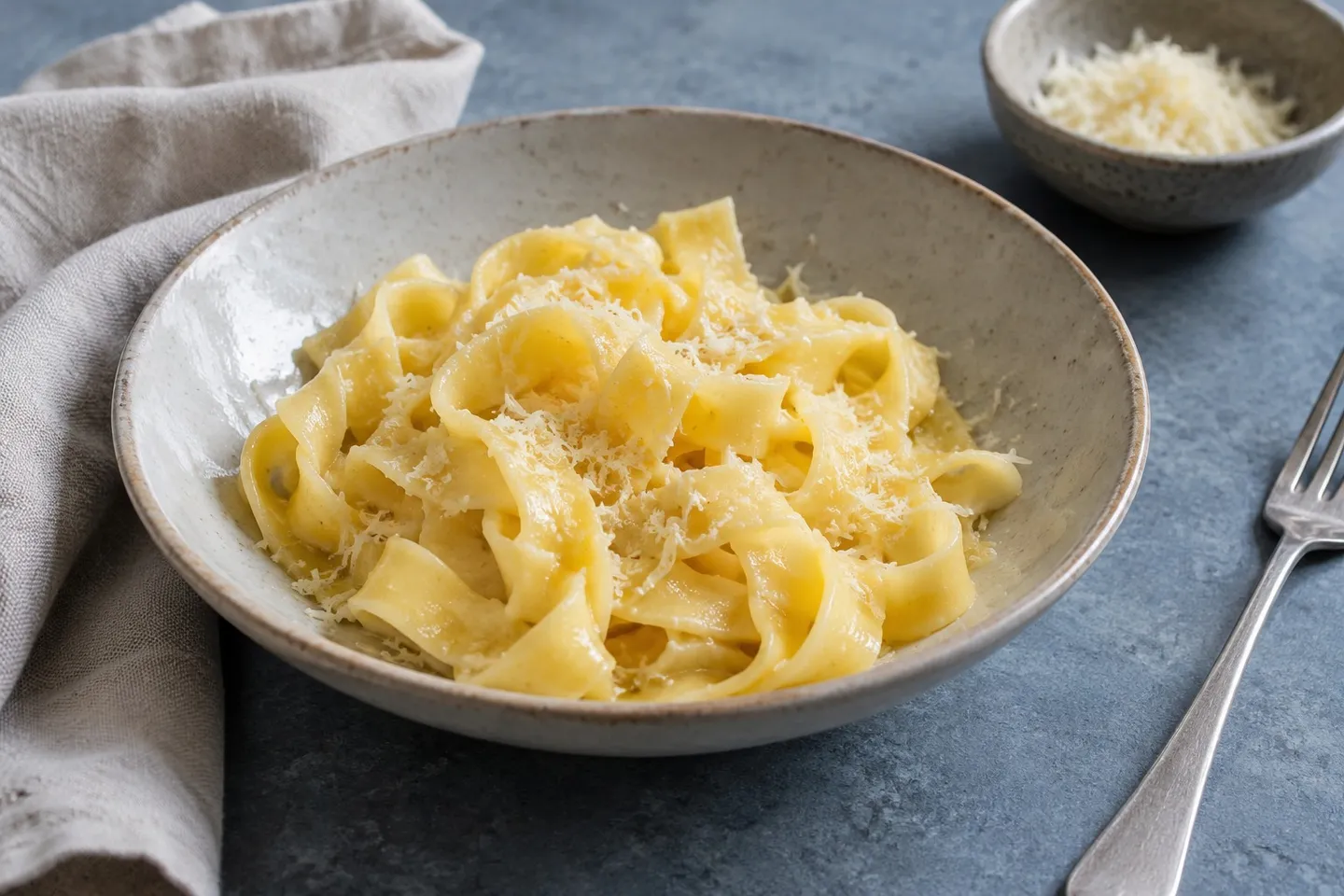
Macrows (Medieval Pasta with Butter and Cheese)
Fresh pasta ribbons layered with melted butter and grated cheddar, adapted from the medieval English recipe for macrows.
- Original yieldYield
- 4 small main-dish servings4 small main-dish servings
- PrepPrep time
- CookCook time
- TotalTotal time
Published Updated
Original recipe: 4 small main-dish servings
The story behind the recipe
Grated cheese falls between warm pasta ribbons, and melted butter follows it into the folds. Medieval macrows has much the same immediate appeal: a thin sheet of dough, boiling water, cheese, and butter. The short passage leaves the cook to supply details that a modern recipe would put on the page.
Below and above
Layering is the instruction to notice. The source puts cheese and butter below and above the pasta, comparing the arrangement with another preparation, losyns. The reference assumes a cook who already knows it. It doesn't ask for a separate cheese sauce.
Read more about this recipe
What the cooks leave unsaid
Macrows belongs to The Forme of Cury, associated with Richard II's master cooks and compiled around 1390. Samuel Pegge printed the edition used here in 1780. Its cooks say to grate the cheese, boil the cut dough well, arrange the dish, and serve. They don't name a cheese variety, put eggs into the dough, or give ingredient amounts.
That brevity leaves enough certainty to picture the dish and enough room for different kitchens to make it differently. Our version chooses ready-made fresh egg ribbons and mature cheddar. Reserved cooking water and a gentle final toss help spread the butter and cheese; they are modern additions to the simple layering.
Pegge questioned the name. The resemblance to macaroni and cheese is appealing, but resemblance alone doesn't establish direct descent. The more secure connection is the one on the plate: warm pasta with cheese and butter reaching between its pieces.
Fresh pasta is the starting point
Fresh and dried pasta of the same starting weight won't give identical finished amounts. The fresh ribbons specified here already contain more water before cooking. A dried substitute needs a separately considered quantity because its cooked yield will differ.
Finely grated cheddar spreads more easily between ribbons than large cheese chunks. Even so, some flecks can remain visible. This isn't meant to become the smooth sauce of a different pasta dish, and there is no oven stage to brown a crust on top.
The reserved water gives you a way to loosen the coating if it gathers too tightly as the pasta cools. Add it gently as directed, keeping the ribbons intact. A deep bowl of sauce isn't the objective; butter and cheese should cling among the folds.
Assemble near serving
The Forme of Cury article puts macrows beside Tart de Bry and the sharp roots of compost. Modest pasta portions suit a meal with other dishes or vegetables alongside.
If there's a tart in the oven, wait to assemble the pasta until close to eating. Warm ribbons can carry the cheese and butter through their layers; a long wait while another dish finishes gives that coating time to tighten. Serve the macrows loosely piled, with the grated cheese still visible between the folds.
Make it your wayOriginal: 4 servings · Makes 4 small main-dish servings
Original recipe: 4 small main-dish servings
Ingredients
For 4 small main-dish servings. Quantities are shown as written.
Source measurement convention: Metric. Explicit unit definitions take precedence; unconfirmed measures must be checked before conversion.
Original quantities for 4 small main-dish servings.
- Ready-made fresh egg pasta ribbons250 g
- Unsalted butter100 g
- Mature cheddar, finely grated150 g
- Hot pasta cooking water, reserved from the pot120 ml
- Fine salt4 g
Measurement notes
Measurement notes
Original ingredients
- 250 g ready-made fresh egg pasta ribbons
- 100 g unsalted butter
- 150 g mature cheddar, finely grated
- 120 ml hot pasta cooking water, reserved from the pot
- 4 g fine salt
Equipment
 4-liter pasta pot
 Colander
 Box grater
Instructions
Heat the water, melt butter and warm the dish
Bring 2 liters of water to a boil in a 4-liter pasta pot. Add the fine salt. While the water heats, melt the unsalted butter gently in a small pan or microwave and warm a serving dish with hot water, then dry it.
Boil the fresh pasta
Boil the fresh egg pasta ribbons for the package time, usually 3 to 4 minutes, until tender. This recipe starts with prepared fresh pasta; making dough is a separate task.
Reserve cooking water and drain
Before draining, measure out 120 ml of the hot pasta cooking water. Drain the pasta without rinsing.
Layer the pasta, butter and cheese
Put a third of the pasta in the warm dish. Add a third each of the melted butter and grated cheddar. Repeat twice with the remaining pasta, butter, and cheese.
Toss gently and serve
Pour over the reserved cooking water and gently toss just until the butter and cheese are distributed. Serve immediately. Some grated cheese may remain visible; this is not a smooth cheese-sauce recipe.
Estimated calories 520 kcal
Nutrition portion: 1/4 of recipe · Original yield: 4 small main-dish servings
Source & assumptions
Ingredient-based estimate using CoFID 2021. Approximately 520 kcal per nutrition portion. Uses fresh egg pasta as sold and includes all butter and cheese. Full pasta-input energy is counted, so draining losses can lower the estimate; reserved pasta-water solids are already included. Ingredients, brands and preparation affect values.
Recipe notes
Original recipe notes
These notes describe the original recipe. Quantities mentioned here do not change when you adjust servings.
Pasta choice: Use 250 g fresh pasta, not 250 g dried pasta. Dried pasta absorbs substantially more water, so a dried-pasta version needs its own quantities.
Planning: The 25-minute allowance covers ready-made pasta, heating the water, grating cheese, and assembly. Water-heating time varies with your stove.
Storage: Refrigerate leftovers promptly in a shallow covered container, within 2 hours of cooking, or 1 hour above 90°F (32°C). Keep at 40°F (4°C) or below and use within 3 days. Reheat with a little water until the center reaches 165°F (74°C); the cheese may separate.
Read the scaling guide. Times, temperatures and equipment need their own consideration. Open the recipe tool to review and correct individual amounts.
Sources and attribution
Macrows, recipe 92, p. 46 in Pegge's 1780 The Forme of Cury, compiled around 1390.
Curious about the drinks of the period? Our sister site, Forgotten Drink, explores medieval beer, water and the evidence behind them.
Recipe details
- Recipe tradition
- Vintage
- Cuisine
- British
- Historical period
- Medieval
- Main ingredient
- Pasta
- Browse category
- Main Dishes