
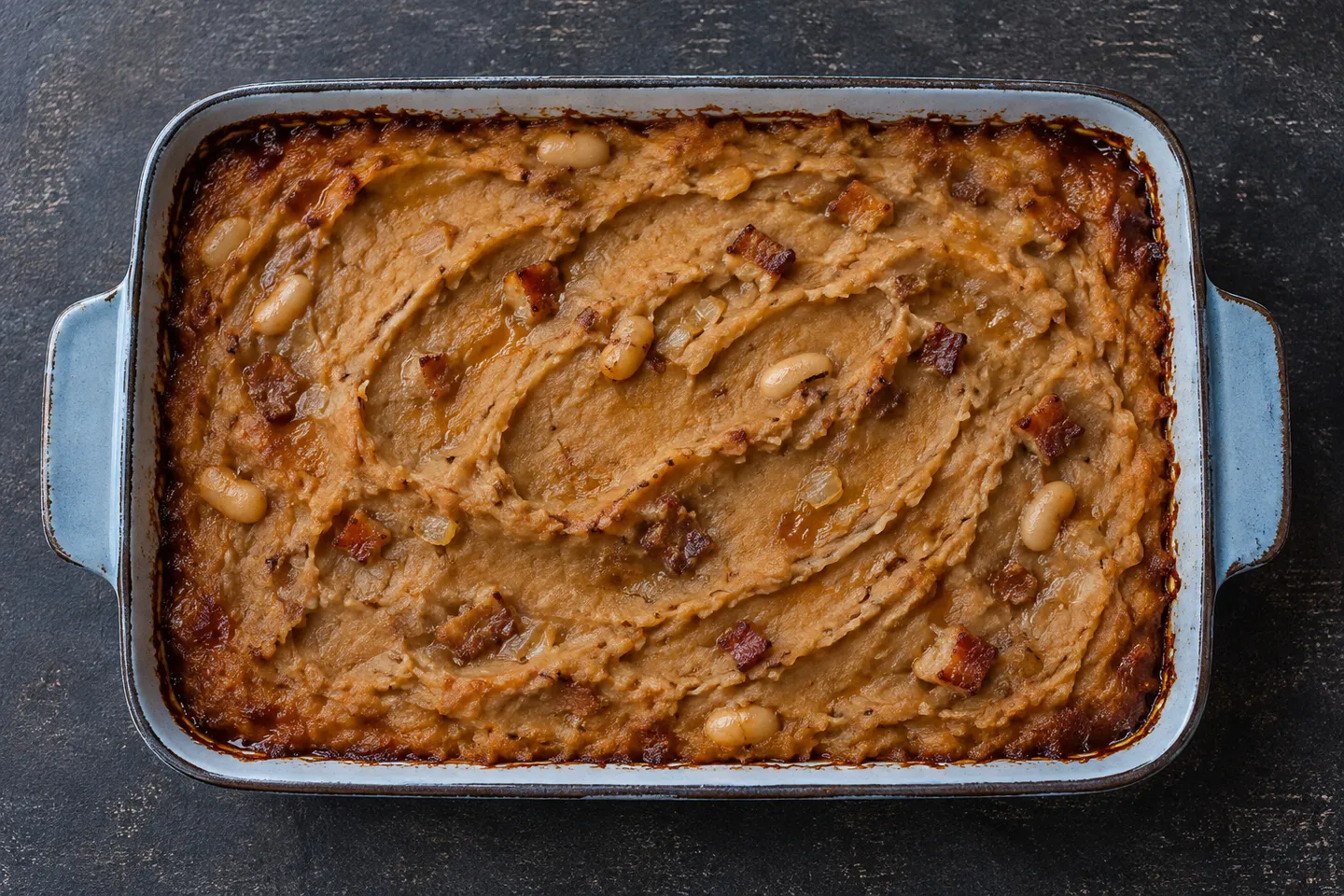
Baked Mashed Navy Beans (1933)
A 1933-inspired bake of mashed navy beans, molasses, salt pork and onions, with a 20-to-25-minute oven finish.
- Original yieldYield
- 6 servings6 servings
- PrepPrep time
- CookCook time
- TotalTotal time
Published Updated
Original recipe: 6 servings
The story behind the recipe
The saving in this 1933 bean dish included the oven bill. Cooked navy beans are mashed with molasses, onions and crisp salt pork, then spread in a shallow dish for a short browning stage. The result has the sweet, savory flavors of baked beans with browned patches over a soft middle. Start with canned beans or beans cooked ahead; the recipe's fifty-minute estimate begins after that cooking is done.
Saving on beans and fuel
On March 27, 1933, the USDA Radio Service reported navy beans selling for as little as two or three cents a pound after an unusually large Michigan crop. Its broadcast, Beans for Economy Meals, also counted the cost of cooking them. Mashing already-cooked beans and spreading them in a shallow dish meant a short oven finish instead of a long bake.
Read more about this recipe
Where canned beans fit
The script also gave canned beans a place in an economical kitchen. Cooking already done before the can arrived was work the household did not have to repeat at its own stove. That is a useful detail in a period recipe: choosing a can was one of the shortcuts discussed at the time.
The printed baked mashed recipe itself begins with dried beans, soaked and boiled before baking. Our version starts with a drained cooked weight. It also uses less salt pork and retains the source's four tablespoons of molasses on that changed bean basis. This is an adaptation with its own proportions; the notes identify the source quantities and the other changes.
Leave some texture in the mash
Leave a few beans whole while mashing the rest. The soft puree holds the mixture together, while those beans and the crisp pork pieces give each spoonful some variation. The source presses its beans through a colander; the potato masher gives this version a less uniform texture.
Cook the onions in the fat rendered from the salt pork. They soften into the mash along with the drippings, so the pork supplies both seasoning and cooking fat. Slab bacon is the listed alternative; smoked bacon adds a smoky flavor of its own.
Molasses adds sweetness through the beans. The reserved cooking liquid makes the mash spreadable, and the shallow dish leaves room for browning across the top. The light ridges made with the back of a spoon give the finished surface its uneven golden patches. Keep the same shallow layer when making more, using another dish if needed.
A sharp pickle beside the molasses
The radio script proposes a complete meal: creamed carrots, dill pickles, fried canned pineapple and hot corn muffins with honey or orange marmalade. The beans were one part of a menu with several flavors and textures, including a sharp accompaniment to their molasses sweetness.
You could borrow the whole menu or just the dill pickle. Its sharpness belongs beside the sweet molasses, and the pairing comes straight from the broadcast.
Make it your wayOriginal: 6 servings
Original recipe: 6 servings
Ingredients
For 6 servings. Quantities are shown as written.
Source measurement convention: Metric. Explicit unit definitions take precedence; unconfirmed measures must be checked before conversion.
Original quantities for 6 servings.
- Cooked navy beans (drained weight; with liquid reserved before rinsing)720 gOriginal recipe guidance: roughly 3 cans.
- Salt pork (or slab bacon, diced into small cubes)150 g
- Yellow onions (approx. 2 small, finely chopped)150 g
- Dark molasses60 mlAuthor measures: 4 metric tbsp (1 metric tbsp = 15 ml).
- Fine salt1 metric tsp
- Ground black pepper1/2 metric tsp
- Reserved bean cooking liquid (or water)120 ml
- Neutral cooking oil (or butter, for greasing)1 metric tsp
Measurement notes
- fine salt, ground black pepper, neutral cooking oil (or butter, for greasing): tsp: 1 = 5 ml.
Measurement notes
Original ingredients
- 720 g cooked navy beans (drained weight; roughly 3 cans, with liquid reserved before rinsing)
- 150 g salt pork (or slab bacon, diced into small cubes)
- 150 g yellow onions (approx. 2 small, finely chopped)
- 60 ml dark molasses (4 tbsp)
- 1 tsp fine salttsp: 1 = 5 ml.
- 1/2 tsp ground black peppertsp: 1 = 5 ml.
- 120 ml reserved bean cooking liquid (or water)
- 1 tsp neutral cooking oil (or butter, for greasing)tsp: 1 = 5 ml.
Equipment
 Potato masher or food mill
 Shallow baking dish (approx. 20x30 cm)
Instructions
Prepare the oven and cooked beans
Prepare the oven and dish
Preheat your oven to 200°C (400°F). Lightly coat a shallow baking dish with the neutral cooking oil (or butter).
Mash the cooked beans
In a large mixing bowl, mash the cooked navy beans with a potato masher until thick and mostly smooth, leaving some whole beans for texture.
Brown the pork and soften the onions
Render the salt pork
Place the diced salt pork into a cold skillet over medium heat. Fry slowly until the cubes are golden and crisp (6 to 8 minutes). Lift the pork bits out with a slotted spoon and set aside, reserving the rendered fat in the pan.
Cook the onions
Add the chopped yellow onions to the hot pork fat in the skillet. Cook over medium heat for 5 minutes until soft and golden brown.
Mix and bake in a shallow layer
Mix the bean puree
Fold the cooked onions, rendered pan drippings, crisp pork bits, dark molasses, fine salt, ground black pepper, and reserved bean cooking liquid into the mashed beans until well incorporated into a spreadable puree.
Fill the baking dish
Spread the bean mixture evenly into the prepared baking dish to an approximate depth of 2 cm. Use the back of a spoon to create light ridges across the top.
Bake until browned
Bake for 20 to 25 minutes until the top is bubbling around the edges and flecked with golden-brown spots.
Serve hot
Serve hot directly from the baking dish alongside cornbread or greens.
Estimated calories 240 kcal
Nutrition portion: 1/6 of recipe · Original yield: 6 servings
Source & assumptions
Ingredient-based estimate using CoFID 2021, identified manufacturer information. Approximately 240 kcal per nutrition portion. Uses the listed slab-bacon and water alternatives and includes the measured greasing oil. Ingredients, brands and preparation affect values.
Recipe notes
When adjusting quantities
Scale ingredients proportionally. Maintain a shallow layer (about 2 cm deep) in the baking dish so the surface browns properly.
Original recipe notes
These notes describe the original recipe. Quantities mentioned here do not change when you adjust servings.
Starting with dried beans: Cooking the beans is a separate preparation step. The 50-minute estimate starts with already-cooked beans.
If using canned beans, reserve the required bean liquid before draining and rinsing all the beans. Weigh the drained beans to reach the listed amount; can sizes and drained yields vary. Water can be used instead of the reserved liquid.
Adaptation: The source starts with 1½ pounds of dried beans and four tablespoons of molasses; here, 720 g of drained cooked beans receives the same molasses allowance. We use 150 g salt pork in place of its half-pound and specify seasoning and liquid. The source presses its beans through a colander; we mash them and leave some whole. Its method doesn't say when to add the listed molasses, so we fold it in with the onions and drippings.
The 50-minute total time accounts for 15 minutes of mashing and dicing, 11 to 13 minutes of pork and onion cooking, and 20 to 25 minutes of oven browning.
Read the scaling guide. Times, temperatures and equipment need their own consideration. Open the recipe tool to review and correct individual amounts.

Sources and attribution
Adapted from USDA Radio Service, Beans for Economy Meals (March 27, 1933), p. 2
USDA Radio Service, Beans for Economy Meals, March 27, 1933, pp. 1–2; Baked Mashed Beans on p. 2.