
- Vintage recipes
- Meatless cooking
- Historical ingredients
Nuts, Bread and Beans: How Old Cookbooks Built Meatless Meals
Compare nut loaves and lima-bean sausage to see how older cooks shaped savory meals, and why fat, stock and sauce choices still matter.
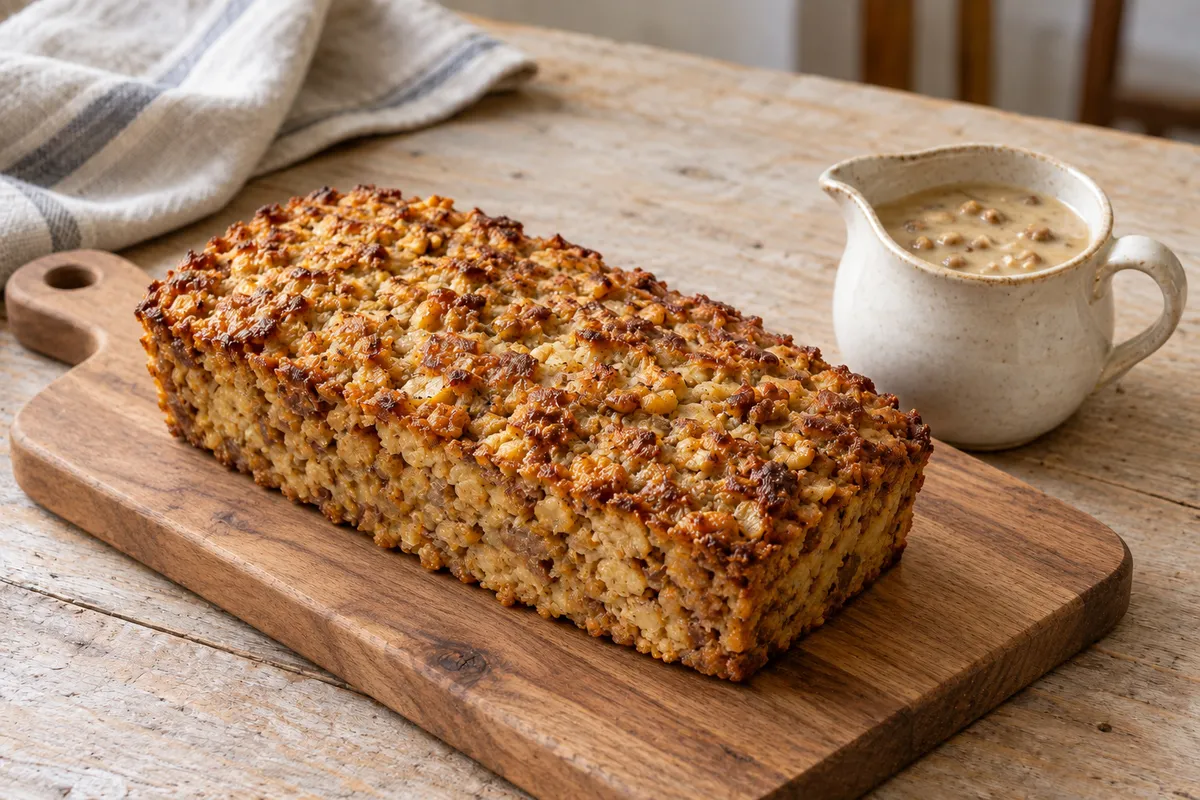
A loaf of bread crumbs and chopped nuts goes into the oven, then comes to the table with brown sauce. Mashed lima beans take a different route: shaped into finger-sized rolls, coated in flour and fried golden. Both offer something substantial to put at the center of a meal without a piece of meat.
Their ingredient lists reveal different ways of getting there. One combines soft bread, nuts and egg; the other starts with beans cooked very soft. Seasonings, fats and accompaniments then determine what kind of meal each becomes, including whether it stays meatless all the way to the plate.
These preparations appear in two early twentieth-century books: Maria Willett Howard’s revised 1908 Lowney’s Cook Book and the Pittsburgh Twentieth Century Club War Time Cook Book of 1918. Read together, they show why an old meatless dish deserves more attention than a modern dietary label attached to its name.
A slice from the oven or a roll from the skillet
Lowney’s first Nut Loaf, on page 163, combines two cups of soft bread crumbs with one cup of chopped nut meats, an egg, melted butter, hot water or stock, and seasonings. It bakes in a bread pan, covered for the first half of cooking, with three bastings of melted butter.
The Pittsburgh book’s Mock Sausage begins with one cup of lima beans soaked overnight. They are boiled until very soft, drained and mashed, then seasoned with salt, pepper, sage, thyme and sweet marjoram. The cook shapes small rolls, coats them in flour and fries them in corn or another vegetable oil.
| Decision | Lowney’s nut loaf, p. 163 | Pittsburgh mock sausage, p. 47 |
|---|---|---|
| Starting mixture | Soft bread crumbs and chopped nuts | Cooked, drained, mashed lima beans |
| Egg? | One listed | None listed |
| Added liquid? | Hot water or stock | No separate addition after draining |
| Shaping and cooking | Bread pan; baked and basted | Finger-sized rolls; flour-coated and fried |
| Main seasoning direction | Worcestershire sauce and onion juice | Sage, thyme and sweet marjoram |
| Accompaniment in the entry | Brown sauce with extra chopped nuts | No sauce specified |
The cup measures describe ingredients in different states. A cup of dried beans before soaking isn’t comparable to a cup of chopped nuts or soft crumbs. This is a comparison of preparations, not a calculation of equal yields or nutritional value.
For the cook, the first choice is the shape of dinner. A baked loaf and individually fried rolls ask for different equipment and attention. The source recipes provide those distinct starting points before any modern substitution is needed.
Bread, nuts and the work of an egg
Soft bread crumbs matter in the loaf. Dry packaged crumbs, freshly crumbled bread and a firmly packed cup don’t become interchangeable because they share a measure. The source specifies the soft form, alongside chopped nut kernels rather than nut butter or finely ground meal.
The nuts aren’t identified by species. A walnut version makes that choice definite; it doesn’t uncover a hidden instruction in the original. Chopped walnuts also preserve a meaningful distinction between pieces distributed through the mixture and a smooth nut paste.
An egg joins the bread-and-nut mixture. That is one of the clearest differences from the bean rolls, which list no egg. The two recipes don’t show that egg can simply be removed from the loaf. They begin with different mixtures and shape them differently.
Lowney contains another Nut Loaf on page 379, in Economical Receipts. It retains two cups of bread crumbs and an egg but doubles the nuts to two cups. One cup of milk softens the crumbs before the other ingredients are added; the first loaf uses half a cup of water or stock and mixes everything together.
Even within one cookbook, then, Nut Loaf isn’t a fixed formula. The economical version also changes the seasoning, fat allowance and sauce. Its different proportions are an invitation to read that entry on its own terms, rather than combine favorite details from both lists and expect the same result.
Beans take the place of the mixture, not one ingredient
The mock sausage’s sequence tells the cook a great deal in a few lines: soak, boil very soft, drain, mash, season, shape. The beans reach the shaping stage already transformed. There is no instruction to add dry crumbs or beat in an egg.
Flour comes afterward, as a coating for the rolls. Moving it into the mash as though it were a listed binder would change its job. The vegetable oil likewise belongs to the frying step, not to a measured mixture poured into a loaf pan.
Sage, thyme and sweet marjoram give the rolls a defined seasoning direction. Each receives half a teaspoon in the source, while salt and pepper are left unquantified. The name Mock Sausage makes sense as a description of the small seasoned rolls; it needn’t promise the texture of a modern commercial sausage or a casing around the beans.
Several cooking details remain open. The entry doesn’t quantify the flour or oil, define an exact roll size beyond a finger, or give boiling and frying times. Our Sage Lima Bean Rolls adaptation supplies practical amounts and modern instructions. Those decisions belong to that version, rather than being attributed to an unusually detailed 1918 method.
The same page contains meat recipes, including beef olives fried with bacon. The book’s title doesn’t make every entry meatless. What distinguishes this particular preparation is its bean mixture and its explicit choice of vegetable frying oil.
Follow the fat beyond the main ingredient
The first Lowney loaf offers water or stock. Its brown sauce offers milk or brown stock. Water in the loaf and milk in the sauce are choices already present in the source, giving a route without meat stock while retaining butter, milk and egg.
The economical loaf allows butter or bacon fat in the mixture, and water, butter or pork fat for basting. These are consequential alternatives for a reader planning a meatless dinner. The nuts don’t cancel out the bacon fat.
Seasonings need the same attention. The first loaf contains Worcestershire sauce, which can include fish ingredients such as anchovies. Check the label and choose a fish-free Worcestershire-style alternative for our vegetarian walnut adaptation. That is a present-day ingredient choice, not a claim about the exact product used in 1908.
The bean rolls have a more direct source instruction here: corn or another vegetable oil. Replacing that with dripping would change the fat choice that makes this entry useful to a modern meatless menu. Check the whole preparation rather than treating its central ingredient as a dietary guarantee.
A sauce can complete the dish and change the description
Lowney’s page 163 loaf is served with Brown Sauce carrying an extra quarter cup of chopped nuts. The sauce is part of the presentation: nuts appear inside the loaf and in the accompaniment.
The Brown Sauce entry on page 124 browns butter, then flour and seasonings, before adding milk or brown stock. Its name doesn’t require meat gravy. Our walnut-loaf adaptation chooses milk and increases the liquid for a looser sauce; the balance is a modern decision, disclosed with the recipe.
The economical loaf is served hot or cold with tomato sauce. That sounds like a simple meatless accompaniment until its separate recipe is read: Lowney’s Tomato Sauce includes stock without specifying vegetable stock. Choosing a vegetable version would need to be intentional.
The mock sausage entry specifies no sauce. It doesn’t need to borrow the loaf’s accompaniment to become a complete historical example. For a modern menu, consider any added gravy or sauce on its own ingredients, just as carefully as the fat in the frying pan.
Two ways to bring the comparison into the kitchen
Choose our Walnut Loaf with Brown Sauce adaptation for the bread-and-nut direction: soft crumbs, chopped walnuts, an egg, butter basting and a milk-based walnut sauce. Its defined pan and modern cooking checks turn Lowney’s brief entry into a usable method.
Choose Mock Sausage: Sage Lima Bean Rolls for the bean direction. It begins with dried limas and keeps the flour on the outside, with vegetable oil for frying. The smaller shapes offer a different cooking project from a loaf that spends an hour in the oven.
Use each complete recipe for quantities and handling. In particular, Lowney’s historical instruction to taste the mixed loaf includes uncooked egg; it should not become a tasting step with ordinary shell eggs. The FDA’s egg-safety guidance supports thorough cooking or appropriately treated eggs for preparations served raw.
The useful choice is larger than nuts versus beans. It’s a slice with sauce or a small fried roll, a soft-crumb mixture with egg or a mash formed without one, and a set of fat and seasoning decisions that follows the dish all the way to the table.
Sources
Maria Willett Howard, Lowney’s Cook Book, revised edition, 1908, Brown Sauce p. 124, Tomato Sauce p. 132, Nut Loaf entries pp. 163 and 379. Twentieth Century Club War Time Cook Book, Pittsburgh, 1918, Mock Sausage p. 47. Egg-safety guidance is linked beside the relevant claim.