
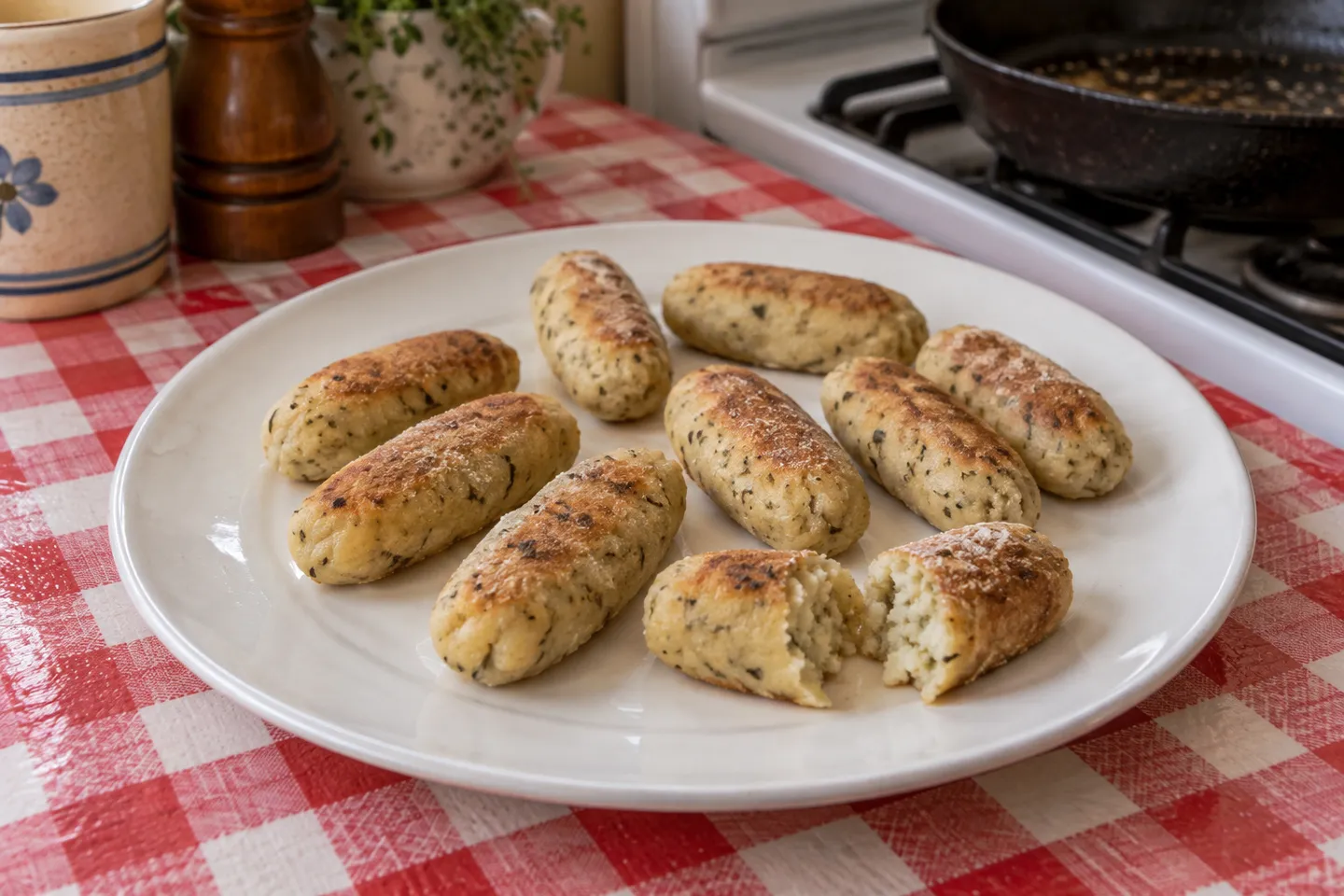
Mock Sausage: Sage Lima Bean Rolls (1918)
Mashed dried lima beans seasoned with sage, thyme and sweet marjoram, shaped into finger-size rolls, floured and pan-fried golden in corn oil.
- Original yieldYield
- About 18 to 30 finger-size rollsAbout 18 to 30 finger-size rolls
- PrepPrep time
- CookCook time
- TotalTotal time
Includes an 8-hour or overnight soak and 10 minutes of cooling the mash. On the day: about 25 minutes to pick over, shape and flour; up to 75 minutes of boiling, up to 4 minutes drying the mash, and about 25 minutes of frying in batches. Older beans can take longer.
Published
Original recipe: About 18 to 30 finger-size rolls
The story behind the recipe
This sausage is lima beans, boiled soft, mashed and seasoned with sage, thyme and sweet marjoram. Then they're shaped like fingers, floured and fried golden in corn oil. No meat goes into the rolls, and no lard goes into the pan. That second part matters as much as the first. The 1918 cookbook behind this recipe wanted to save meat and animal fat in the same skillet.
Why mashed beans hold together
There's no egg, crumb or other binder here. The beans do that job. Cooked until very soft, lima beans mash into a thick, starchy paste that keeps its shape once it cools a little. That makes the boil the important step. Underdone beans give a crumbly mash, and a wet one slumps.
Read more about this recipe
The herbs do the sausage work
With no meat to lean on, the seasoning carries the name. Sage, thyme and sweet marjoram supply the sausage idea. The book asks for half a teaspoon of each, powdered. That means ground herbs, not crumbled leaves, and this version keeps the book's measure.
The same cookbook's sauce chapter says dishes built on beans, rice or "other foods having little flavor of their own" need special attention to seasoning, and this recipe is a clear case. The original leaves salt and pepper to the cook, so we've set amounts for one cup of dried beans.
Oil instead of lard
The frying fat is the other half of the recipe. A few pages earlier, in the meat chapter, the book prints a line in capitals: "LEARN TO USE THE VEGETABLE OILS." It names corn, cottonseed, peanut and olive oil for cooking and frying. The front pages also ask cooks to swap wartime substitutes for butter, sugar, animal fat and wheat where they can.
Mock Sausage follows that advice. Corn oil keeps animal fat out of the pan, just as the beans keep meat out of the rolls.
What the flour coat is for
Flour is the one wheat ingredient, and it's only a thin coat. It dries the surface of a soft mash so it's easier to handle. It also gives the hot oil something to brown. Since the inside is already cooked, the frying only has to build that crust. A shallow layer of oil does the job.
Its place in a Pittsburgh club's cookbook
The recipe is printed without a contributor's name on page 47 of the Twentieth Century Club War Time Cook Book (Pittsburgh, 1918). Sales went to the club's war work. Howard Heinz, the federal food administrator for Pennsylvania, wrote a foreword asking households to cut their use of wheat, meat, sugar and animal fats. The Food Administration leaned heavily on voluntary effort, though it also had powers to compel.
The meat chapter's other dishes are worth a look. A few pages earlier, Liberty Meat is fried slices of cornmeal mush with walnuts and peanut butter. Mock Duck is round steak rolled around stuffing. Not every mock dish in the book was meatless. Our article on wheatless and meatless cooking in 1918 follows the wider campaign.
A baked cousin from Massachusetts
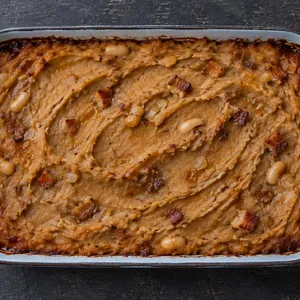
Carolyn Putnam Webber's Two Hundred and Seventy-Five War-Time Recipes, printed in Bedford, Massachusetts, the same year, has Bean Sausages made from lima beans and sage. Hers adds bread crumbs and drippings and bakes in a greased pan. The Pittsburgh version skips the binder and the animal fat and finishes on the stove.
What we filled in
The original specifies a cup of dried beans and the herb measures. Soak and boil times, salt, pepper, flour, oil depth and roll size are our choices. Finger size here means about 1 1/2 tablespoons of mash. The overnight soak and the boil until very soft stay as the book wrote them.
Read the original wording
Historical reference only. Follow the ingredients and cooking steps below when cooking.
Historical ingredients
- one cup lima beans
- salt
- pepper
- a half a teaspoonful each of powdered sage, thyme and sweet marjoram
- flour
- corn or other vegetable oil
Historical method
Soak one cup lima beans over night, boil until very soft, drain and mash, season with salt, pepper and a half a teaspoonful each of powdered sage, thyme and sweet marjoram; make into rolls about the size of a finger; roll in flour and fry a golden brown in corn or other vegetable oil.
Make it your wayOriginal: 6 servings · Makes About 18 to 30 finger-size rolls
Original recipe: About 18 to 30 finger-size rolls
Ingredients
For About 18 to 30 finger-size rolls. Quantities are shown as written.
Source measurement convention: US customary. Explicit unit definitions take precedence; unconfirmed measures must be checked before conversion.
Original quantities for About 18 to 30 finger-size rolls.
- Dried lima beans1 cup
- Fine salt3/4 tsp
- Ground black pepper1/4 tsp
- Ground sage1/2 tsp
- Ground thyme1/2 tsp
- Ground marjoram (sweet marjoram)1/2 tsp
- All-purpose flour (for rolling)1/4 cup
- Corn oil or other vegetable oil (for shallow frying)1/2–3/4 cup
Measurement notes
- dried lima beans, all-purpose flour (for rolling), corn oil or other vegetable oil (for shallow frying): US cup: 1 = 236.5882 ml (rounded).
- fine salt, ground black pepper, ground sage, ground thyme, ground marjoram (sweet marjoram): US tsp: 1 = 4.9289 ml (rounded).
Measurement notes
Original ingredients
- 1 cup dried lima beansUS cup: 1 = 236.5882 ml (rounded).
- 3/4 tsp fine saltUS tsp: 1 = 4.9289 ml (rounded).
- 1/4 tsp ground black pepperUS tsp: 1 = 4.9289 ml (rounded).
- 1/2 tsp ground sageUS tsp: 1 = 4.9289 ml (rounded).
- 1/2 tsp ground thymeUS tsp: 1 = 4.9289 ml (rounded).
- 1/2 tsp ground marjoram (sweet marjoram)US tsp: 1 = 4.9289 ml (rounded).
- 1/4 cup all-purpose flour (for rolling)US cup: 1 = 236.5882 ml (rounded).
- 1/2 to 3/4 cup corn oil or other vegetable oil (for shallow frying)US cup: 1 = 236.5882 ml (rounded).
Equipment
 Large saucepan (4-quart)
 Potato masher
 Heavy cast-iron skillet (10 or 12-inch)
Instructions
Soak the lima beans
Rinse the dried lima beans, pick out any grit or broken pieces, and put them in the saucepan with about 3 cups of cold water. Cover and soak for at least 8 hours or overnight.
Boil until very soft
Drain the beans and discard the soaking water. Return them to the saucepan, cover with fresh water by about 2 inches, and bring to a boil over high heat. Lower the heat to keep a steady gentle boil and cook, partly covered, for 45 to 75 minutes, adding hot water if the beans start to show above the surface. They're ready when every bean is very soft and crushes easily against the side of the pan with a spoon, with no firm or chalky center. Don't stop early: dried lima beans must be fully cooked.
Drain and mash
Drain the beans well and return them to the empty saucepan. Mash them with the potato masher until fairly smooth. If the mash looks wet or sticky, stir it over low heat for 2 to 4 minutes to drive off some moisture, then take it off the heat.
Season the mash
Stir in the fine salt, ground black pepper, ground sage, ground thyme and ground marjoram until evenly mixed. Taste and add a little more salt if needed. Let the mash cool for about 10 minutes, until it's comfortable to handle.
Shape and flour the rolls
Spread the all-purpose flour on a plate. Scoop about 1 1/2 tablespoons of mash at a time and roll it between your palms into a finger shape about 3 inches long and 3/4 inch thick. Roll each one in the flour, tap off the excess, and set it on a tray. If the mash sticks to your hands, dust them lightly with flour.
Heat the oil
Pour enough corn oil into the skillet to cover the base about 1/8 inch deep, about 1/2 cup in a 10-inch skillet. Heat over medium heat until a pinch of flour dropped in sizzles at once without darkening. The oil will shimmer; on a thermometer that's roughly 350°F (175°C).
Fry until golden
Fry the rolls in batches, lowering each one in gently and leaving space between them. Cook for 5 to 7 minutes, turning every minute or two, until golden brown on all sides. Lower the heat a little if the flour coating darkens before the rolls are browned all around. Don't leave the hot oil unattended.
Drain and serve
Drain the rolls on paper towels. Add more oil between batches as needed, letting it reheat before adding more rolls. Serve hot.
Estimated calories 180 kcal
Nutrition portion: 1/6 of recipe · Original yield: About 18 to 30 finger-size rolls
Source & assumptions
Rough estimate per standard nutrition portion (1/6 batch, about 3 to 5 rolls). Uses published cooked-bean factors, an industrial light-coating proxy for flour and a pan-fried potato-cake oil model. Original roll yield is unchanged. Hydration, flour adhesion and oil pickup can differ substantially; not measured or validated for this specific recipe.
Recipe notes
When adjusting quantities
Keep each roll about 1 1/2 tablespoons of mash. A larger batch means more frying batches, not bigger rolls or shorter frying. Boiling time depends on the beans, not the quantity.
Original recipe notes
These notes describe the original recipe. Quantities mentioned here do not change when you adjust servings.
Lima beans: Soaking, discarding the soaking water and boiling in fresh water until very soft are what make dried lima beans safe to eat, as well as mashable. Don't shorten the boil to save time.
Herbs: The 1918 recipe calls for powdered herbs, so this version uses ground sage, thyme and marjoram at the book's half teaspoon each. Rubbed sage or crumbled dried leaves measure differently by the spoon; if you use them, season the mash gradually and taste before shaping.
Yield: The roll count depends on how much the beans swell and how much moisture you drive off, so expect anywhere from about 18 to 30 rolls.
Read the scaling guide. Times, temperatures and equipment need their own consideration. Open the recipe tool to review and correct individual amounts.
Sources and attribution
Twentieth Century Club of Pittsburgh, Twentieth Century Club War Time Cook Book (Pittsburgh: Pierpont, Siviter & Co., 1918), p. 47
Twentieth Century Club of Pittsburgh, Twentieth Century Club War Time Cook Book (Pittsburgh: Pierpont, Siviter & Co., 1918), "Mock Sausage," p. 47; vegetable-oil advice p. 44 and seasoning note p. 76. A scan is available from the Internet Archive. Webber's Bean Sausages appear in Two Hundred and Seventy-Five War-Time Recipes (Bedford, Massachusetts, 1918). Food Administration background: National Archives, Sow the Seeds of Victory!
Recipe details
- Recipe tradition
- Vintage
- Course or meal
- Dinner
- Cuisine
- American
- Source decade
- 1910s
- Occasion
- Wartime cooking
- Browse category
- Main Dishes