
- Vintage
- American cooking
- 1910s
- Wartime cooking
Wheatless and Meatless in 1918: How Cookbooks Turned Ounces into Cups
How American cookbooks of 1918 translated the Food Administration's wheat, meat, fat and sugar savings into cups, tables and recipes, with three companion recipes.
At the back of the Twentieth Century Club War Time Cook Book, printed in Pittsburgh in 1918, there’s a short table headed “Instead of two (2) cups of wheat flour use.” For barley muffins, it asks for half a cup of wheat flour and 2¼ cups of barley flour. For buckwheat muffins, the same half cup of wheat is joined by only 1¼ cups of buckwheat. Two muffins are doing the same job of replacing the same wheat, and they arrive at it with a whole cup’s difference in substitute flour.
The page explains why: “Note that the amount of wheat flour plus the amount of substitute flour does not always equal the two cups of wheat flour in the Standard recipe on account of the varying weights per cup of the suggested substitutes” (p. 155).
During the First World War, the American government counted food in ounces, pounds and bushels, while home recipes were written in cups. The cookbooks of 1917 and 1918 spent much of their effort translating one into the other, and three recipes from them show that arithmetic at work.
A pledge to follow directions
The United States Food Administration was created by executive order on August 10, 1917, under the Food and Fuel Control Act, better known as the Lever Act. Herbert Hoover ran it, and he built its household program around volunteering rather than compulsory rationing. Homemakers were asked to sign pledge cards, and printed “home cards” told them what to save.
The War Cook Book for American Women, issued by the Food Administration and compiled by Frederic J. Haskin, explains that the pledge was not a promise to do one particular thing but “an agreement to follow directions,” and those directions changed with supplies. The signer promised to follow them “in so far as my circumstances permit.”
By early 1918 the directions had become specific. The home card printed in Haskin’s book, dated 1918, asks for two wheatless days a week (Monday and Wednesday) plus one wheatless meal every day, one meatless day (Tuesday) plus one meatless meal daily, and two porkless days (Tuesday and Saturday). Every day was to save fat and sugar. A Portland newspaper’s report of the rules, published on January 27, 1918, adds a shopping rule: anyone buying wheat flour was to buy an equal weight of other cereals with it, the arrangement known as the fifty-fifty rule. Bakers’ Victory bread had to contain a minimum share of other grains.
The rules spoke in equal weights and percentages. A recipe card in a kitchen drawer said two cups of flour.
For the earlier vessel and spoon names behind such directions, see old recipe measurements.
What an ounce looked like
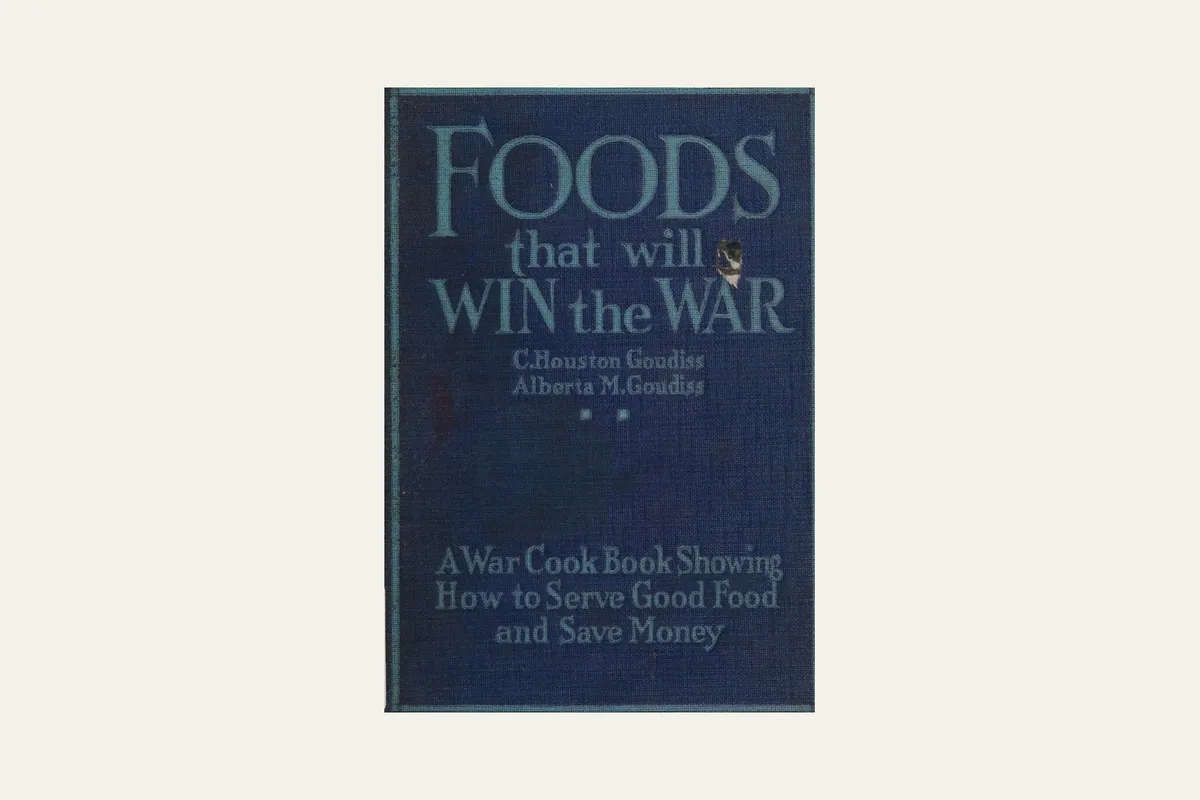
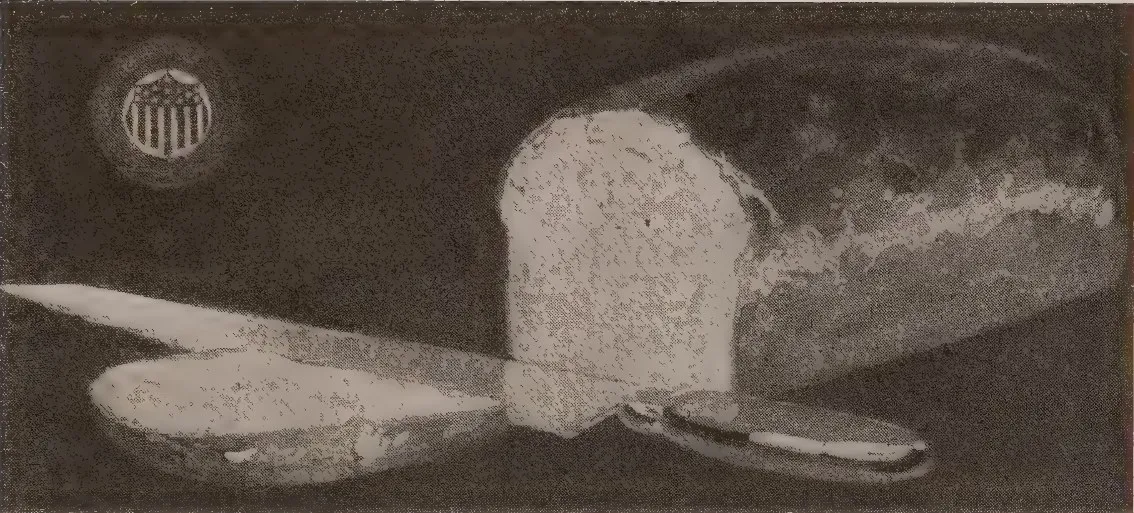
C. Houston Goudiss and Alberta M. Goudiss open the wheat chapter of Foods That Will Win the War and How to Cook Them (New York, 1918) with a single piece of bread: “A slice of bread seems an unimportant thing. Yet one good-sized slice of bread weighs an ounce” (p. 11). It contains, they add, almost three-fourths of an ounce of flour. Then they multiply one wasted slice a day across twenty million homes until it becomes millions of bushels of wheat.
Haskin’s book turns a national target into a personal one: save two ounces of wheat flour for each person in the family each day, which it equates with leaving out three slices of white bread. The two books agree reasonably well. Three of Goudiss’s slices would hold a little over two ounces of flour.
Amelia Doddridge, whose Liberty Recipes came out in Cincinnati in 1918, put the same idea into slogans. Her page of “Conservation Slogans” includes “Save an ounce a day; ’twill surely pay” and, more grandly, “The power of an ounce of Wheat is the power of a Democracy” (p. 15). The ounce was the unit of patriotism, but home recipes didn’t measure flour in ounces.
A cup of barley is not a cup of wheat
Doddridge tackled that gap directly. Before her yeast breads she prints a table and explains its purpose: “As substitution for wheat flour is made by weight instead of by measure, the following table will be found helpful” (p. 18). Each entry is the amount that weighs the same as one cup of wheat flour. Barley flour takes 1⅜ cups. Buckwheat and coarse cornmeal take ⅞ cup. Fine cornmeal and corn flour take a scant cup. Rolled oats take 1½ cups.
Her table and the Pittsburgh one were printed separately but tell the same story. Scale Doddridge’s figures to the 1½ cups of wheat flour that the Pittsburgh muffins replace and you get just over 2 cups of barley and about 1⅓ cups of buckwheat, close to the Pittsburgh figures of 2¼ and 1¼. Behind both lies the same fact: a cup of each flour weighs something different.
The Pittsburgh page gives the reason directly: “As the housewife does not make her recipes by weight, however, but by measure, it is necessary to indicate the amount by measure of the cereal flours and meals which should be used” (p. 154). It’s signed by the United States Food Administration for Allegheny County. Doddridge’s measuring note supplies the other half: level cups, and flour sifted once before measuring. A weight table only works if everyone fills the cup the same way. Such tables weren’t unique to these books; extension services printed similar charts of substitutes equal to a cup of flour.
Fifty-fifty and its limits
Doddridge explains that yeast bread needs wheat for its gluten. For quick breads she’s more relaxed: “A safe proportion is ‘fifty-fifty’ (half wheat and half a substitute flour),” she writes, adding that seventy to one hundred percent substitutes may work in many cases (p. 32).
The Cornmeal Ragged Robins from the Goudiss chapter on corn show what that leeway looks like in an actual recipe. The source calls for 1½ cups of cornmeal to 1 cup of bread flour, so cornmeal makes up 60 percent of the grain by volume. Doddridge’s table says a cup of cornmeal weighs roughly what a cup of wheat flour does, or slightly more if the meal is coarse, so the share by weight is at least as high. Either way, these drop biscuits sit past the fifty-fifty line, inside the range Doddridge called workable for quick breads.
The rules kept moving. A Food Administration notice for Missouri dated September 2, 1918 announced that the fifty-fifty rule was abolished from September 1 and replaced with a four-to-one rule: one pound of substitutes sold for every four pounds of wheat flour. A Wisconsin extension circular of October 1918 described Victory bread as 20 percent substitute flours and 80 percent wheat. Directions that changed were exactly what the pledge had promised.
A cake that lists what it leaves out
Doddridge opens her cake chapter by naming the problem: “Recipes for the richer cakes and cookies call for ingredients which violate greatly the conservation program” (p. 83). She then advises substituting for wheat flour, animal fat and sugar, making that substitution by weight with the same table.
Her Eggless, Milkless, Butterless Cake (p. 89) shows that accounting, with a title that reads like an inventory of savings. Brown sugar, water, raisins, a little fat and spices are boiled together, and the batter needs no eggs, milk or butter. The recipe says simply “2 c. flour,” and leaves the type of flour to the reader, who already has the chapter’s advice and the weight table. Brown sugar sweetens it, and raisins help, as the Pittsburgh rules suggested when they said fruit could “furnish a portion of the sweetness” (p. 154).
Goudiss and Goudiss print a near relative with an even longer title: “Wheatless, Eggless, Butterless, Milkless, Sugarless Cake.” It sweetens with corn syrup and uses fine cornmeal with rye flour, or alternatively 3½ cups of whole wheat flour. That alternative fits the book’s own logic, which counts whole wheat and Graham flour as savings because more of the grain goes into the flour. In this recipe, at least, “wheatless” left room for whole wheat. Side by side, the two cakes show each recipe choosing which savings to claim.
Meatless days and fat-saving days together
The Mock Sausage from the Pittsburgh book (p. 47) answers a different line of the home card. Mashed lima beans stand in for the meat, seasoned with sage, thyme and sweet marjoram, and the rolls are fried in “corn or other vegetable oil.” The card defined porkless as without pork products, lard included, so the oil keeps the dish porkless as well as meatless and free of animal fat. It doesn’t make the dish a fat saving in itself: the card asked for a fat-saving day every day, listed cottonseed oil among the fats to save and told cooks to fry less, while recommending vegetable oils in place of butter or lard. The recipe measures its beans by the cup and its herbs by the half teaspoon, but leaves the frying oil unmeasured, which is exactly where the card’s fat arithmetic would apply.
The Goudiss “Meatless Sausage” makes different choices. It allows peas, beans, lentils or lima beans, binds them with bread crumbs and egg, and fries them in drippings, which the card also told cooks to save and reuse.
The same Pittsburgh page also prints a Yorkshire pudding made with four eggs and two cups of flour, and beef olives fried with bacon. The club collected recipes from its members, many of them peacetime dishes, and handled the gap with instructions rather than edits. A committee note at the front reads: “It is suggested that as far as possible the butter, sugar, animal fat and wheat given in these recipes be changed to war time substitutes.” The county’s federal food administrator, W. D. George, urged in his foreword that “in the other recipes a careful scientific substitution be practiced.”
Three ways to carry the same rules
The three books behind our companion recipes handled the same program differently. Doddridge, a home economics teacher writing for “housewives and teachers of Cooking,” built on standard recipes and conversion tables. Goudiss and Goudiss, a magazine publisher and a cookery-school director, opened each chapter with the government’s reasons and figures. The Pittsburgh club printed its members’ cooking and left the conversion to readers, with a page of rules at the back.
Those tables still describe real differences between flours, and a kitchen scale now settles the question Doddridge raised in 1918. For other periods’ approaches to scarcity, see the Depression-era budget dinners and the British recipes in Cooking on the Kitchen Front.
Source note
Amelia Doddridge, Liberty Recipes (Cincinnati: Stewart & Kidd, 1918), foreword and pp. 15–19, 32, 83 and 89. C. Houston Goudiss and Alberta M. Goudiss, Foods That Will Win the War and How to Cook Them (New York: World Syndicate Company, 1918), pp. 11, 19, 53 and 66, checked against the Wellcome Library scan (Internet Archive b32758686). Twentieth Century Club War Time Cook Book (Pittsburgh: Pierpont, Siviter & Co., 1918), front matter and pp. 47 and 154–155. Frederic J. Haskin, comp., War Cook Book for American Women (Washington: U.S. Food Administration, about 1918), pp. 3–10 and 20, checked against the Boston Public Library copy on the Internet Archive (warcookbookforam00hask).
Federal context: National Archives, Sow the Seeds of Victory!; The Sunday Oregonian, January 27, 1918, section 1, p. 5, via Historic Oregon Newspapers; U.S. Food Administration, Missouri Division, New Wheat Conservation Rules (September 2, 1918); University of Wisconsin Agricultural Extension Service, Victory Breads, Circular 108 (October 1918); NC State University Libraries, Recipes from World War I (Part 2): Wheatless.