
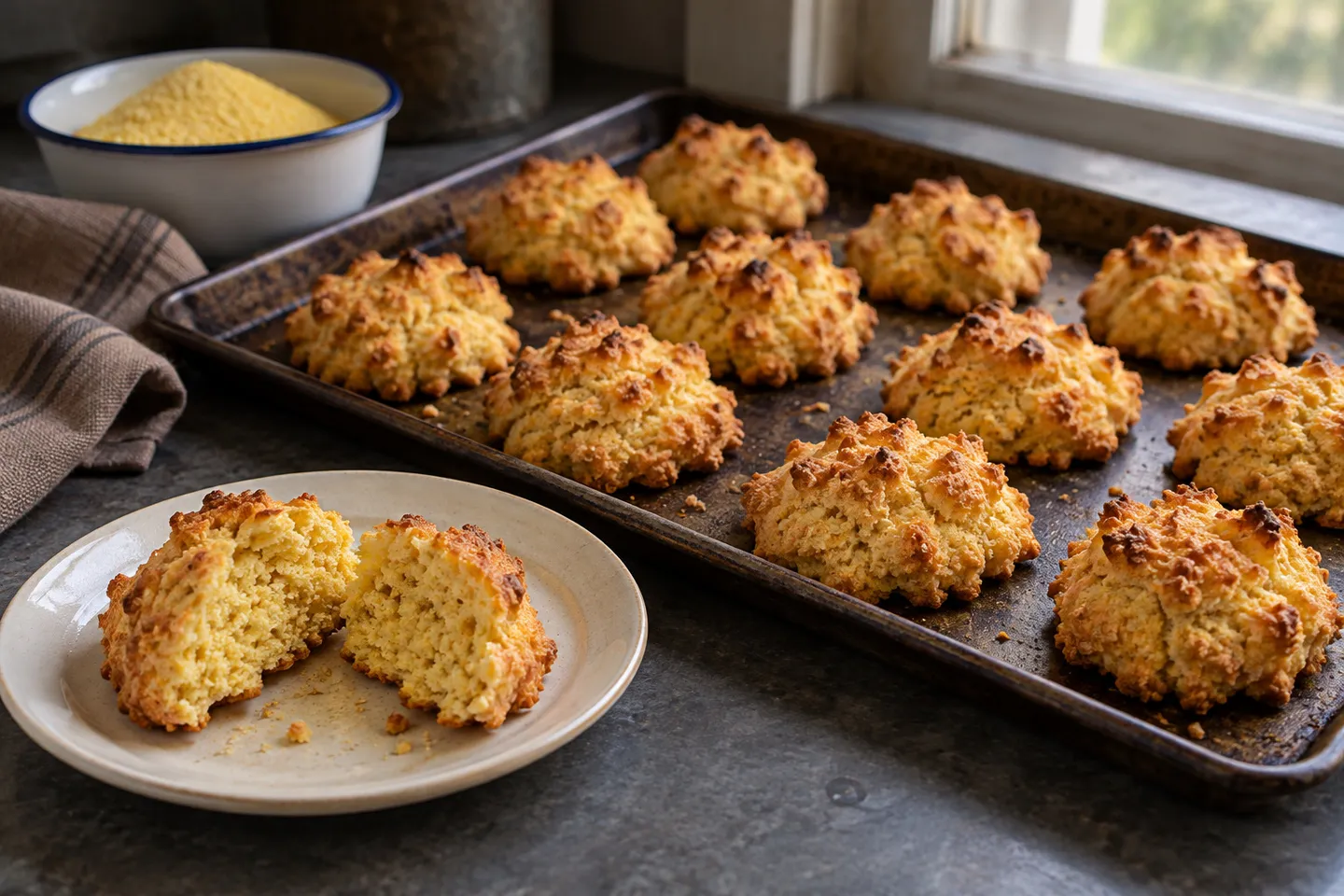
Cornmeal Ragged Robins (1918)
Drop biscuits from a 1918 wheat-saving cookbook, made mostly with cornmeal and raised with cream of tartar and baking soda instead of baking powder.
- Original yieldYield
- About 24 to 28 drop biscuits (estimated, not measured)About 24 to 28 drop biscuits (estimated, not measured)
- PrepPrep time
- CookCook time
- TotalTotal time
Preheat the oven while you mix. The batch normally fills two sheets baked together; if you bake them one after the other, allow about 15 minutes more.
Published
Original recipe: About 24 to 28 drop biscuits (estimated, not measured)
The story behind the recipe
Cream of tartar and baking soda go into these cornmeal drop biscuits as two separate measures, doing the job a can of baking powder does today. The soft dough is spooned onto a greased sheet instead of rolled, and there's more cornmeal in it than wheat flour. Milk, salt and a little fat round out the list, with no egg and no sugar.
One cup of wheat in two and a half
Bread flour is one cup out of two and a half cups of grain, about 40 percent by volume. Reducing the wheat flour was the economy behind this 1918 wartime recipe. The cup and a half of cornmeal brings the flavor and color; the wheat supplies the gluten that cornmeal lacks.
Read more about this recipe
Why a quick bread made sense
The recipe appears in Foods That Will Win the War and How to Cook Them, written by C. Houston Goudiss and Alberta M. Goudiss and published in New York by World Syndicate Company in 1918. It sits in a short chapter called "The Use of Corn," inside a section on why households were being asked to save wheat.
The authors walk through the problem. Yeast bread needs gluten, and apart from rye, the other grains don't have enough of it. Cornmeal, they write, can go into a yeast loaf at only about 10 percent before the bread turns heavy and small. Quick breads avoid that limit, so the book steers readers toward them: "The home baker can better serve her country by introducing into her menus numerous quick breads that can be made from cornmeal, rye, corn and rye, hominy, and buckwheat."
The campaign behind all this was run by the U.S. Food Administration under Herbert Hoover, which asked households to keep wheatless and meatless days. By early 1918, newspapers were printing the schedule as wheatless Monday and Wednesday and a meatless Tuesday.
One formula, three grains
The same book also prints Rolled Oats Ragged Robins in its oats chapter and Rye Ragged Robins in its rye chapter. All three keep the cup of bread flour, the milk, the cream of tartar, the fat and the soda, and swap the cup and a half of cornmeal for oats or rye flour. The book treats it as one formula with a changeable grain. It never explains the name, and ragged robin is also a wildflower.
What the cream of tartar is doing
Baking powder is, at heart, baking soda packed with a dry acid, and cream of tartar was the original acid. This recipe measures the two separately: 2 1/2 teaspoons of cream of tartar to 1 1/4 teaspoons of soda. That's exactly the common 2-to-1 ratio for making baking powder at home. Some extension charts use a little more acid, closer to 2 1/2 to 1, so the book's balance may leave a little soda unneutralized.
We kept the book's amounts anyway. This kind of acid starts reacting as soon as it gets wet, so the dough isn't one to leave sitting before it bakes.
Choosing the fat and the heat
The recipe says only "fat." A caption just before the corn chapter cites U.S. Food Administration regulations and asks cooks to leave fat and sweetening out of breads, adding, "Whenever Fat Is Used, Use Drippings." This recipe still calls for four tablespoons. The chapter on saving fat lists "hydrogenated oils, home-rendered fats, lard and beef and mutton suet" for shortening and keeps butter for the table. Cold lard or vegetable shortening fits that list and stays firm enough to cut into the dry ingredients.
"Hot oven" needed a number. The book's only stated baking temperature is 450°F, for wheat bread and rolls, and it adds that breads made with other grains want "a little lower temperature." A 1931 USDA baking bulletin puts a hot oven at 400° to 425°F. So this version bakes at 425°F (220°C), the top of that range and a step below the book's 450°F. The 12 to 15 minutes come straight from the source. For the wider wheat and meat campaign, see our article on wheatless and meatless cooking in 1918.
Read the original wording
Historical reference only. Follow the ingredients and cooking steps below when cooking.
Historical ingredients
- 1½ cups cornmeal
- 1 cup bread flour
- 1½ teaspoons salt
- 1⅓ cups milk
- 2½ teaspoons cream of tartar
- 4 tablespoons fat
- 1¼ teaspoons soda
Historical method
Sift dry ingredients. Cut in the fat. Add liquid and drop by spoonfuls on greased baking sheet. Bake in hot oven 12 to 15 minutes. These may be rolled and cut same as baking powder biscuits.
Make it your wayOriginal: 26 servings · Makes About 24 to 28 drop biscuits (estimated, not measured)
Original recipe: About 24 to 28 drop biscuits (estimated, not measured)
Ingredients
For About 24 to 28 drop biscuits (estimated, not measured). Quantities are shown as written.
Source measurement convention: US customary. Explicit unit definitions take precedence; unconfirmed measures must be checked before conversion.
Original quantities for About 24 to 28 drop biscuits (estimated, not measured).
- Cornmeal (plain fine or medium grind, yellow or white, not self-rising mix)1 1/2 cups
- Bread flour1 cup
- Salt1 1/2 tsp
- Cream of tartar2 1/2 tsp
- Baking soda1 1/4 tsp
- Cold lard or vegetable shortening4 tbsp
- Milk1 1/3 cups
- Extra lard or shortening, for greasing the baking sheet, as needed
Measurement notes
- cornmeal (plain fine or medium grind, yellow or white, not self-rising mix), bread flour, milk: US cup: 1 = 236.5882 ml (rounded).
- salt, cream of tartar, baking soda: US tsp: 1 = 4.9289 ml (rounded).
- cold lard or vegetable shortening: US tbsp: 1 = 14.7868 ml (rounded).
Measurement notes
Original ingredients
- 1 1/2 cups cornmeal (plain fine or medium grind, yellow or white, not self-rising mix)US cup: 1 = 236.5882 ml (rounded).
- 1 cup bread flourUS cup: 1 = 236.5882 ml (rounded).
- 1 1/2 tsp saltUS tsp: 1 = 4.9289 ml (rounded).
- 2 1/2 tsp cream of tartarUS tsp: 1 = 4.9289 ml (rounded).
- 1 1/4 tsp baking sodaUS tsp: 1 = 4.9289 ml (rounded).
- 4 tbsp cold lard or vegetable shorteningUS tbsp: 1 = 14.7868 ml (rounded).
- 1 1/3 cups milkUS cup: 1 = 236.5882 ml (rounded).
- Extra lard or shortening, for greasing the baking sheet, as needed
Equipment
 Baking sheets
Instructions
Heat the oven and grease the sheets
Heat the oven to 425°F (220°C) with racks in the upper and lower thirds. Grease two baking sheets with a little of the extra lard or shortening.
Sift the dry ingredients
Sift the cornmeal, bread flour, salt, cream of tartar and baking soda together into a large bowl, tipping in any coarse meal left in the sifter, then stir until evenly mixed.
Cut in the fat
Cut the cold lard or vegetable shortening into the dry ingredients with a pastry blender, two knives or your fingertips until no pieces bigger than a small pea remain.
Stir in the milk
Pour in the milk and stir just until the dry ingredients are moistened and a soft, sticky dough forms.
Drop the dough
Drop all the dough by rounded spoonfuls of about 2 tablespoons onto the greased sheets, about 2 inches apart.
Bake both sheets until golden
Bake both sheets right away for 12 to 15 minutes, swapping their rack positions halfway through, until the edges and bottoms are golden brown and the tops feel firm when pressed.
Estimated calories 70 kcal
Nutrition portion: 1/26 of recipe · Original yield: About 24 to 28 drop biscuits (estimated, not measured)
Source & assumptions
Ingredient-based estimate using CoFID 2021, USDA SR Legacy (2018). About 70 kcal per nutrition portion (1/26 of the recipe). Standard nutrition portion: one-twenty-sixth of the original batch. The original estimated yield remains 24–28 biscuits. Excludes unmeasured baking-sheet grease. Actual ingredients and preparation affect the estimate.
Recipe notes
When adjusting quantities
Scale every ingredient together so the cream of tartar and baking soda stay in proportion. Bake extra drops on more sheets; temperature and time stay the same for the same spoon size.
Original recipe notes
These notes describe the original recipe. Quantities mentioned here do not change when you adjust servings.
The 1918 recipe says the dough "may be rolled and cut same as baking powder biscuits," but it gives no thickness, cutter size or change to the milk. The drop method above is the one the source describes in full.
The book gives no count and no spoon size. The yield is an arithmetic estimate, roughly 3 to 3 1/2 cups of dough in 2-tablespoon drops, not a measured batch. Smaller drops make more biscuits and may be done sooner, so start checking early.
The book asks for drippings wherever fat is used. Clarified drippings that are firm when chilled can take the place of the lard or shortening; they bring the flavor of whatever meat they came from.
Read the scaling guide. Times, temperatures and equipment need their own consideration. Open the recipe tool to review and correct individual amounts.
Sources and attribution
C. Houston Goudiss and Alberta M. Goudiss, Foods That Will Win the War and How to Cook Them (New York: World Syndicate Company, 1918), p. 19
C. Houston Goudiss and Alberta M. Goudiss, Foods That Will Win the War and How to Cook Them (New York: World Syndicate Company, 1918), "Cornmeal Ragged Robins," p. 19. The ingredient amounts are unchanged. The oven setting, choice of fat, spoon size, yield estimate and doneness cues are ours.
Recipe details
- Recipe tradition
- Vintage
- Course or meal
- Baking
- Cuisine
- American
- Source decade
- 1910s
- Occasion
- Wartime cooking
- Browse category
- Baking & Desserts