
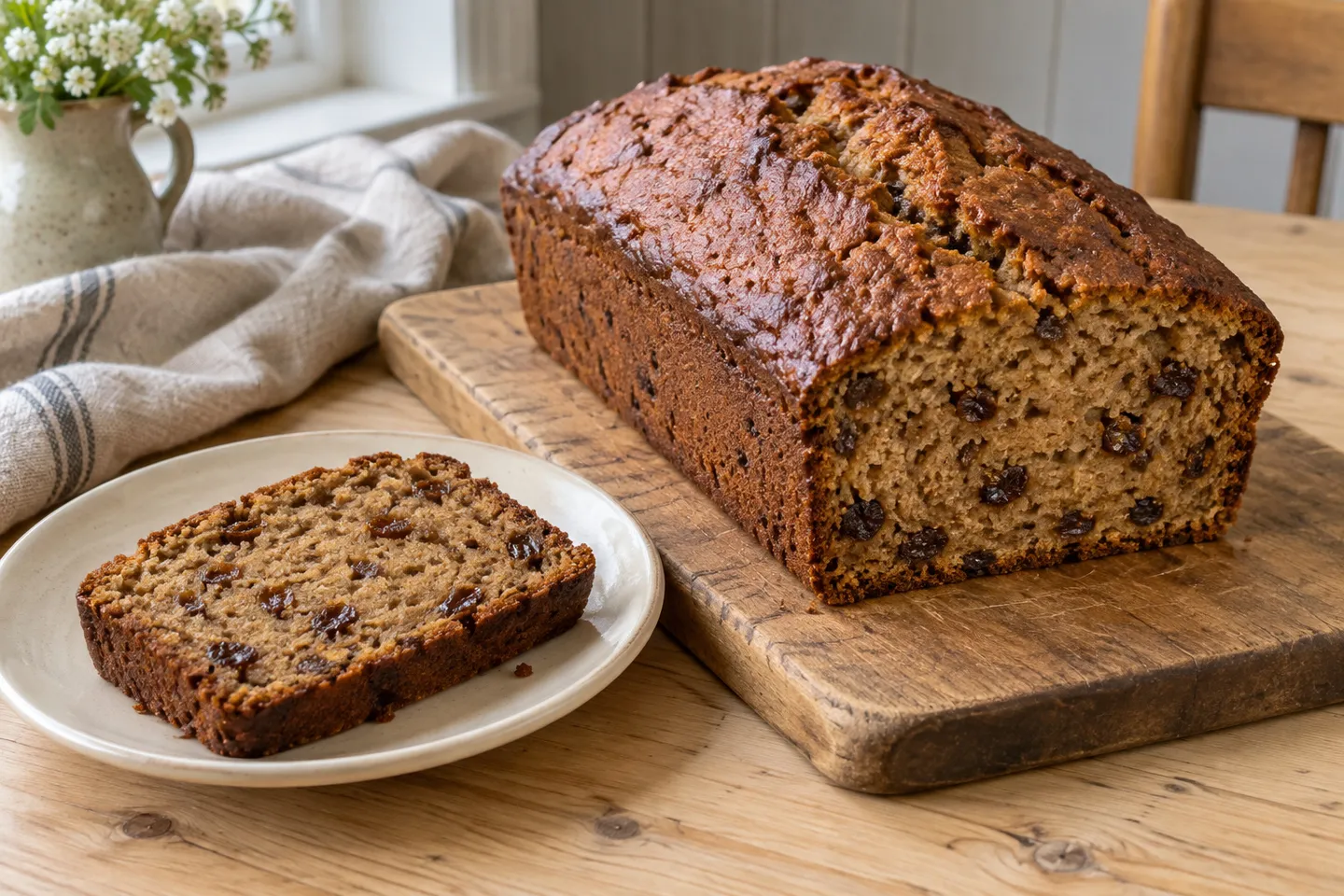
Eggless, Milkless, Butterless Cake (1918)
A spiced raisin loaf from a 1918 American wartime cookbook, made without eggs, milk or butter by boiling brown sugar, water, raisins and fat into a syrup before the flour goes in.
- Original yieldYield
- 1 loaf (9x5-inch pan)1 loaf (9x5-inch pan)
- PrepPrep time
- CookCook time
- TotalTotal time
Ready to slice in about 4 hours 40 minutes: about 1 hour for the boiled syrup to cool, 15 minutes resting in the pan and an estimated 2 hours for the loaf to cool completely on a rack.
Published
Original recipe: 1 loaf (9x5-inch pan)
The story behind the recipe
The name of this cake is built almost entirely from what it lacks, and Amelia Doddridge printed it that way as though the missing ingredients mattered more than anything she could list. What it does contain could come off an ordinary pantry shelf in 1918: brown sugar and raisins, a third of a cup of fat, cinnamon, nutmeg and salt, flour, and plain water poured in where another cake would have used milk.
What the cake leaves out
Eggs, milk and butter were standard in the richer cakes of the period, and butter in particular fell under the US Food Administration's wartime call to save fats. A cake named for doing without all three announced its economy in the title, before a cook had read a single measurement.
This is a 1918 war cake in the practical sense: a spiced raisin loaf made without eggs, milk or butter. Doddridge printed the more literal name, and that's the name kept here. Another cookbook from the same year called its own, different boiled-fruit cake “War Cake.” The shared idea doesn't make their recipes interchangeable.
Read more about this recipe
A teacher's book from a demonstration kitchen
Liberty Recipes was published in Cincinnati in 1918. A photograph at the front explains that Doddridge, a home economics teacher, tried out most of its recipes in a Food Administration demonstration kitchen in Wilmington, Delaware. The cake appears in her chapter "Patriotic Cakes and Cookies," which opens by warning that rich cakes worked against the conservation program and that wartime bakers should keep to the simplest recipes, replacing wheat flour, animal fat and sugar wherever they could. Among her suggestions are raisins baked inside the cake and no frosting at all, and this recipe takes both.
Sugar was a household matter too. In the summer of 1918 the Food Administration asked families to keep to about two pounds of sugar per person each month, a voluntary allotment that store posters repeated to shoppers, and this cake still spends a full cup of brown sugar from it.
Flour, measured her way
The recipe asks for "2 c. flour" and never names the grain, although the other cakes on the same page ask for wheat, barley or potato flour by name. Without a stated substitute, this version uses all-purpose wheat flour. How to measure it is spelled out: a note at the front of the book says every measurement is level, and that unless a recipe says otherwise, flour is sifted once and then spooned into the cup until it is level full. The ingredient list follows her method.
The fat with no name
The ingredient list says only "1/3 c. fat," which leaves the choice to the cook, although the rest of the book points the way. Her chapter tells bakers to substitute vegetable fats or fat compounds for animal fat, and an earlier photograph, labeled "Lard & Butter Substitutes," shows tins of Wesson Oil and Mazola beside cartons of oleomargarine. Because the fat here is melted rather than creamed, a solid shortening and a liquid oil can both do the job, so this version offers either. Butter would undo the title, and some margarines contain milk ingredients.
A pattern older than the war
The Story of Crisco, Marion Harris Neil's cookbook for Procter & Gamble with copyright dates of 1913 and 1914, includes a Butterless-Milkless-Eggless Cake with the same boiled-fruit approach, larger and richer than Doddridge's, with cloves, mace and chopped nuts. Doddridge's version is plainer, and she doesn't say where it came from.
Other 1918 books took the idea elsewhere. The Twentieth Century Club of Pittsburgh printed a "War Cake" with raisins, currants, half a cup of lard and walnuts. C. Houston and Alberta Goudiss, whose book also gave us cornmeal ragged robins, went further: their cake can leave out white wheat flour and sugar, using corn syrup with cornmeal and rye flour, or whole wheat flour. Our look at wheatless and meatless cooking in 1918 follows the same rules into savory dishes such as the Pittsburgh club's mock sausage.
The title is useful when choosing a recipe, but it doesn't tell you everything the cake contains. This version still uses wheat flour and brown sugar, as well as raisins and vegetable fat. “War cake” identifies a family of economical cakes here; the 1918 date and Doddridge attribution identify the particular recipe behind this loaf.
Giving the slow-oven instruction a modern setting
Doddridge's whole baking instruction is "Bake slowly 1 hour in a loaf pan," with no temperature and no pan size. Cookbooks of the next decade or so placed a slow oven at roughly 250 to 300°F. This version bakes at 325°F in a 9x5-inch pan, which sits nearer what those books called a moderate oven, so that a dense raisin loaf can set through in about the hour she allowed. The leavening stays exactly as printed: half a teaspoon of baking powder and a full teaspoon of baking soda.
Read the original wording
Historical reference only. Follow the ingredients and cooking steps below when cooking.
Historical ingredients
- 1 c. brown sugar
- 1 c. water
- 1 c. raisins seeded and cut up
- 1 t. salt
- 1 t. cinnamon
- 1/3 c. fat
- 1/2 t. nutmeg
- 2 c. flour
- 1/2 t. baking powder
- 1 t. soda
Historical method
Boil carefully for 3 minutes; when cool, add 2 c. flour, 1/2 t. baking powder, 1 t. soda. Bake slowly 1 hour in a loaf pan.
Make it your wayOriginal: 12 servings · Makes 1 loaf (9x5-inch pan)
Original recipe: 1 loaf (9x5-inch pan)
Ingredients
For 1 loaf (9x5-inch pan). Quantities are shown as written.
Source measurement convention: US customary. Explicit unit definitions take precedence; unconfirmed measures must be checked before conversion.
Original quantities for 1 loaf (9x5-inch pan).
- Lightly packed brown sugar1 cup
- Water1 cup
- Raisins, measured whole, then chopped1 cup
- Vegetable shortening or neutral oil1/3 cup
- Salt1 tsp
- Ground cinnamon1 tsp
- Ground nutmeg1/2 tsp
- All-purpose flour, sifted once, then spooned into the cup and leveled2 cups
- Baking powder1/2 tsp
- Baking soda1 tsp
- Vegetable shortening or neutral oil, for greasing the pan, as needed
Measurement notes
- lightly packed brown sugar, water, raisins, measured whole, then chopped, vegetable shortening or neutral oil, all-purpose flour, sifted once, then spooned into the cup and leveled: US cup: 1 = 236.5882 ml (rounded).
- salt, ground cinnamon, ground nutmeg, baking powder, baking soda: US tsp: 1 = 4.9289 ml (rounded).
Measurement notes
Original ingredients
- 1 cup lightly packed brown sugarUS cup: 1 = 236.5882 ml (rounded).
- 1 cup waterUS cup: 1 = 236.5882 ml (rounded).
- 1 cup raisins, measured whole, then choppedUS cup: 1 = 236.5882 ml (rounded).
- 1/3 cup vegetable shortening or neutral oilUS cup: 1 = 236.5882 ml (rounded).
- 1 tsp saltUS tsp: 1 = 4.9289 ml (rounded).
- 1 tsp ground cinnamonUS tsp: 1 = 4.9289 ml (rounded).
- 1/2 tsp ground nutmegUS tsp: 1 = 4.9289 ml (rounded).
- 2 cups all-purpose flour, sifted once, then spooned into the cup and leveledUS cup: 1 = 236.5882 ml (rounded).
- 1/2 tsp baking powderUS tsp: 1 = 4.9289 ml (rounded).
- 1 tsp baking sodaUS tsp: 1 = 4.9289 ml (rounded).
- Vegetable shortening or neutral oil, for greasing the pan, as needed
Equipment
 Medium saucepan (2-quart)
 9x5 inch loaf pan
 Fine-mesh sifter
- Parchment paper
 Wire cooling rack
Instructions
Boil the raisin syrup
Put the brown sugar, water, chopped raisins, vegetable shortening or neutral oil, salt, ground cinnamon and ground nutmeg in a medium saucepan. Bring to a boil over medium heat, stirring until the sugar dissolves and the fat melts, then boil gently for 3 minutes, stirring now and then so the sugar doesn't catch.
Cool the syrup
Take the pan off the heat and let the syrup cool to room temperature, about 1 hour. It should feel cool, not warm, before the flour goes in.
Heat the oven and line the pan
While the syrup cools, heat the oven to 325°F (165°C). Grease a 9x5-inch (23x13 cm) loaf pan with shortening or oil and line the bottom and long sides with a strip of parchment paper.
Whisk the dry ingredients
In a bowl, whisk together the all-purpose flour, baking powder and baking soda.
Stir in the flour
Stir the flour mixture into the cooled raisin syrup until no dry flour remains. The batter will be thick.
Fill the pan
Scrape the batter into the prepared pan and smooth the top.
Bake the loaf
Bake for 55 to 65 minutes, until the top is firm and springs back when pressed and a skewer inserted in the center comes out clean or with a few moist crumbs.
Cool and turn out
Cool the cake in the pan on a wire rack for 15 minutes, then lift it out with the parchment and let it cool completely before slicing.
Estimated calories 230 kcal
Nutrition portion: 1/12 of recipe · Original yield: 1 loaf (9x5-inch pan)
Source & assumptions
Ingredient-based estimate using CoFID 2021, USDA SR Legacy (April 2018), identified manufacturer information. Approximately 230 kcal per nutrition portion. Standard nutrition portion: one-twelfth of the loaf. Uses vegetable shortening and a representative packed brown-sugar measure; unmeasured pan-greasing fat is excluded. Ingredients, brands and preparation affect values.
Recipe notes
When adjusting quantities
This makes one 9x5-inch loaf. For more, bake each batch in its own pan; the oven temperature and baking time do not change automatically.
Original recipe notes
These notes describe the original recipe. Quantities mentioned here do not change when you adjust servings.
Measure the raisins whole, then chop them.
Read the scaling guide. Times, temperatures and equipment need their own consideration. Open the recipe tool to review and correct individual amounts.
Sources and attribution
Amelia Doddridge, Liberty Recipes (Cincinnati: Stewart & Kidd, 1918), p. 89
Amelia Doddridge, Liberty Recipes (Cincinnati: Stewart & Kidd, 1918), "Eggless, Milkless, Butterless Cake," page 89; chapter notes on pages 83 and 84; measuring note in the front matter. The choice of fat, the lightly packed brown sugar, the pan size, the oven temperature and the doneness check are modern adaptations.
Recipe details
- Recipe tradition
- Vintage
- Cuisine
- American
- Source decade
- 1910s
- Occasion
- Wartime cooking
- Browse category
- Baking & Desserts