

- Baking
- Methods
- Equipment
- Steam
The Hollow Middle: Popovers, Yorkshire Puddings and Cream Puffs
Compare thin pouring batters with cooked choux, and see why the bake must support the hollow center after it rises.
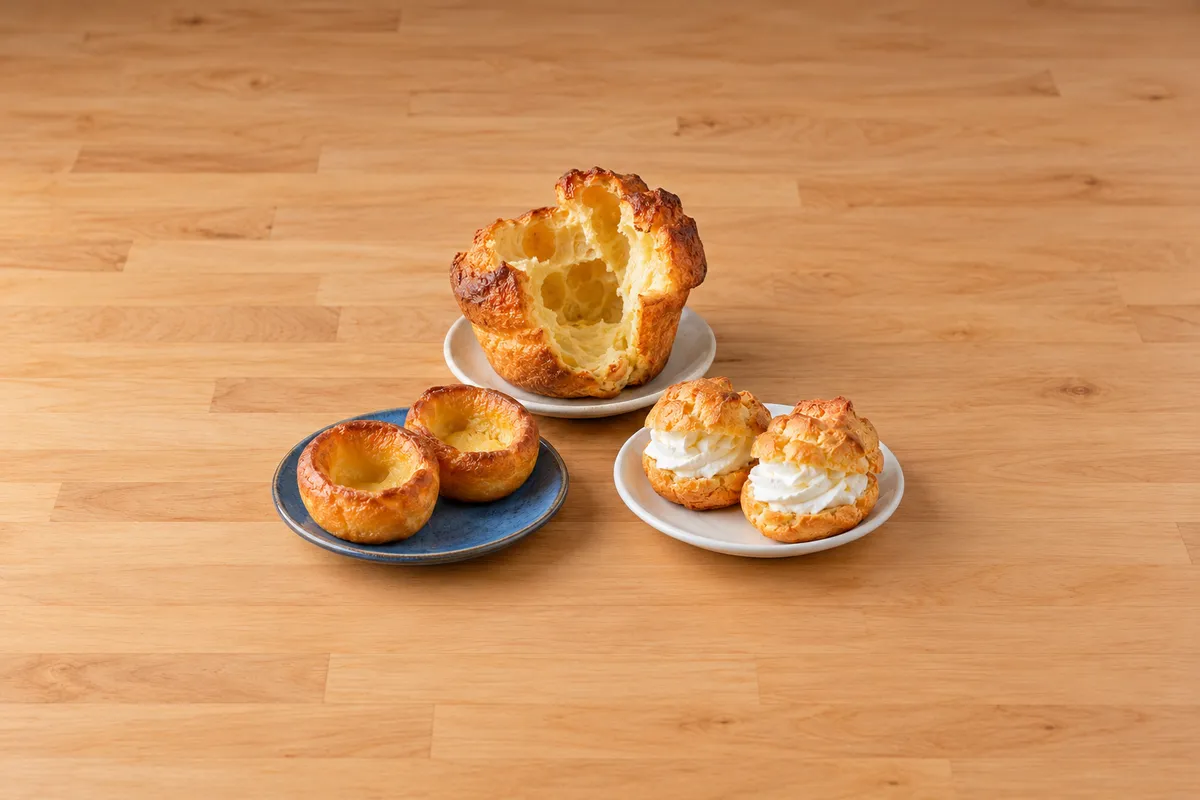
A hollow middle can be a baker’s success. In a popover, it leaves room inside a crisp shell. A Yorkshire pudding opens into a cup for gravy. Split a cream puff and there is space for vanilla cream.
The three shapes begin with wet mixtures that expand as they bake. The useful comparison is how each mixture is prepared to hold that expansion, and how the bake finishes the structure afterward. A tall puff still needs enough support to survive the trip from oven to table.
Our recipes take two routes: a thin batter poured into a hot pan, and a thick choux paste cooked in a saucepan before the eggs are added. Understanding that difference is more helpful than treating all three as interchangeable combinations of flour, eggs and liquid.

Read the diagram as text
The hollow middle needs a firm wall. Internal water supplies steam. Each recipe sets and finishes its own structure. Pouring batters. Popovers and Yorkshire puddings Thin batter is held by hot muffin cups. The baked form may open into a cup or enclose a hollow. Follow each recipe’s own pan, portions and oven schedule. Cooked choux paste. Cream-puff shells Paste is cooked before eggs are beaten in. Mounds hold their shape on baking sheets. Bake, vent, split and cool before adding cream. Schematic cross-sections, not to scale. A rising shape still needs set, dry walls. These mixtures and baking schedules are not interchangeable.
Two batters that pour
Popovers (1931) use a cup each of milk and sifted pastry flour, one egg, a little melted butter and salt. The recipe specifies how to sift and fill the flour measure. Its cup isn’t permission to substitute a universal weight for every kind of flour.
The batter goes into a preheated iron or heavy metal muffin pan. A higher oven setting starts the bake, followed by a lower setting to finish it. The source’s description of water vapor as the raising force gives a plain reason for the large amount of liquid.
Our Individual Yorkshire Puddings are also poured, but their recipe uses a different balance: 140 g all-purpose flour, 200 ml measured beaten egg and 200 ml milk. Oil heats in the muffin cups before the batter is added.
The resemblance is useful; the differences still belong to the recipes. These aren’t two versions of one batter that can be exchanged without thought. Flour type, egg amount, fat, portioning and bake all affect what you are making.
Steam needs something to expand
Water in the mixture becomes vapor as heat reaches it. Expansion can push a wet batter or paste outward, while the flour-and-egg structure becomes firm enough to hold the shape. The oven has to do both jobs.
King Arthur Baking’s explanation of choux connects steam lift with the egg-supported structure and the importance of dry shell walls. A puff that rises impressively can still slump if its walls remain too wet.
This helps explain why taking a pale pastry out as soon as it looks large can disappoint. Height is one clue. Color, firmness and the recipe’s drying stages tell you whether the structure is finished.
It also helps separate this process from adding a tray of water to an oven for another kind of bread. Here the useful water begins inside the mixture. Follow each recipe’s oven setup rather than adding an unrelated steam-making step.
Choux is cooked before it is baked
Cream Puffs with Vanilla Cream begin in a saucepan. Water, butter and salt come to a boil, flour goes in together, and stirring turns them into a paste. The eggs wait until the paste has cooled.
That first cooking stage distinguishes choux from a bowl of popover batter. By the time the mixture is portioned, it has already been heated and worked into a cohesive mass. It is thick enough to sit in a mound on a sheet.
The eggs are added one at a time. During mixing, the paste can look separated before it becomes smooth. That temporary appearance is different from finding dry flour lumps in a finished pouring batter. Read the cue within the method you are following.
The French word choux means cabbages, a reference to the small baked shapes, as King Arthur’s explanation notes. The familiar English “cream puff” puts the emphasis on what happens after the shell is made.
Give the hollow shape its own finish
| Recipe | Mixture before baking | Where it bakes | Finish that matters |
|---|---|---|---|
| Popovers | Thin pastry-flour batter | Preheated muffin cups | Lower-temperature finish until firm and dry |
| Small Yorkshire puddings | Egg-rich pouring batter | Hot oiled muffin cups | Browned, set shape; serve immediately |
| Cream puffs | Cooked paste beaten with eggs | Spaced mounds on sheets | Lower-temperature bake, vent, split and cool |
The popover recipe starts at 425°F, then drops to 350°F. The Yorkshire pudding version uses a conventional 230°C oven for its small-pan batch. The cream puffs start at 425°F for fifteen minutes, continue at 350°F, then receive a brief venting stage.
Those schedules aren’t a menu of equivalent options. Keep the temperatures and sequence with the relevant mixture, portion size and pan. The table explains the tasks rather than replacing the full cooking instructions.
A drying finish can seem slow when the pastry already looks ready from outside. It earns its place by preparing the interior for what happens next: hot service, a spoonful of gravy or a moist filling.
Pan size is a portioning decision
For the Yorkshire puddings, check that both pans fit while they are cold. Standard muffin cups make small puddings, and the full version uses twenty-four cups. A deep popover pan or a shallow four-hole Yorkshire pudding tin has a different capacity.
The popover recipe allows eight to twelve cups, with none filled above halfway. Respect that fill instruction rather than choosing a number merely to match a photograph. The recipe’s range and the actual pan need to agree.
Cream puffs need room sideways as well as upward. Twelve equal mounds are divided between two sheets with generous gaps. A larger mound is a different baking problem; doubling the batter doesn’t authorize doubling each puff’s size and using the same timer.
Check the planned oven load before mixing. If everything won’t fit with room for circulation, make separate batches according to the recipe rather than forcing more pans into the oven during the early rise.
Choose the last step before starting
For popovers and Yorkshire puddings, have the rest of the meal ready as their bake ends. These are preparations for hot service. A long wait changes the experience that their crisp exterior and softer middle are meant to give.
Cream puffs ask for the opposite planning decision. They must cool before filling. The final slit and splitting stage expose the interior; the vanilla cream waits in the refrigerator until the shells are completely cold.
Fill close to serving. A moist cream against a crisp shell will change its texture over time, even when the pastry was baked correctly. Keeping the filling and shell separate until needed preserves the contrast you worked to make.
Choose the recipe by the finish you want, then make room for its final stage. The empty middle is only useful when the pastry around it is ready.