
Popovers (1931)
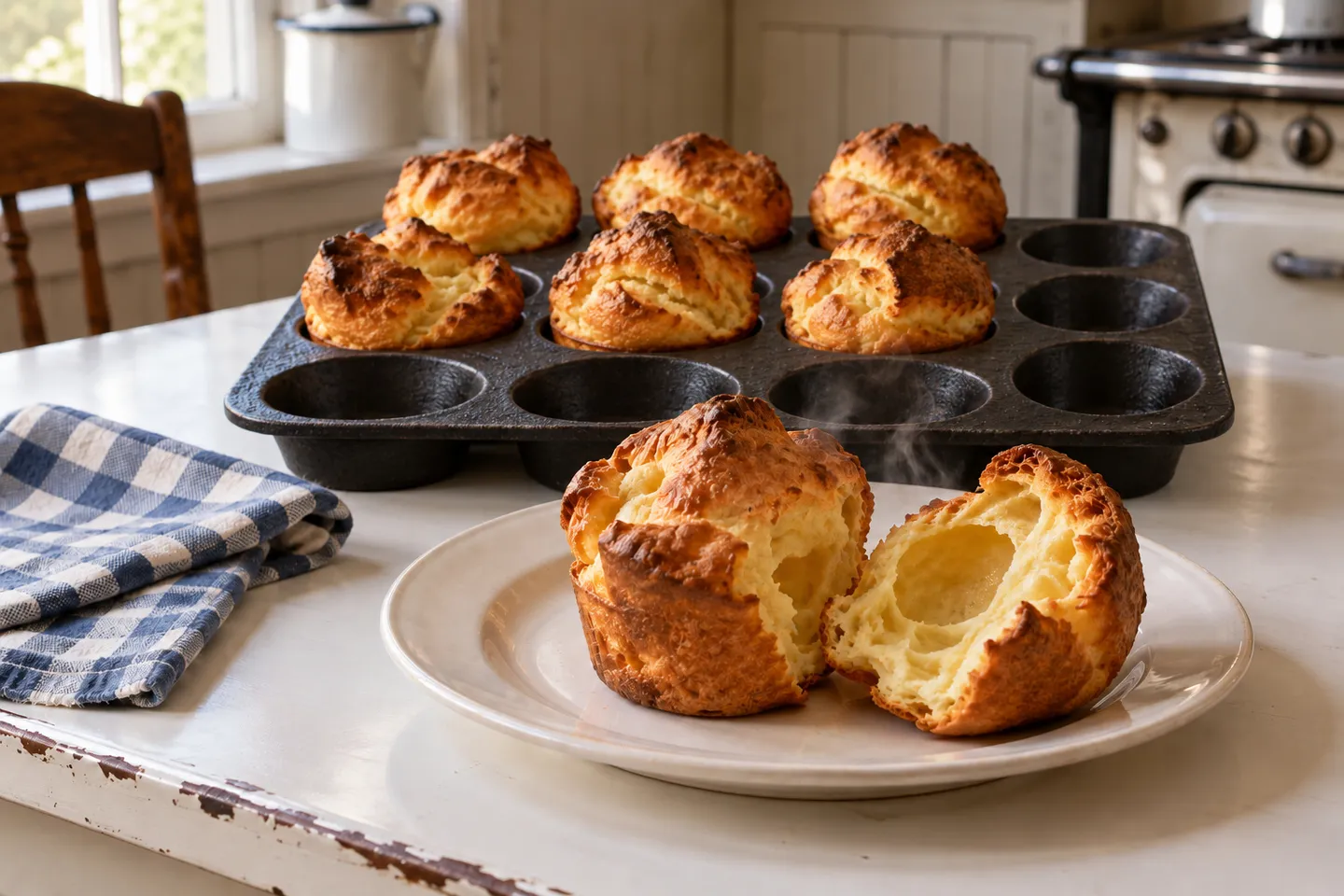
Tall, hollow popovers with no baking powder, lifted by steam in a preheated iron muffin pan and baked at 425°F, then finished at 350°F to dry the centers.
- Original yieldYield
- 8 to 12 popovers8 to 12 popovers
- PrepPrep time
- CookCook time
- TotalTotal time
Baking takes 40 to 45 minutes; go by the color and firmness cues. The pan heats in the oven while you mix the batter.
Published
Original recipe: 8 to 12 popovers
The story behind the recipe
Popovers belong to the small group of quick breads that use no baking powder at all. This 1931 version is a cup of milk to a cup of sifted flour, with one egg, a little melted fat and a pinch of salt, stirred into a batter thin enough to pour. That even ratio leaves the batter rich in liquid, and the liquid is the whole point.
Steam needs a pan that's already hot
The bulletin groups popovers with true sponge cakes as the exceptions that need no chemical leavening, because they are "raised by water vapor." Steam only lifts the batter if heat arrives fast. A preheated pan starts the sides cooking on contact, so the milk turns to steam and pushes upward before the crust sets around it.
Read more about this recipe
Why the bulletin names soft-wheat flour
Charlotte Chatfield's quick-bread quantities are for "the soft wheat, or pastry, type." Soft-wheat flour feels velvety, she explains, a little like cornstarch, while hard-wheat flour is grittier and packs more tightly. A sifted quart of soft-wheat flour weighed about 14 or 15 ounces in her account, against 16 or 17 ounces or more for hard wheat. So when a harder flour stands in, she uses seven-eighths of a cup for each cup, keeping the weight about the same.
That's why this version calls for pastry flour. Her measuring rules also say to sift flour once before measuring, then dip and level it, because packed flour means too much. In a batter this simple, an extra spoonful shows. Our guide to cups, grams and the ingredients between covers why volume measures drift.
Picking a number from a range
The bulletin gives ranges: one to one and a half eggs, and one to two teaspoons of fat. We chose one large egg and two teaspoons of melted butter.
One whole egg sits inside the printed range without splitting an egg, and the range leaves a little room. A doubled batch takes two eggs, though the bulletin would allow a third.
The fat choice comes from a footnote. Chatfield's quantities assume fat containing no water, and butter needs about a sixth more to do the same work. Two teaspoons of butter therefore carry a little less than two teaspoons of pure fat, which stays inside her range and adds butter's flavor.
Iron pans and a two-step oven
Chatfield is particular about the pan: hot, well greased and "preferably iron or granite because they hold the heat." Granite meant enameled ware. A heavy pan keeps feeding heat into the batter while it climbs, instead of cooling the moment the batter goes in.
The oven gets two settings: about 425°F to start, then about 350°F after roughly 20 minutes, "so that the inside of the pop-overs will dry out a little without making the crusts too hard and brown." The bake runs about 45 minutes. Chatfield notes elsewhere that most baking needs no change of temperature once it's right at the start, so this is a deliberate exception.
We kept her settings. Most of the modern popover recipes we compared also start hot, at 425°F to 450°F, and lower the heat partway through. She also recommends an inexpensive oven thermometer as the surest check, which suits a recipe this dependent on heat. Our guide to slow, moderate and hot ovens covers the period oven terms behind settings like these.
Read the original wording
Historical reference only. Follow the ingredients and cooking steps below when cooking.
Historical ingredients
- 1 cup milk.
- 1 cup sifted soft-wheat flour.
- 1 to 2 teaspoons fat.
- 1 to 1½ eggs.
- ⅛ teaspoon salt.
Historical method
The so-called batter method of mixing is generally recommended for pour batters and for muffin and other plain drop batters, because it is quick and easy. The dry ingredients are mixed and sifted, the eggs are beaten slightly and added to the other liquid ingredients, which are then stirred gradually into the dry. The melted fat is added last to the batter rather than mixed with the liquids.
Stir the liquid slowly into the dry ingredients to avoid forming lumps.
Fill hot, well-greased muffin pans, preferably iron or granite because they hold the heat, not more than half full of batter and place at once in a hot oven (about 425° F.). After about 20 minutes lower the temperature to about 350° F., so that the inside of the pop-overs will dry out a little without making the crusts too hard and brown. Pop-overs require baking about 45 minutes.
Make it your wayOriginal: 10 servings · Makes 8 to 12 popovers
Original recipe: 8 to 12 popovers
Ingredients
For 8 to 12 popovers. Quantities are shown as written.
Source measurement convention: US customary. Explicit unit definitions take precedence; unconfirmed measures must be checked before conversion.
Original quantities for 8 to 12 popovers.
- Sifted pastry flour1 cup
- Salt1/8 tsp
- Large egg1
- Milk1 cup
- Butter (melted)2 tsp
- Shortening or neutral oil (for greasing the hot pan, as needed)
Measurement notes
- sifted pastry flour, milk: US cup: 1 = 236.5882 ml (rounded).
- salt, butter (melted): US tsp: 1 = 4.9289 ml (rounded).
Measurement notes
Original ingredients
- 1 cup sifted pastry flourUS cup: 1 = 236.5882 ml (rounded).
- 1/8 tsp saltUS tsp: 1 = 4.9289 ml (rounded).
- 1 large egg
- 1 cup milkUS cup: 1 = 236.5882 ml (rounded).
- 2 tsp butter (melted)US tsp: 1 = 4.9289 ml (rounded).
- Shortening or neutral oil (for greasing the hot pan, as needed)
Equipment
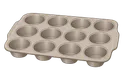 12-cup cast-iron or heavy metal muffin pan
 Fine-mesh sifter
 Whisk
Instructions
Heat the pan and oven
Put a 12-cup cast-iron or heavy metal muffin pan in the oven and heat the oven to 425°F (220°C), with the pan inside, while you make the batter. If you have an oven thermometer, use it to confirm the temperature.
Sift the flour and salt
Sift the pastry flour once, then spoon it lightly into a cup measure and level it without packing. Sift the measured flour again with the salt into a mixing bowl.
Whisk the egg and milk
In a second bowl, beat the egg slightly with a whisk, then whisk in the milk.
Stir the liquid into the flour
Stir the egg and milk into the flour slowly, a little at a time, until the batter is smooth and free of lumps.
Add the melted butter
Stir in the melted butter last.
Grease and fill the hot pan
Using dry oven mitts, take the hot pan out and set it on a heatproof surface. Grease the cups well with shortening or neutral oil, taking care because the fat may smoke on hot metal. Divide the batter among 8 to 12 cups, filling none of them more than half full.
Bake at 425°F
Return the pan to the oven at once and bake for 20 minutes without opening the door.
Finish at 350°F
Lower the heat to 350°F (175°C) and bake 20 to 25 minutes longer, about 40 to 45 minutes in all, until the popovers are tall, deep golden brown and firm and dry to the touch on their sides. If they still look pale or feel soft, give them a few more minutes.
Serve hot
Lift the popovers out of the pan and serve them hot, keeping your face back as you tear the first one open, since the hollow center releases steam.
Estimated calories 70 kcal
Nutrition portion: 1/10 of recipe · Original yield: 8 to 12 popovers
Source & assumptions
Ingredient-based estimate using CoFID 2021, USDA household-measure references. About 70 kcal per nutrition portion (1/10 of the recipe). Standard nutrition portion: one-tenth of the original batch. This is an editorial batch fraction; the recipe makes 8–12 popovers. Excludes unmeasured pan grease. Actual ingredients and preparation affect the estimate.
Recipe notes
When adjusting quantities
To double the batch, double every ingredient (2 eggs) and bake in two preheated pans. Using 3 eggs instead is an optional variation within the 1931 range. Oven temperatures and baking times stay the same.
Original recipe notes
These notes describe the original recipe. Quantities mentioned here do not change when you adjust servings.
Pastry flour is the soft-wheat type the bulletin assumes. If you'd rather weigh it, the bulletin's own figures put a cup of sifted soft-wheat flour at about 3 1/2 to 3 3/4 ounces.
Use fresh milk rather than sour milk. The bulletin allows sour milk in its other quick breads but makes an exception for popovers.
Read the scaling guide. Times, temperatures and equipment need their own consideration. Open the recipe tool to review and correct individual amounts.
Sources and attribution
Adapted from Charlotte Chatfield, Home Baking, USDA Farmers' Bulletin No. 1450 (revised December 1931), pp. 10–11
Charlotte Chatfield, Home Baking, U.S. Department of Agriculture Farmers' Bulletin No. 1450 (Washington, revised December 1931), "Pop-overs," pages 10–11, with the batter method and baking-temperature guidance on page 10 and flour and measuring guidance on pages 2–3 and 8–9. This version names pastry flour, sets one large egg and two teaspoons of butter from the printed ranges, and adds Celsius settings and doneness cues.
Recipe details
- Recipe tradition
- Vintage
- Course or meal
- Baking
- Cuisine
- American
- Source decade
- 1930s
- Browse category
- Baking & Desserts