
- Vintage recipes
- Baking equipment
- Breakfast baking
Gem Pans and Muffin Tins: What Changes When You Change the Pan?
Read old gem-pan directions through their batter, pan material and heating instructions, then decide what a modern muffin tin can reasonably replace.
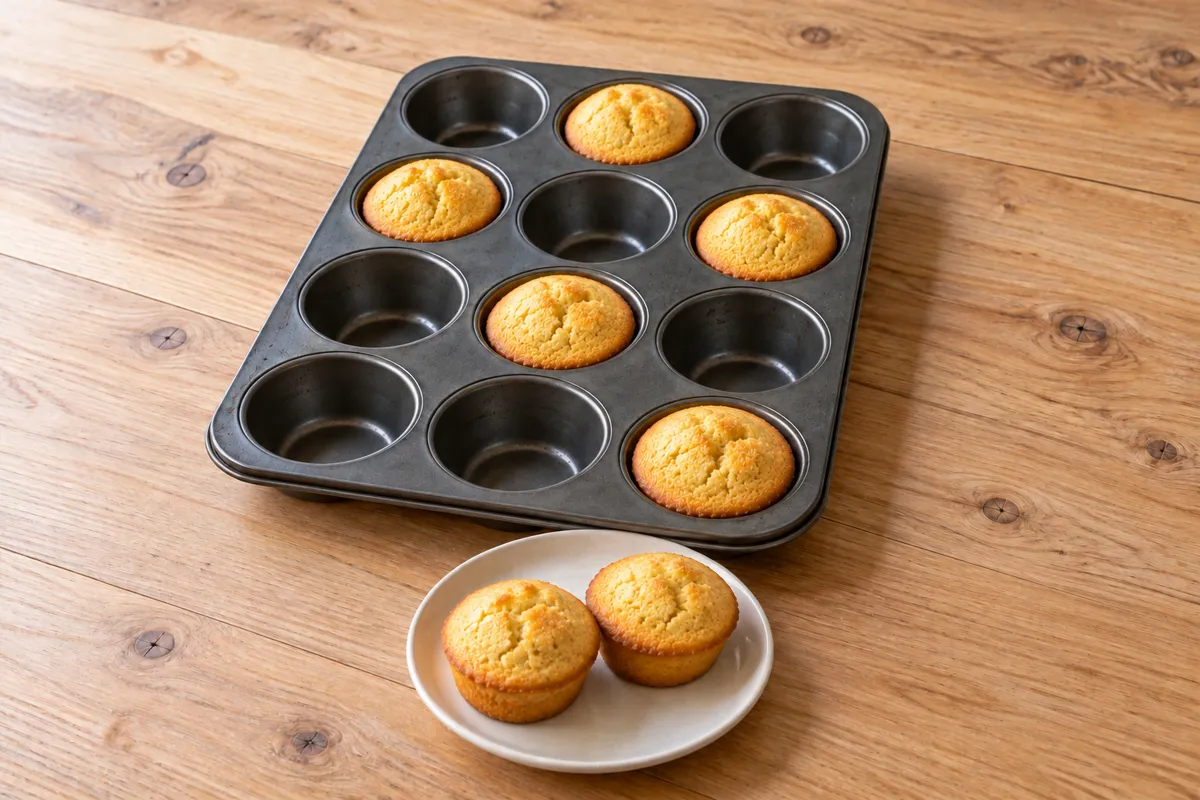
The instruction is tucked into a muffin recipe: if iron pans are used, heat them first. A neighboring recipe specifies tin gem pans. A third sends an oatmeal mixture into iron pans to rise at the back of the range. An old gem pan, it turns out, comes with more decisions than the shape of its little hollows.
A modern muffin tin may be a useful starting point for adapting these recipes. Before treating it as a direct replacement, though, read what the recipe asks the pan to do. Its material, the size of each cavity and whether it starts hot all belong to the cooking method.
Fannie Merritt Farmer’s Boston Cooking-School Cook Book, in the revised 1918 edition, supplies a particularly revealing group of examples. Muffins and gems share equipment, yet their batters and preparation aren’t identical. The names alone won’t tell you how to fill the pan.
What did the gem pan hold?
In these recipes, gem pans hold individual portions of breakfast breads. Farmer uses them for Graham Muffins, Corn Meal Gems and yeast-raised oatmeal muffins. There isn’t a single gem batter behind every appearance of the term.
The overlap survives in museum cataloging. Tempe History Museum’s undated cast-iron gem pan is described as a gem and muffin pan.
Farmer names tin as well as iron. Twin Mountain Muffins finish in buttered tin gem pans. One Egg Muffins I go into buttered gem pans, with the extra instruction to heat them beforehand if they’re iron. Both entries give twenty-five minutes, but the pan directions differ.
Two mixtures, one borrowed method
Graham Muffins II and Corn Meal Gems make a good pair to read together. The Graham recipe uses Graham or entire wheat flour alongside plain flour, with milk, egg, sugar, melted butter and baking powder. Corn Meal Gems combine cornmeal and flour with the same broad group of supporting ingredients, in different proportions.
Their connection is explicit: the cornmeal entry tells the cook to mix and bake as Graham Muffins II. Following that reference supplies a hot oven, buttered gem pans and twenty-five minutes. The shorter recipe hasn’t provided a separate method of its own.
That matters if you’re working from a clipped recipe or a photograph of one page. Without the referenced entry, the cornmeal formula loses its baking directions. With it, you can see both the shared equipment and the differences in the mixture.
| Source detail | Graham Muffins II | Corn Meal Gems |
|---|---|---|
| Main dry ingredients | Graham or entire wheat flour, plus plain flour | Cornmeal, plus flour |
| Listed milk | 1 cup | ¾ cup |
| Listed melted butter | 3 tablespoons | 1 tablespoon |
| Listed baking powder | 5 teaspoons | 3 teaspoons |
| Baking directions | Hot oven, buttered gem pans, twenty-five minutes | Refers back to Graham Muffins II |
Our Graham Muffins with Whole Wheat follows Farmer’s entire-wheat option, with white flour, sugar and melted butter: a sweetened breakfast bread to split while warm. Cornmeal Gems uses twice as much white flour as cornmeal by volume, and only a tablespoon each of sugar and melted butter. Those plainer gems can sit beside eggs, soup or beans. The choice changes the bread you serve, not just its color.
Both adaptations use a room-temperature metal muffin pan with twelve wells, each about 120 ml to the rim, filled about two-thirds full. That gives the cook a defined, commonly available vessel instead of requiring an antique pan with unknown capacity. The complete recipes give the quantities and baking cues; neither adaptation calls for heating the empty pan.
If you want to explore what the pan changes, keep the chosen formula steady rather than adjusting its flour, leavener and milk at the same time.

For a modern well holding about 120 ml to the rim, an approximately 80 ml starting portion uses two-thirds of its volume, leaving about 40 ml unused capacity. Volume and depth fractions differ in a tapered well. Measure a clean, cool well with water to the rim, then empty and dry it. These adaptations use greased metal pans at room temperature.
Why a hot pan is a choice
One Egg Muffins I makes the material distinction unusually plain. Farmer doesn’t merely say to use gem pans. She adds that iron ones must be heated first.
Modern cast-iron guidance also treats the starting temperature as a choice. Lodge recommends preheating its cast-iron bakeware when a crisp crust is wanted, while using a room-temperature pan for more delicate baked goods.
It also doesn’t mean every modern muffin tin should be heated empty. Follow the instructions for your actual pan and the modern recipe you’re using, including any coating limitations. A direction for iron doesn’t automatically become a direction for silicone, stoneware or coated metal.
Farmer starts her Raised Oatmeal Muffins with an overnight rise. The mixture goes into buttered iron gem pans, then rises again at the back of the range so the pan gradually heats as the mixture fills it. Here, warming the pan belongs to the rise itself. Gems weren’t confined to a quick batter dropped into already hot iron.
For today’s bake, follow a modern recipe’s proofing and handling directions. The gradual warming shows how closely this particular batter’s rise was tied to its vessel.
The companion recipes use 400°F (205°C) as their chosen conventional-oven setting, rather than an exact conversion of Farmer’s word “hot.” Our guide to old oven directions explains why the book and the particular bake matter when interpreting those words.
Count the cavities, then consider their size
A six-cavity pan and a twelve-cavity pan don’t tell you the portion size by themselves. The cavities may be wider, deeper or differently shaped. Matching the number of cakes in an old serving estimate won’t establish that your pan is the same size.
King Arthur’s baking-pan guide describes modern muffin pans ranging from miniature to jumbo, with different cavity dimensions. A recipe written for a standard pan can’t be assumed to give the same count in every other pan called a muffin tin.
If capacity isn’t supplied with your pan, you can compare clean, cool cavities using measured water. Record whether you’re measuring to the rim or to a marked depth, then empty and dry the pan. Rim capacity is a comparison measurement, not an instruction to fill each cavity with batter to the top.
For an actual bake, use the fill level in the complete modern recipe. A larger cavity holding more batter creates a different portion from a smaller cavity filled to the same fraction of its depth. Keep the chosen portion size visible instead of stretching a batch to match an expected count.
When you need a larger batch, the scaling guide separates changing ingredient amounts from changing the pan and cooking schedule.
Farmer says One Egg Muffins I makes thirty muffins without giving a cavity capacity. Your pan’s measured cavities are a better guide to portion size than that count alone.
Change one part of the setup at a time
Material deserves attention alongside capacity. King Arthur’s guide reports different browning from metal and stoneware muffin pans, and notes that flexible silicone pans need support from a baking sheet.
For a practical adaptation, settle three things before mixing: the pan material, the portion in each cavity, and whether the pan starts hot. Keep that setup consistent, then use the modern recipe’s doneness cues to judge the bake. Record the timing for the portions and pan you actually used.
Sources
Fannie Merritt Farmer, The Boston Cooking-School Cook Book, revised edition, 1918, Raised Oatmeal Muffins p. 66; Twin Mountain Muffins pp. 71–72; One Egg Muffins I p. 72; Graham Muffins II p. 73; Corn Meal Gems p. 74. Museum cataloging and current pan guidance are linked beside their claims.