
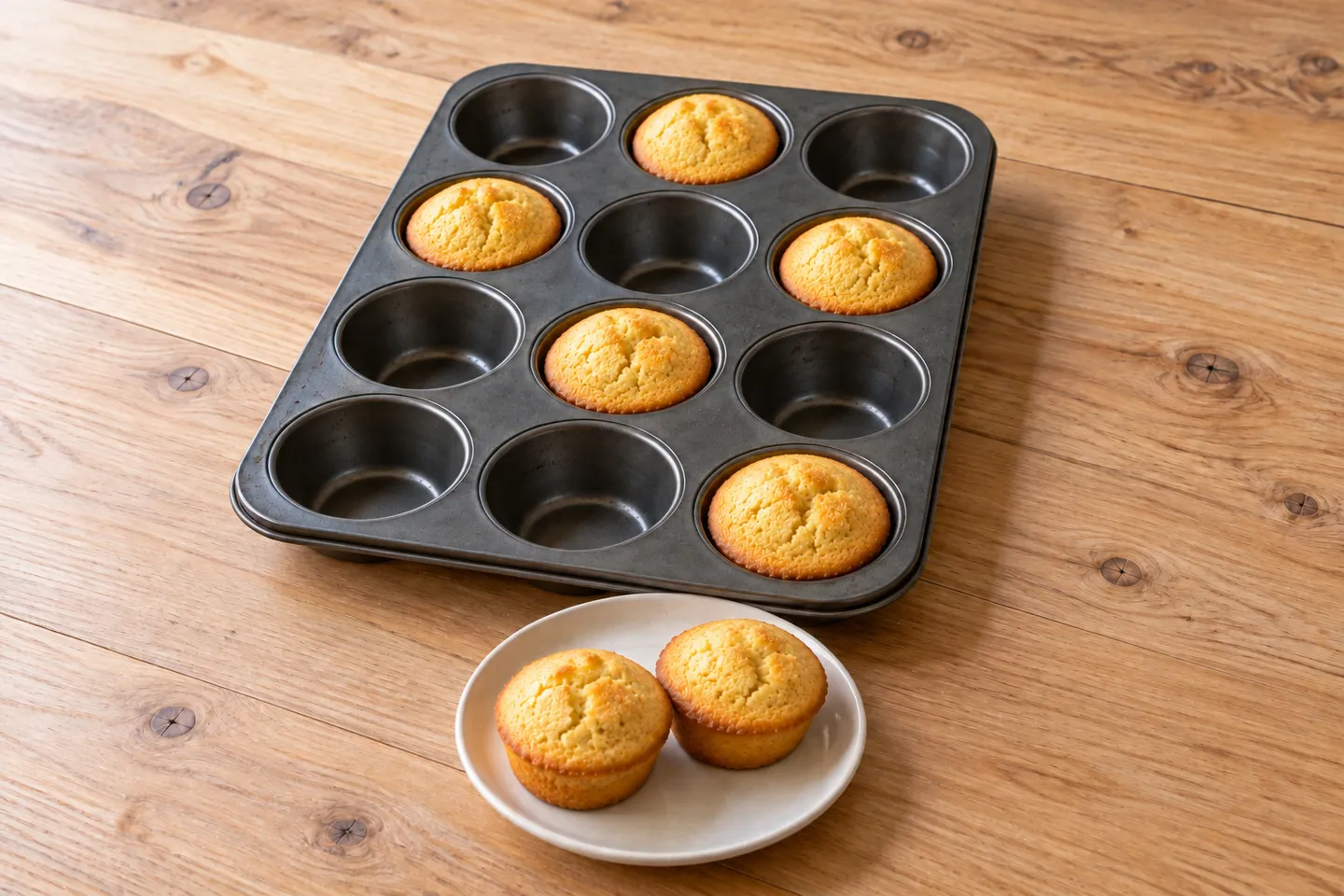
Cornmeal Gems (1918)
Small cornmeal-and-wheat muffins with a tablespoon each of sugar and melted butter, adapted from Farmer's 1918 Corn Meal Gems for a modern metal pan.
- Original yieldYield
- 4 breakfast servings; about 6 to 8 small gems (estimated)4 breakfast servingsabout 6 to 8 small gems (estimated)
- PrepPrep time
- CookCook time
- TotalTotal time
Estimated: 15 minutes for setup and mixing, 18 to 25 minutes baking, then 5 minutes in the pan. Preheat during preparation; further cooling is optional.
Published
Original recipe: 4 breakfast servings; about 6 to 8 small gems (estimated)
The story behind the recipe
There is twice as much wheat flour as cornmeal by volume in these cornmeal gems, with just a tablespoon each of sugar and melted butter. They are small, plain breakfast muffins rather than sweet corn cakes. Yellow cornmeal gives them a pale gold crumb; the wheat flour remains a substantial part of the mixture.
Follow the short instruction
Farmer ends the 1918 entry with “Mix and bake as Graham Muffins II.” That earlier recipe supplies the order of mixing, buttered gem pans, a hot oven and twenty-five minutes. The directions below follow that connection, with a defined modern metal pan and oven setting so the recipe can stand on its own.
Read more about this recipe
The corn is a meal
Use plain, medium-grind yellow cornmeal: dried corn ground into small granules. This recipe doesn't call for sweetcorn kernels, cornstarch or a self-rising cornbread mix. The first adds a different ingredient; the second is a starch; the mix already contains other ingredients, including leavener.
Farmer's quantity is half a cup of cornmeal to a cup of flour. The meal remains visible as small grains in the crumb, while the white flour supplies the larger share of the dry grain mixture. That balance distinguishes these gems from a corn-only bread. It also means they contain wheat, alongside milk and egg.
We use medium-grind yellow meal for this version; Farmer lists simply “corn meal.” Her weight table's granulated-cornmeal entry supplies the weight beside our half cup, rounded for a kitchen scale.
A different batter from the same page
The neighboring recipes show why the borrowed method shouldn't be mistaken for a shared formula. Graham Muffins II has more milk, more butter and more sugar, and its flour mixture includes whole wheat. The cornmeal gems have their own ingredient balance and three teaspoons of baking powder.
We keep the source's three teaspoons of baking powder, specifying a modern double-acting product. Each spoonful is measured level, following Farmer's general measuring directions.
Hominy Gems, printed immediately below, takes another route. Farmer pours boiling water over the hominy, scalded milk over the cornmeal, and later adds beaten yolks and stiffly beaten whites. Our Corn Meal Gems has none of those stages. There is no soak to schedule and no egg white to whip separately.
A portion small enough for the pan
The source doesn't give a cavity volume. We use the same room-temperature metal pan specified for our Graham muffins, as explained in Gem Pans and Muffin Tins, with wells of about 120 ml to the rim. Fill them about two-thirds full and let the amount of batter determine how many wells you use.
Farmer's instruction to preheat iron belongs to One Egg Muffins I, a separate entry in the chapter. The method she names for these cornmeal gems calls for buttered pans without that extra step.
Keep the finished gems plain at first. A warm one beside eggs, soup or a bean dish makes sense of their small sugar allowance: this is a corn-and-wheat bread that can sit with a savory meal.
Make it your wayOriginal: 4 servings · Makes 4 breakfast servings; about 6 to 8 small gems (estimated)
Original recipe: 4 breakfast servings; about 6 to 8 small gems (estimated)
Ingredients
For 4 breakfast servings; about 6 to 8 small gems (estimated). Quantities are shown as written.
Source measurement convention: US customary. Explicit unit definitions take precedence; unconfirmed measures must be checked before conversion.
Original quantities for 4 breakfast servings; about 6 to 8 small gems (estimated).
- Medium-grind yellow cornmeal1/2 cupAuthor measures: 85 g.
- All-purpose flour1 cupAuthor measures: 113 g.
- Double-acting baking powder3 tsp
- Granulated sugar1 tbsp
- Fine salt1/2 tsp
- Whole milk3/4 cup
- Large egg1
- Unsalted butter, melted and cooled until lukewarm1 tbsp
- Unsalted butter, melted, for greasing2 tsp
Measurement notes
- medium-grind yellow cornmeal, all-purpose flour, whole milk: US cup: 1 = 236.5882 ml (rounded).
- double-acting baking powder, fine salt, unsalted butter, melted, for greasing: US tsp: 1 = 4.9289 ml (rounded).
- granulated sugar, unsalted butter, melted and cooled until lukewarm: US tbsp: 1 = 14.7868 ml (rounded).
Measurement notes
Original ingredients
- 1/2 cup (85 g) medium-grind yellow cornmealUS cup: 1 = 236.5882 ml (rounded).
- 1 cup (113 g) all-purpose flourUS cup: 1 = 236.5882 ml (rounded).
- 3 tsp double-acting baking powderUS tsp: 1 = 4.9289 ml (rounded).
- 1 tbsp granulated sugarUS tbsp: 1 = 14.7868 ml (rounded).
- 1/2 tsp fine saltUS tsp: 1 = 4.9289 ml (rounded).
- 3/4 cup whole milkUS cup: 1 = 236.5882 ml (rounded).
- 1 large egg
- 1 tbsp unsalted butter, melted and cooled until lukewarmUS tbsp: 1 = 14.7868 ml (rounded).
- 2 tsp unsalted butter, melted, for greasingUS tsp: 1 = 4.9289 ml (rounded).
Equipment
 12-cup metal muffin pan (about 120 ml per well)
 Wire cooling rack
Instructions
Prepare the oven and pan
Heat a conventional oven to 400°F (205°C), with a rack in the middle. Use a room-temperature metal muffin pan with 12 wells of about 120 ml each, measured to the rim. Brush the bottoms and sides with the 2 tsp melted butter for greasing; do not heat the empty pan.
Measure and sift the grain ingredients
If using cups, sift the cornmeal and all-purpose flour separately before measuring. Return any cornmeal caught in the sieve to the meal, stir it through, then spoon each grain ingredient into its cup and level without packing. If using the stated weights, weigh the meal and flour directly, then sift together, retaining all the meal.
Mix in the leavener and seasoning
Mix the baking powder, sugar and salt thoroughly into the meal and flour so no pockets of leavener remain.
Combine the batter
Beat the egg in a small bowl. Stir the milk gradually into the dry ingredients, then add the beaten egg and the 1 tbsp melted butter. Stir until evenly moistened with no dry flour remaining; do not beat the batter until smooth.
Fill the muffin wells
Spoon all the batter into the greased wells, filling each about two-thirds full. Expect roughly 6 to 8 portions, but use another well rather than overfilling to match a count. A final smaller portion is fine; it may finish sooner.
Bake until the centers are set
Bake immediately, checking from 18 minutes and allowing about 18 to 25 minutes in total. The tops should be set and lightly golden, the edges browned, and a skewer inserted into the center of a gem should come out without wet batter. Remove smaller portions sooner if they are already done.
Rest and unmold
Let the gems stand in the pan for 5 minutes. Loosen the edges gently, lift them onto the wire rack and serve warm, or let them cool completely before covering.
Estimated calories 290 kcal
Nutrition portion: 1/4 of recipe · Original yield: 4 breakfast servings; about 6 to 8 small gems (estimated)
Source & assumptions
Ingredient-based estimate using CoFID 2021, identified manufacturer information. Approximately 290 kcal per nutrition portion. One-quarter of the original batter, regardless of gem count. Includes all measured greasing butter. Ingredients, brands and preparation affect values.
Recipe notes
When adjusting quantities
Keep the same pan material, cavity size and fill when scaling. Use additional pans or mix separate batches just before baking; do not leave wet batter waiting through another bake. Times and temperatures do not scale. For a half batch, beat the egg and use half by weight.
Original recipe notes
These notes describe the original recipe. Quantities mentioned here do not change when you adjust servings.
The batch serves four as the bread portion of breakfast; the estimated gem count is our planning figure, not Farmer's yield. Portion by the stated fill level.
Use plain cornmeal and plain all-purpose flour. Coarse polenta, cornstarch, corn flour sold as a fine powder and self-rising mixes are different products from the medium-grind meal specified here. Keep all the cornmeal when sifting; the sieve is for breaking lumps and combining ingredients, not removing the grain.
Pan finish, actual portions and oven behavior can change the baking time. Use the stated window as a guide and check the center as described in the method. A different pan material or cavity size needs a separately adjusted baking schedule.
For a larger quantity, keep each portion at the same fill in the same size well. Mix extra batches just before their pan goes into the oven. Scaling ingredients does not change the fixed pan capacity, oven setting or written timing.
Read the scaling guide. Times, temperatures and equipment need their own consideration. Open the recipe tool to review and correct individual amounts.
Sources and attribution
Fannie Merritt Farmer, The Boston Cooking-School Cook Book, revised edition (Boston: Little, Brown, and Company, 1918), Corn Meal Gems, p. 74, with Graham Muffins II method, p. 73
Farmer, revised1918 edition, Corn Meal Gems
Fannie Merritt Farmer, *The Boston Cooking-School Cook Book*, revised edition, 1918, “Corn Meal Gems,” p. 74, referring to “Graham Muffins II,” p. 73; measuring directions and tables, pp. 25–28.
Recipe details
- Recipe tradition
- Vintage
- Cuisine
- American
- Source decade
- 1910s
- Cooking method
- Oven
- Browse category
- Breakfast & Brunch