
- Jewish cooking
- Cooking techniques
- Food history
- Passover
Time, Texture and Tradition: Jewish Cooking Techniques Across the Ages
A Sabbath pot, poached fish, leek patties and an egg-risen cake show how time, ingredients and religious practice shape the cooking.
A ladder appears on the brass cooking pot. It belongs to an inscription identifying a woman through her husband and her father’s house sign, rather than through her own name. The pot, dated 1579/80 and made in Frankfurt, now sits in the Jewish Museum’s collection. A household utensil has kept a small piece of its owner’s identity for more than four centuries.
Its history also points toward a meal prepared ahead. The museum places such pots in the context of Sabbath food and communal ovens. For a cook, that means thinking beyond the moment of serving: what can spend hours in a covered pot, and what texture should it have when the lid is lifted?
That question is one way into Jewish cooking. Another is how finely to chop fish before poaching it. Or how firmly to squeeze cooked leeks before frying them. Or how to fold starch into beaten eggs without losing the air. Four companion recipes let us follow those decisions, with religious practice, regional ingredients and documented changes alongside the food.
Before the recipe, a timetable
The connection between advance preparation and the Sabbath appears in the biblical account of manna. In Exodus 16:23, baking and boiling are to be done before the day of rest. Preparation belongs to the day before: a timetable that later cooks answered with different pots and ingredients.
Later practice is more detailed, and communities have developed different ways to prepare and keep meals. The Jewish Language Project’s account in the Posen Library connects Sabbath-stew names with heat, covering and an overnight stay. Cholent has medieval Judeo-French roots in its name; hamin and adafina belong to other linguistic settings. The vocabulary has traveled with the food.
Those names shouldn’t be flattened into an instruction to put the same ingredients in every pot. A stew based on barley isn’t identical to one with chickpeas, rice or eggs. A shared preparation problem can produce quite different meals.
For the modern companion cholent, the schedule is deliberately an afternoon in a conventional oven. It allows checks for moisture and tenderness before serving. It doesn’t prescribe how to operate an appliance on the Sabbath; cooks observing those rules need guidance appropriate to their own practice.
What the Frankfurt pot can tell us
The Jewish Museum’s cooking pot is a particularly tangible historical anchor. Its inscription is dated, and its material is brass. It offers a dated household object around which to place the history.
The ladder refers to the house sign associated with the owner’s father, Moses zur Leiter. The museum explains how house signs helped identify families in Frankfurt. Marking a pot also made practical sense in a setting where household food could go to a shared oven.
The inscription makes an otherwise ordinary pot personal. In a shared oven, identifying whose vessel was whose mattered as much as choosing a suitable container for the food.
Long cooking changes the spoonful
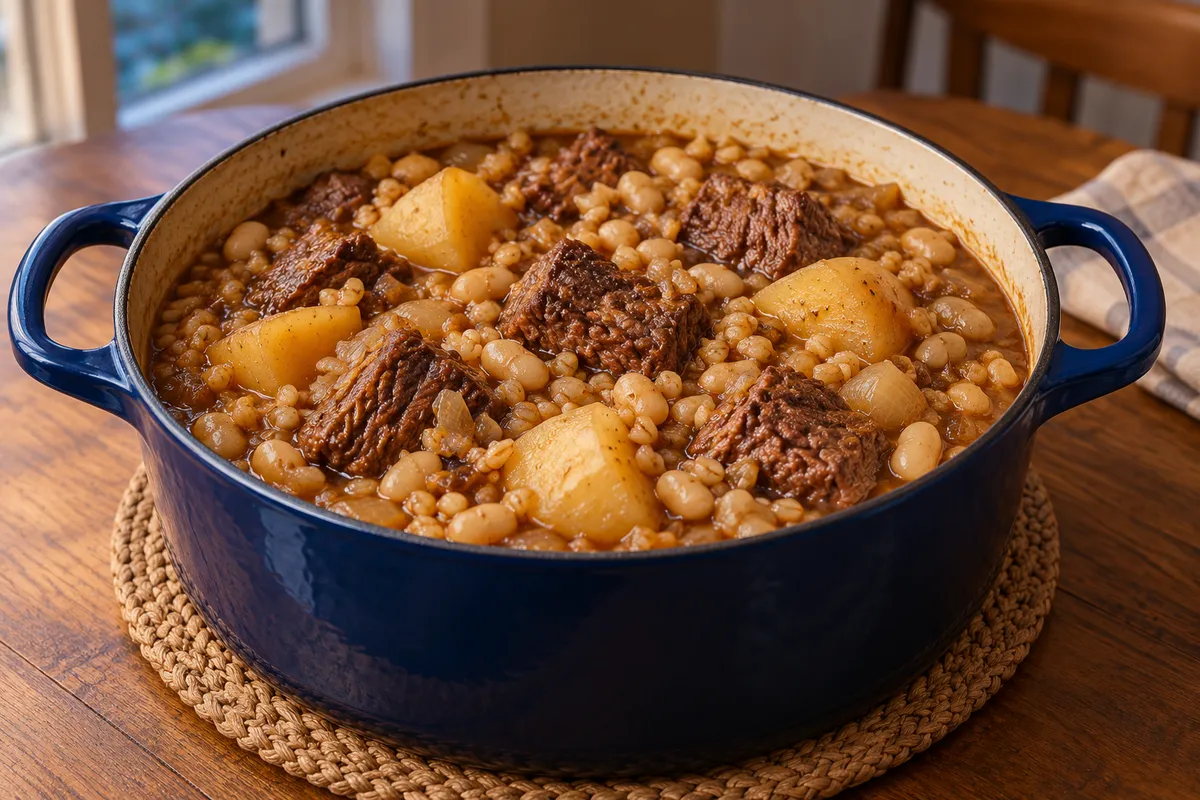
In our beef, barley and bean cholent, the beef should yield easily to a fork. Pearl barley absorbs liquid and thickens the pot; potatoes soften into substantial pieces. The canned beans are already cooked, so they are added later. Their timing is a modern practical choice.
The grain matters as much as the meat. A pot can appear generously supplied with water at the start and become much thicker as it cooks. Checking moisture prevents the barley from catching on the base while the beef still needs time. The covered vessel limits evaporation, but it doesn’t eliminate it.
Different published contemporary recipes show different schedules. Marion Rogovin’s contribution to the Jacob Burns Film Center’s community cookbook uses a covered oven casserole. Joel Haber’s Polish Chulent, published by Reform Judaism, uses a slow cooker. The companion recipe adapts the daytime oven approach, with prepared weights and boneless chuck.
Keep that distinction at the table, too. It is a meat dish, without a butter or cream finish. The cooking choices follow both the desired stew and the intended kosher context, with the flavor coming from the meat and its long cooking.
Chopped fish, a quiet poach
Gefilte fish offers a different kind of preparation ahead. The fish is finely processed, combined with a binder, shaped and poached, then chilled. The finished portion is a cohesive oval, not a fillet that separates into flakes under the fork.
The word gefilte means stuffed. Chabad’s account describes the relationship between filling a fish skin with the prepared mixture and the separate shaped portions now familiar to many cooks. That change helps explain a name that can otherwise seem disconnected from the food on the plate.
Our gefilte fish with carrots follows a modern version shared by Liz Galst with Jewish Food Society. Her chosen fish mixture differs from the earlier one in her family. We retain the two-to-one combination of Arctic char and striped bass, with a smaller batch and a simpler poaching liquid.
The char gives the patties a slight blush. Carrot coins and a spoonful of cool poaching liquid accompany the smooth ovals, which are served cold after a refrigerated rest.
Chopping, binding and gentle heat all contribute to that texture. A rolling boil can jostle the portions before they have set. An overnight chill belongs in the plan from the outset, so this isn’t a starter to begin just before guests arrive.
Leeks need squeezing before frying
The Sephardic leek fritters begin with a less glamorous task: washing between the layers. Their prepared weight excludes the tough leaves and the sand. Once the leek and potato are tender, the cook drains them and squeezes the leek before adding egg and breadcrumbs.
That removal of water is the decisive step. Extra moisture makes the mixture loose, encouraging the cook to add more binder and move further from a leek-dominated patty. A thin round also cooks differently from a thick ball; the middle needs to set while the outside browns.
There are meat-containing and meatless Sephardic leek-patty recipes. Kosher Cowboy’s published version directly supports the meatless potato-and-egg approach used here. The companion recipe defines the vegetable weights and uses a shallower oil layer, to make a tender vegetable center under the fried surface.
The broader variety remains visible in ANU Museum’s Foodish collection, which includes a meat-and-leek version. Meat and potato versions answer the same moisture problem with different mixtures, and each deserves its own description.
Our patties use ordinary wheat breadcrumbs. That is the version to shop for and cook; it isn’t the Passover branch. Festival names don’t make two binders behave identically in the frying pan.
A cookbook makes the change visible
Printed books let us see some adaptations on the page. The Economical Jewish Cook, arranged by May Henry and Edith B. Cohen, identifies itself as a class book for schools. In its 1897 third edition, the authors describe revising and adding recipes. They were recording a working cookery repertoire, not a collection expected to remain untouched.
On printed page 72, a Swiss-roll entry sends the reader back to page 50, then specifies potato flour or motza meal in place of flour, with a different filling. A short cross-reference carries a substantial change. Read only the general roll and the festival variation disappears; read only the variation and some of the method is missing.
This is also why an old ingredient name deserves care. Historical potato flour doesn’t automatically identify the same packaged product as modern potato starch. The alternatives in that entry have different stated quantities, too. Calling them all flour would hide information the cook needs.
The earlier Jewish Manual of 1846 is another reference point in this English-language cookbook history. Wellcome’s catalogue attributes it probably to Lady Judith Montefiore. That qualification belongs with the attribution; the catalogue doesn’t make her authorship certain.
A sponge lifted by eggs
Our Passover sponge cake with potato starch uses an identified modern potato-starch formula from Spice and Spirit, excerpted by Chabad. The earlier roll and the modern ring cake share an interest in egg lift, with different formulas and shapes.
The whites are beaten with sugar, then folded with the yolks and starch. The aim is to keep enough air in the mixture for a foam cake. Vigorous stirring after that work defeats the purpose of beating the eggs in the first place.
The smooth, ungreased tube pan is part of the method. The sponge grips its walls as it bakes and then cools upside down. A decorative nonstick mold may look attractive, but its coating and shape don’t provide the specified support. Plan the safe inversion arrangement before there is a hot pan to turn over.
Once the cake is cold, release the outer wall and the tube before loosening the base. The ring can come to the table whole, with its lemon flavor and light crumb carrying a plain slice.
Choose ingredients for the intended kitchen
Jewish food history and kosher suitability are related questions, with different kinds of evidence. A museum pot or an old recipe explains a historical setting. Ingredient sourcing, processing and equipment matter to the meal being made now.
Chabad’s guide to meat, dairy and pareve explains those categories and their kitchen implications. A recipe without pork isn’t automatically certified kosher. Nor does the absence of ordinary flour certify a cake for Passover; OU Kosher’s ingredient guidance makes clear that even a gluten-free label answers a different question.
The four recipes are therefore separate choices. The barley stew isn’t a Passover dish. The leek patties here contain breadcrumbs. The fish uses matzo meal, which matters to households with particular festival practices. The cake specifies potato starch and needs appropriately selected ingredients and equipment.
Choose the technique that suits the meal: a covered pot for softened grain and tender beef, a quiet poach for shaped fish, thorough draining before frying leeks, or careful folding for a sponge. Each has a history worth reading and a texture worth paying attention to at the stove.

Read the diagram text
Documented anchors alongside four separate modern recipes. Historical evidence: Exodus 16:23 A religious framework for preparation before the day of rest. 1579/80 · Frankfurt A brass cooking pot survives in the Jewish Museum collection. 1846 · The Jewish Manual An English-language cookbook; authorship is qualified in its catalog. 1897 · The Economical Jewish Cook Third edition, pages 50 and 72: a roll and its Passover variation. Modern cooking choices: Covered cholent pot Daytime oven cooking softens beef, barley and potatoes. Chop and gently poach Finely processed fish becomes cohesive ovals, then chills. Drain before frying Squeeze cooked leeks before making thin vegetable patties. Beat and fold A modern potato-starch sponge uses egg foam and a smooth tube pan. These are separate reading paths, not claims of direct descent or invention dates. These recipes are not one Passover menu.
Sources
The Jewish Museum, Cooking Pot, accession JM 23-64; Exodus 16:23; Jewish Language Project, Sabbath-stew names, via Posen Library (2024); May Henry and Edith B. Cohen, The Economical Jewish Cook, third edition (1897), title page, preface p. iv and pp. 50, 72; Wellcome Collection’s catalogue of The Jewish Manual (1846). Contemporary recipe and practice sources are linked beside their discussion. The companion recipes identify their individual adaptations and preparation schedules.