
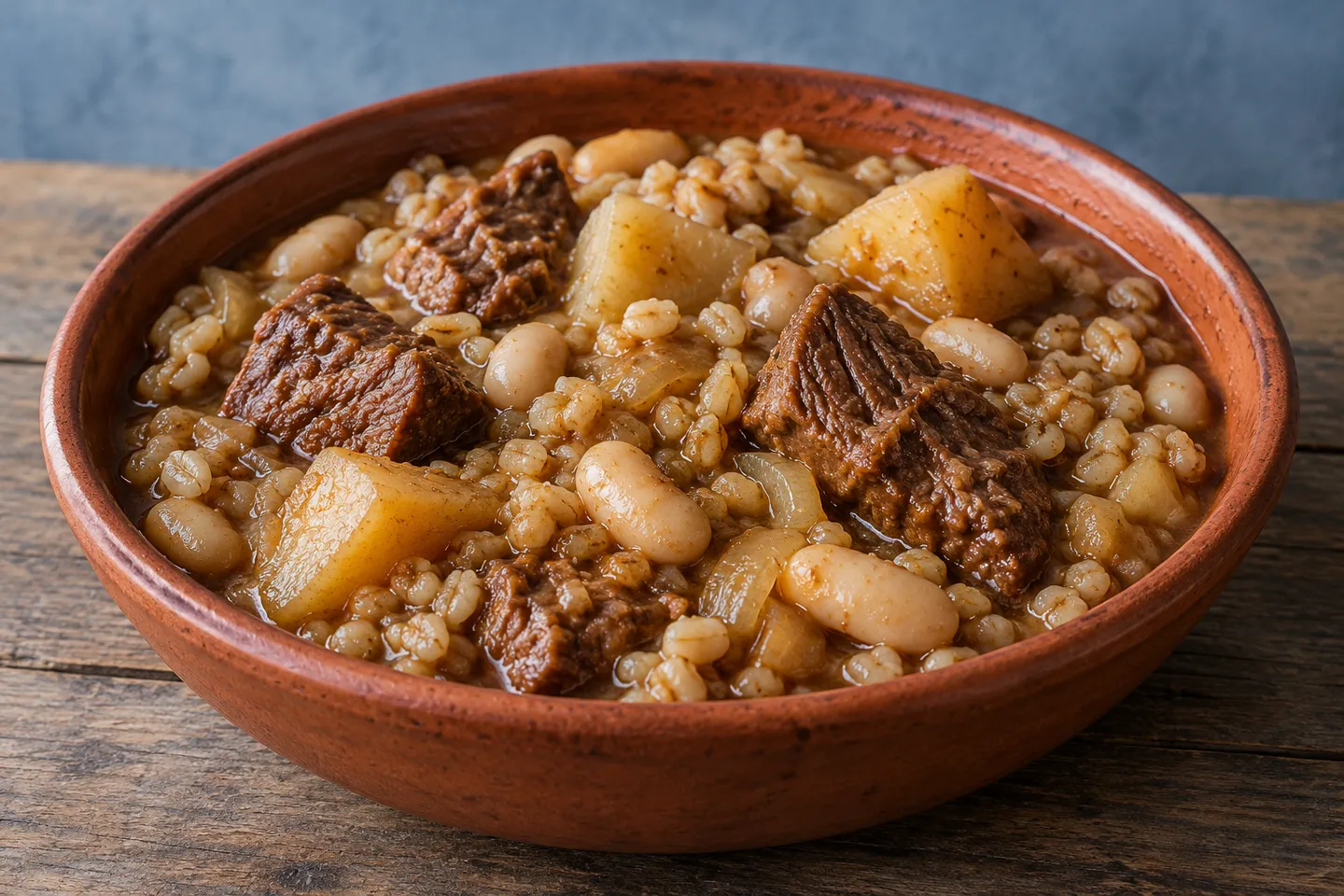
Beef, Barley and Bean Cholent
A covered-pot beef stew with pearl barley, potatoes and white beans, adapted to a daytime oven schedule.
- Original yieldYield
- 6 substantial bowls6 substantial bowls
- PrepPrep time
- CookCook time
- TotalTotal time
Estimated: 25 minutes preparation, about 10 minutes on the stove, 3 to 4 hours in the oven and 10 minutes standing. Check tenderness rather than assuming every cut finishes at the same time.
Published
Original recipe: 6 substantial bowls
The story behind the recipe
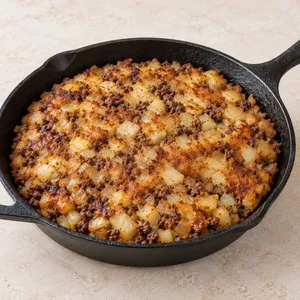
The barley thickens the liquid around the beef and potatoes until this is a stew to spoon into bowls, with softened grain in every spoonful. White beans go in near the end because they're already cooked. The covered oven pot does most of the work.
A daytime pot
This version takes an afternoon. It keeps the long, gentle cooking associated with cholent while giving the cook a defined oven schedule and a chance to check the liquid. Serve it when the beef is tender, with the barley fully softened around it.
Read more about this recipe
The meal prepared ahead
Cholent belongs to the Ashkenazi Sabbath-pot tradition. Preparing food before the Sabbath and keeping it warm for a later meal shaped both the choice of ingredients and their texture. A firm piece of stewing beef can become tender during prolonged cooking; a grain can absorb liquid as the pot cooks.
Jewish Sabbath stews have many regional names and forms. The beef, barley, potatoes and white beans here belong to one documented modern combination. Other pots use different grains or legumes, shaped by their communities and local cupboards.
Marion Rogovin's Old World Cholent, published by the Jacob Burns Film Center, is a useful comparison: its beef, beans, barley and potatoes cook in a covered casserole at a moderate oven temperature. Joel Haber's Polish Chulent, published by Reform Judaism, describes a different, slow-cooker schedule. Those choices show how a familiar pot can be cooked with different equipment.
Start with the right weights
The barley is weighed dry. The beans are weighed after draining a can, and the potatoes after peeling. Those details matter more than the number of cans or the size of a potato in the shopping bag.
Canned beans are a practical change from the dried beans in the published comparisons. They're added late so that another several hours of cooking doesn't turn them entirely into the sauce. Don't replace them with raw dried beans and keep the same schedule: soaking, initial cooking and water requirements would all need attention.
Tender beef, soft grain
Chuck is the specified cut. It is suited to a long covered cook, unlike a thin steak intended for quick searing. Its tenderness is the final cue; the clock supplies a window for checking it.
The pot needs enough liquid for the barley as well as the meat. Check during cooking and add hot water if the surface is drying. At the end, allow a short rest so the bubbling settles before spooning into bowls. A thick consistency is expected, but a scorched layer under dry grain isn't.
Serve from the pot
Keep the bowl simple. Serve the stew on its own, with the beef, barley and beans together. The long cook gives them a shared texture without an extra sauce to make at the last minute.
Explore the historical background and companion recipes in Time, Texture and Tradition: Jewish Cooking Techniques Across the Ages.
Make it your wayOriginal: 6 servings · Makes 6 substantial bowls
Original recipe: 6 substantial bowls
Ingredients
For 6 substantial bowls. Quantities are shown as written.
Source measurement convention: Metric. Explicit unit definitions take precedence; unconfirmed measures must be checked before conversion.
Original quantities for 6 substantial bowls.
- Boneless beef chuck, cut into 3 cm pieces750 g
- Onions, peeled weight, sliced300 g
- Potatoes, peeled weight, cut into 4 cm chunks500 g
- Uncooked pearl barley, rinsed150 g
- Canned cannellini beans, drained and rinsed weight480 g
- Water1.5 l
- Sunflower oil20 ml
- Fine salt1 tsp
- Ground black pepper1/2 tsp
Measurement notes
- fine salt, ground black pepper: US tsp: 1 = 4.9289 ml (rounded).
Measurement notes
Original ingredients
- 750 g boneless beef chuck, cut into 3 cm pieces
- 300 g onions, peeled weight, sliced
- 500 g potatoes, peeled weight, cut into 4 cm chunks
- 150 g uncooked pearl barley, rinsed
- 480 g canned cannellini beans, drained and rinsed weight
- 1.5 L water
- 20 ml sunflower oil
- 1 US tsp fine saltUS tsp: 1 = 4.9289 ml (rounded).
- 1/2 US tsp ground black pepperUS tsp: 1 = 4.9289 ml (rounded).
Equipment
 Large heavy pot or Dutch oven
Instructions
Heat the oven and choose the pot
Heat the oven to 325°F (160°C), conventional heat. Use a heavy covered Dutch oven with at least 5 liters capacity, suitable for both the stove and oven.
Soften onions and start the stew
Heat the oil over medium heat. Add the onions and cook for about 8 minutes, stirring, until softened. Add the beef, potatoes, barley, salt, pepper and water. Bring to a simmer, stirring along the base so the barley doesn't catch.
Cook the covered pot
Cover and transfer to the oven. Cook for 2 1/2 hours, checking after 90 minutes and stirring gently along the bottom. If the grain is drying before the beef is tender, add hot water a little at a time to keep the mixture moist.
Add beans and finish until tender
Stir in the drained beans. Cover and continue cooking for 30 to 90 minutes, until a fork enters the beef easily, the potatoes are tender and the barley is fully soft. Keep enough liquid around the solids to prevent scorching.
Rest and serve the cholent
Stand for 10 minutes, then divide among six bowls at the original yield. Serve hot. Refrigerate leftovers promptly in shallow containers, within 2 hours of cooking or 1 hour if the air is above 90°F (32°C).
Estimated calories 490 kcal
Nutrition portion: 1/6 of recipe · Original yield: 6 substantial bowls
Source & assumptions
Ingredient-based estimate using CoFID 2021, identified USDA reference entries and representative product labels. Approximately 490 kcal per original serving; ingredients and preparation affect values.
Recipe notes
When adjusting quantities
Keep the original pot depth and use another pot for a larger batch. Liquid loss and cooking time do not scale with servings.
Original recipe notes
These notes describe the original recipe. Quantities mentioned here do not change when you adjust servings.
Adapted from Marion Rogovin's Old World Cholent, Breaking Bread from the JBFC Community, pp. 17–18, with Joel Haber's Polish Chulent as a regional comparison. This version uses boneless chuck, prepared metric weights, canned beans added late, more barley, water instead of broth, no garlic or marrow bones and oil to soften the onions. The quantities are an adapted batch, not a proportional reduction. The oven schedule follows the former source's daytime approach; it isn't a guide to Sabbath appliance practice.
Contains barley (gluten). The bean weight is cooked and drained; it isn't a dried-bean equivalent. For kosher preparation, select appropriate meat and processed ingredients and use suitable equipment. Store cooked leftovers at 40°F (4°C) or below and reheat throughout to 165°F (74°C).
Read the scaling guide. Times, temperatures and equipment need their own consideration. Open the recipe tool to review and correct individual amounts.
Sources and attribution
Modern adaptation informed by Marion Rogovin's Old World Cholent in Breaking Bread from the JBFC Community and Joel Haber's Polish Chulent.
Recipe details
- Course or meal
- Dinner
- Cuisine
- Jewish
- Cooking method
- Oven
- Browse category
- Main Dishes