

- Cooking methods
- Vintage
- Fish
- Vegetables
What a Wrapper Changes: Cooking Fish and Vegetables in Parcels
How parchment parcels hold cooking juices, why fish and potatoes need different treatment, and what Nicolas Soyer's 1911 recipes can teach a modern cook.
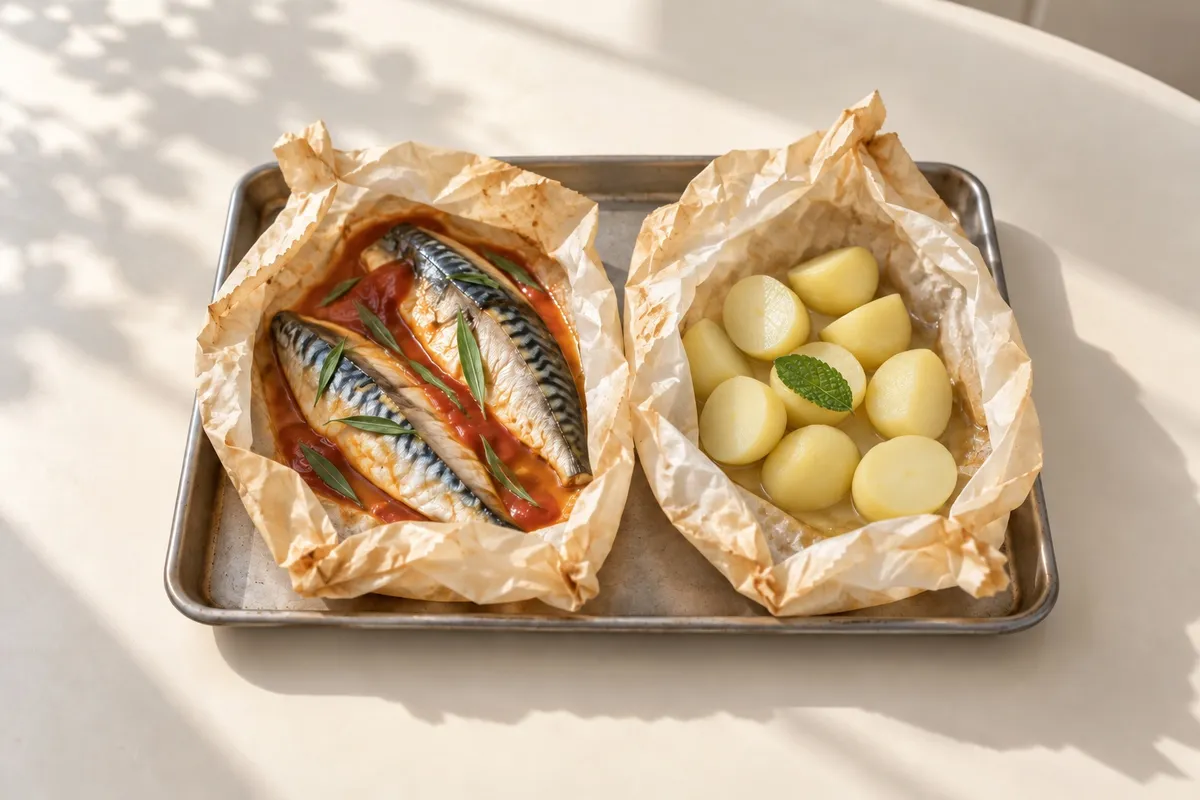
The sauce is still inside when dinner comes out of the oven. Open a fish parcel carefully and there’s something to spoon over the fillets: their juices, melted butter and whatever seasoning went in before the paper was folded. A potato parcel starts with a different problem. It needs enough moisture to cook the potatoes through, without a saucepan of water to drain afterward.
Both are enclosed oven cooking, often called en papillote when the wrapper is parchment. The useful decision happens before the fold: how much liquid does this food need, and how will you know it’s cooked when you can’t watch it?
Nicolas Soyer answered those questions with fish, ketchup and a very small quantity of water in his 1911 Paper-Bag Cookery. His wrappers were special cooking bags. Our companion recipes use food-grade baking parchment rated for the selected oven temperature.
The fish and potato parcels are opened for serving after separate cooking.
Keep the juices with the food
A folded parcel holds the food and much of its cooking liquid together. Moisture heats inside the wrapper, while the oven supplies heat from outside. The folds need to contain that liquid; a loosely draped sheet over a baking tray isn’t the same arrangement.
That makes a parcel useful when the liquid is part of dinner. Soyer’s mackerel has butter, tarragon and tomato ketchup on the fillets. He tells the cook to serve the sauce with the fish. For potatoes, he specifies three spoonfuls of water for three people. One recipe begins with a sauce; the other adds a little water to help cook a starchy vegetable.
Neither is intended to produce the browned surface of uncovered roasting. If crisp edges are what you want from potatoes, choose an open roasting method. A parcel suits a different result: cooked potato halves with their mint and a little liquid enclosed around them.
Match the liquid to the ingredient
For the fish, start with the specified sauce rather than adding water as an automatic precaution. Soyer allows more ketchup if wanted, but says his stated quantity is enough for cooking. The modern adaptation keeps the same ingredient combination and gives the butter, herb and sauce measured amounts.
Potatoes need a separate judgment. Their size and cut affect how quickly the center cooks. Small new potatoes, peeled and halved, preserve the preparation in Soyer’s recipe. A packet of whole large potatoes would need another timing decision; it wouldn’t be the same batch with an easier preparation step.
Keep liquid inside the folds and support the packet on a rimmed baking sheet. Leave room around the ingredients so you can close the paper without forcing the food against the seam. The parchment manufacturer’s packet-folding instructions show one practical way to make an enclosed pouch.
Check the food when you open the parcel
Enclosing dinner also hides it. Cooking times remain estimates, and a puffed wrapper doesn’t establish that the center is ready.
For fish, carefully open a fold and insert a food thermometer into the thickest part of a fillet. The federal cooking chart gives 145°F (63°C) for fish. Open the paper away from your face and hands, allowing hot steam to escape. If the fish needs longer, fold the parcel closed and return it to the oven.
For potatoes, test the center of a large piece with a fork. The companion recipe uses tenderness as the endpoint. Add cooking time if needed, keeping the packet enclosed rather than assuming the printed interval guarantees the result.
The two recipes have different oven settings and estimated cooking times. Cook them separately as written. Their shared wrapper doesn’t make them a synchronized one-tray meal.
The cooking bag was also a product
Soyer acknowledged that cooking in paper was an older principle. His ambition was to extend it across everyday meals. The American book’s opening advertisement offered specially prepared bags from the Union Bag & Paper Company, while his discussion of kitchen work promised less washing up.
The recipes show how much judgment remained. Someone still had to prepare the fish, cut the potatoes, select the heat, close the bag and decide when dinner was ready. Soyer’s preference for American tomato catsup in the mackerel recipe is another reminder that the supposedly simple method depended on the materials put inside it.
The wrapper matters today too. Use parchment sold for oven cooking and follow its manufacturer’s temperature and appliance restrictions. Reynolds’ parchment guidance, for example, excludes broiling units and contact with flames or oven surfaces. USDA specifically advises against cooking in grocery bags. Soyer’s title is historical attribution, not a shopping instruction.
Two parcels to cook
Mackerel with tarragon and tomato ketchup
Butter, tarragon and a measured layer of ketchup go over the fillets before the parchment closes. The fish and sauce stay together through cooking and serving. Adapted from Soyer’s Mackerel à la Napolitaine, printed in 1911.
Companion recipe: Mackerel in Parchment with Tarragon and Tomato Ketchup (1911).
Minted new potatoes
Halved new potatoes cook with a mint leaf and a little water inside their packet. The comparison with fish makes the liquid decision visible: these potatoes start with measured water rather than a butter-and-ketchup sauce.
Companion recipe: Minted New Potatoes in Parchment (1911).
Sources
Nicolas Soyer, Soyer’s Paper-Bag Cookery (New York: Sturgis & Walton, 1911), opening bag advertisement; introduction, pp. 7–9, and kitchen-work discussion, p. 16; Mackerel à la Napolitaine, pp. 33–34; New Potatoes, p. 69. The American edition includes a revision note by Virginia Terhune Van de Water. The modern recipes use parchment and supplied household quantities; they don’t establish Soyer’s advertised savings in work or fuel. Digitized edition record.