

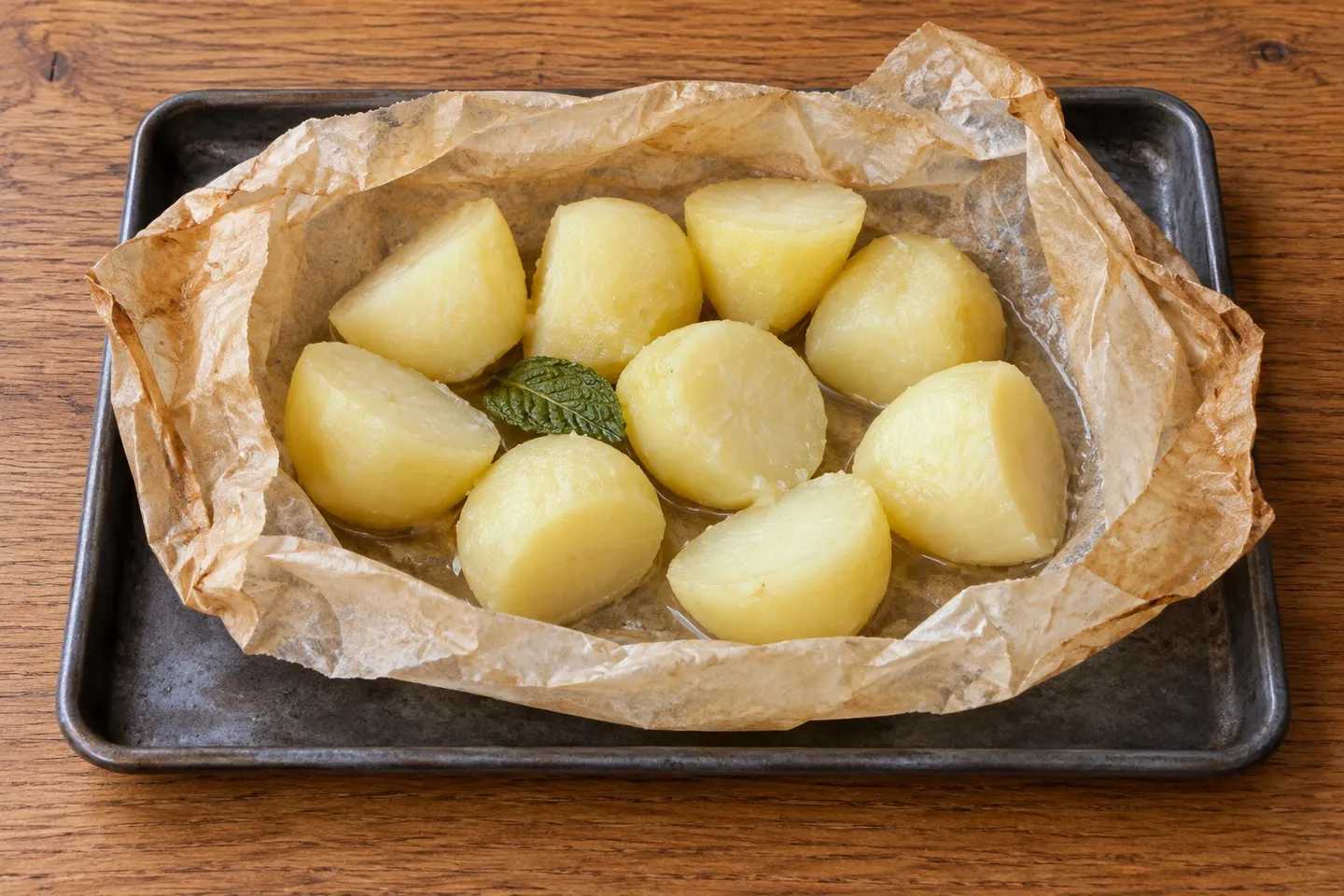
Minted New Potatoes in Parchment (1911)
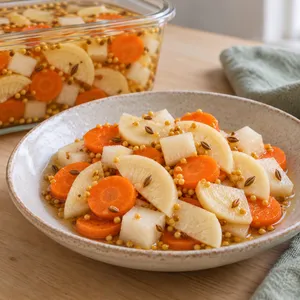
Peeled, halved new potatoes baked in a parchment parcel with a mint leaf and a little water, adapted from Nicolas Soyer's 1911 recipe.
- Original yieldYield
- 3 side portions3 side portions
- PrepPrep time
- CookCook time
- TotalTotal time
Estimated 15 minutes preparation while the oven heats, then 30–40 minutes baking. Potato size and tenderness determine readiness.
Published
Original recipe: 3 side portions
The story behind the recipe
One mint leaf, three spoonfuls of water and enough potatoes for three people: Nicolas Soyer's parcel is a very small ingredient list. The potatoes are peeled and halved, then enclosed for the oven. The result to aim for is a tender potato half, with its seasoning kept inside the paper.
A little water in a closed packet
These aren't roast potatoes with browned edges. The parchment encloses the water around them as they cook. A fork should enter the center of a large piece easily before the parcel goes to the table.
Mint and a little salt are the only seasonings in Soyer's New Potatoes recipe. This version keeps that spare combination and his modest added water.
Read more about this recipe
The cut belongs to the recipe
Soyer says to halve the potatoes, then repeats that all of them should be cut in two. He wanted every potato cut. A packet of whole potatoes would be a different cooking problem, especially if some were much larger than others.
The modern recipe chooses small new potatoes of similar size. Their measured weight is taken after peeling, so the amount in the parcel is clear. Similar halves give you a more consistent size to check at the center.
The source's yield is given as enough for three people. It supplies no weight. The 600 g prepared weight is our household portion choice. The water is also defined using modern metric tablespoons: three whole 15 ml spoonfuls make 45 ml.
A mint leaf in a vegetable chapter
The recipe appears in the vegetable section of Soyer's Paper-Bag Cookery, published in its American edition in 1911. On the same page, an instruction for plainly boiled peas also pairs the vegetable with mint and water inside paper. These are two examples of Soyer applying his wrapper method to ordinary vegetables.
The potato recipe's single leaf is restrained on the page. This adaptation preserves it rather than turning the dish into a heavily herbed side. The salt remains a modest measured starting amount; its exact quantity isn't supplied by the book.
The small ingredient list leaves the potato preparation exposed. Choose similar sizes, keep the halves in a shallow layer and allow room for the folds. Adding more potatoes to one increasingly full packet would change its shape as well as its quantity.
A baking sheet replaces the historical support
Soyer tells the cook to place the bag gently on the broiler. Here the packet sits on a rimmed baking sheet in a conventional oven. The historical word doesn't instruct a modern cook to put parchment under a broiling element.
Food-grade baking parchment also replaces Soyer's cooking bag. Use a product whose manufacturer allows the oven temperature and appliance. Form the packet on its sheet, fold the seams securely and keep the water inside; the sheet supports the paper if the folds leak.
The printed instruction calls for a hot oven and an interval of 30–35 minutes. This version supplies a modern setting and a wider checking interval. The final decision still comes from a potato's center, reached carefully through an opened fold. Reclose the paper if it needs longer, then serve the potatoes hot.
Make it your wayOriginal: 3 servings · Makes 3 side portions
Original recipe: 3 side portions
Ingredients
For 3 side portions. Quantities are shown as written.
Source measurement convention: Metric. Explicit unit definitions take precedence; unconfirmed measures must be checked before conversion.
Original quantities for 3 side portions.
- Small new potatoes, weighed after peeling, halved; choose potatoes about 3–4 cm across before halving600 g
- Cold water45 ml
- Fresh mint leaf1
- Fine salt1/4 metric tsp
Measurement notes
- fine salt: tsp: 1 = 5 ml.
Measurement notes
Original ingredients
- 600 g small new potatoes, weighed after peeling, halved; choose potatoes about 3–4 cm across before halving
- 45 ml cold water
- 1 fresh mint leaf
- 1/4 metric tsp fine salttsp: 1 = 5 ml.
Equipment
 Rimmed baking sheet
- Parchment paper
Instructions
Heat the oven and prepare parchment
Heat a conventional oven to 190°C / 375°F. Use food-grade baking parchment whose manufacturer permits that temperature and appliance. Set a roomy sheet on a rimmed baking sheet so the packet can be filled and closed without unsupported lifting.
Prepare the potatoes
Peel the potatoes, weigh the prepared amount and halve them. Keep the pieces similar in size. Arrange them in a shallow layer in the center of the parchment, using extra packets for a larger batch and no more than 600 g potatoes per packet.
Fill and close the packet
Add the water, mint and salt, dividing them proportionately if using more than one packet. Fold the paper over the potatoes and close the edges with overlapping crimps, keeping seams upward and leaving a little room around the potatoes. Check that the water stays inside the folds.
Bake until tender
Bake for about 30–40 minutes. Carefully open a fold away from your face and hands to release steam. Test the center of a large potato half with a fork; it should be tender throughout. If firm, reclose the packet, return it to the oven and check again after several minutes.
Open and serve
Open the parcel carefully and serve hot. Follow the parchment manufacturer's restrictions: keep paper away from flames, broiling elements and the sides or bottom of the oven.
Recipe notes
When adjusting quantities
Keep the potatoes small and halved. Use additional roomy packets, each holding no more than the original 600 g potatoes in a shallow layer; divide all ingredients proportionately. Don't multiply oven temperature or cooking time.
Original recipe notes
These notes describe the original recipe. Quantities mentioned here do not change when you adjust servings.
Metric spoons mean 5 ml for a whole teaspoon and 15 ml for a whole tablespoon. The listed 1/4 teaspoon salt is 1.25 ml by volume. No salt weight or historical spoon equivalence is inferred. For half a batch, use half the listed water and a portion of a mint leaf; don't round the water back to the original quantity.
Source: Nicolas Soyer, Soyer's Paper-Bag Cookery (New York: Sturgis & Walton, 1911), p. 69. Edition record. Use oven-rated parchment under its manufacturer's restrictions; USDA advises against cooking in grocery bags.
Read the scaling guide. Times, temperatures and equipment need their own consideration. Open the recipe tool to review and correct individual amounts.
Sources and attribution
Adapted from Nicolas Soyer, Soyer's Paper-Bag Cookery (New York, 1911), New Potatoes, p. 69.