

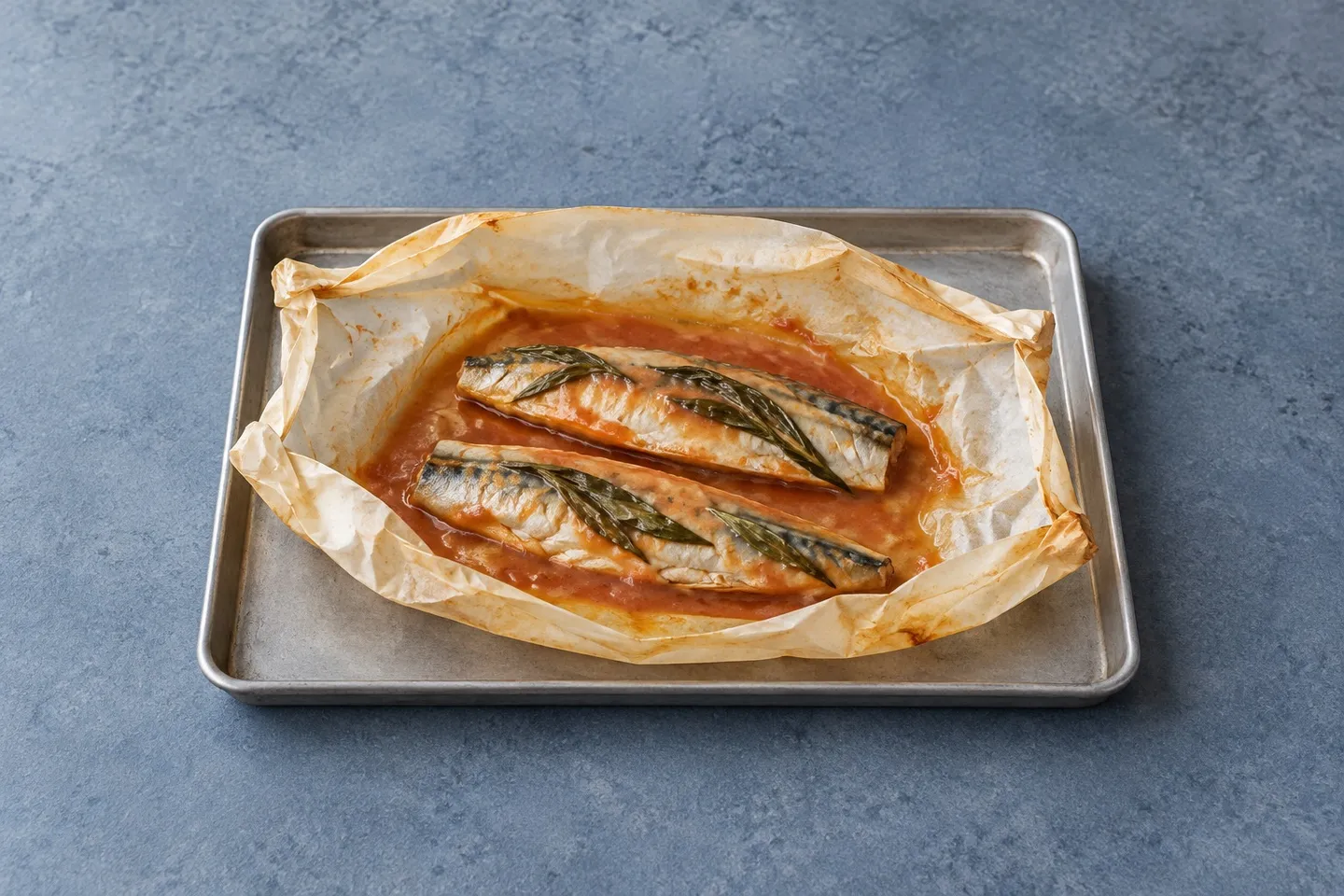
Mackerel in Parchment with Tarragon and Tomato Ketchup (1911)
Mackerel fillets baked in parchment with butter, fresh tarragon and tomato ketchup, adapted from Nicolas Soyer's 1911 recipe.
- Original yieldYield
- 2 main-course portions; four small fillets2 main-course portionsfour small fillets
- PrepPrep time
- CookCook time
- TotalTotal time
Estimated 15 minutes preparation while the oven heats, then 15–25 minutes baking. Fillet thickness and the temperature check determine readiness.
Published
Original recipe: 2 main-course portions; four small fillets
The story behind the recipe
Tomato ketchup goes on the mackerel before the parcel closes. It stays with the butter and fish juices as the fillets cook, ready to spoon over them when the paper opens. Fresh tarragon is the other defining ingredient: a line of leaves laid on each fillet in Nicolas Soyer's 1911 recipe.
Sauce inside the wrapper
This is a fish-and-sauce preparation baked in an enclosed packet. A rimmed baking sheet supports the parchment, and the sauce remains beside the fish. Keep the fillets in a single layer so the folds can close around them without squeezing out their topping.
Read more about this recipe
The catsup Soyer preferred
Soyer calls the dish Mackerel à la Napolitaine and specifies tomato catsup. His American edition even expresses a preference for American rather than English catsup, on grounds of its more delicate flavor. That comparison belongs to the bottles available to him.
The amount of sauce also matters. Soyer permits more, but says his stated spoonful on each fillet is sufficient for cooking. A parcel isn't a reason to pour in water indiscriminately. Here the ketchup and butter are measured ingredients, and the cooking juices are served with them.
A small-fillet supper
The book asks for two filleted mackerel without giving their weight. This version interprets them as four small fillets and supplies a total weight of 400 g. The modern serving size follows that choice. It isn't a recovered weight for Soyer's fish.
Soyer puts a large spoonful of ketchup on each fillet. Here that's a modern 15 ml tablespoon; butter, tarragon and salt quantities are supplied too. His spoon wasn't specified in milliliters.
The source connects cooking time to thickness. That remains useful, even though the modern recipe supplies an oven setting and a food-thermometer endpoint. Fillets of different thickness can finish at different times; the thickest part needs checking before serving.
Special bags, then baking parchment
Soyer wrote about specially prepared cooking bags. The opening pages of his American book advertise them, and he acknowledged that cooking in paper was an older principle. His claim was to extend that approach across ordinary meals.
Today's food-grade baking parchment changes the wrapper. Use paper explicitly rated for the oven setting and make the folds on the baking sheet, so the filled packets don't have to be lifted unsupported. The paper needs space around the fish and closed folds around the juices.
Opening the parcel is the final part of cooking. Hot steam can escape as soon as a fold is released, and the fish still needs a temperature check. A clock or a browned piece of paper can't make that decision for you.
Serve the fillets with the sauce from their packet. To compare the same enclosed method with a vegetable that starts with added water, see the companion article, What a Wrapper Changes: Cooking Fish and Vegetables in Parcels.
Make it your wayOriginal: 2 servings · Makes 2 main-course portions; four small fillets
Original recipe: 2 main-course portions; four small fillets
Ingredients
For 2 main-course portions; four small fillets. Quantities are shown as written.
Source measurement convention: Metric. Explicit unit definitions take precedence; unconfirmed measures must be checked before conversion.
Original quantities for 2 main-course portions; four small fillets.
- Boneless mackerel fillets, thawed if frozen400 g
- Unsalted butter, softened10 g
- Small sprigs fresh tarragon, leaves picked8
- Tomato ketchup60 ml
- Fine salt1/8 metric tsp
- Freshly ground black pepper, to taste
Measurement notes
- fine salt: tsp: 1 = 5 ml.
Measurement notes
Original ingredients
- 400 g boneless mackerel fillets, thawed if frozen
- 10 g unsalted butter, softened
- 8 small sprigs fresh tarragon, leaves picked
- 60 ml tomato ketchup
- 1/8 metric tsp fine salttsp: 1 = 5 ml.
- Freshly ground black pepper, to taste
Equipment
 Rimmed baking sheet
- Parchment paper
 Food thermometer
Instructions
Heat the oven and prepare parchment
Heat a conventional oven to 180°C / 355°F. Use food-grade baking parchment whose manufacturer permits that temperature and appliance. Cut roomy sheets for packets, allowing about one sheet for each pair of small fillets. Set them on a rimmed baking sheet with space between packets.
Prepare the fillets
Check the fillets for remaining pin bones and remove any you find. Spread the softened butter over the center of the parchment sheets, dividing it evenly. Arrange the fish in a single layer, no more than two small fillets per packet.
Season and close the packets
Divide the salt, pepper, tarragon leaves and ketchup evenly over the fillets. Fold each sheet over the fish and crimp the open edges closed with overlapping folds. Leave space inside the packet and keep its seams turned upward to contain the juices.
Bake and check the fish
Bake for about 15–25 minutes. Carefully open a fold away from your face and hands, then check the thickest part of the fish with a food thermometer. It must reach 63°C / 145°F. If needed, fold the packet closed and return it to the oven until that temperature is reached; the estimated time isn't the endpoint.
Open and serve
Open the packets carefully and serve the fish immediately, spooning the sauce and juices over it. Don't expose parchment to a broiling element, flame or the sides or bottom of the oven; follow its manufacturer's restrictions.
Recipe notes
When adjusting quantities
Keep fillets about 100 g each and use a separate packet for each pair. Add packets and baking sheets as needed without crowding. Don't multiply oven temperature or cooking time.
Original recipe notes
These notes describe the original recipe. Quantities mentioned here do not change when you adjust servings.
Use commercially prepared tomato ketchup. Soyer's preference for American catsup doesn't identify a modern brand.
Metric spoons mean 5 ml for a whole teaspoon and 15 ml for a whole tablespoon. The listed 1/8 teaspoon salt is 0.625 ml by volume, not a gram equivalent. When changing quantities, keep the small fillet size and use additional packets rather than stacking fish.
Source: Nicolas Soyer, Soyer's Paper-Bag Cookery (New York: Sturgis & Walton, 1911), pp. 33–34. Edition record. Fish endpoint: FoodSafety.gov minimum temperatures. Wrapper guidance: USDA on grocery bags and manufacturer parchment restrictions.
Read the scaling guide. Times, temperatures and equipment need their own consideration. Open the recipe tool to review and correct individual amounts.
Sources and attribution
Adapted from Nicolas Soyer, Soyer's Paper-Bag Cookery (New York, 1911), Mackerel à la Napolitaine, pp. 33–34.
Recipe details
- Recipe tradition
- Vintage
- Course or meal
- Dinner
- Source decade
- 1910s
- Difficulty
- Intermediate
- Cooking method
- Oven
- Main ingredient
- Fish
- Browse category
- Main Dishes