

- Baking
- Ingredients
- Vintage
- Measurement
Treacle, Molasses or Golden Syrup? Read the Recipe Before You Swap
Use two historical gingerbreads to choose a syrup, understand its liquid and leavener, and separate a weight conversion from an ingredient substitution.
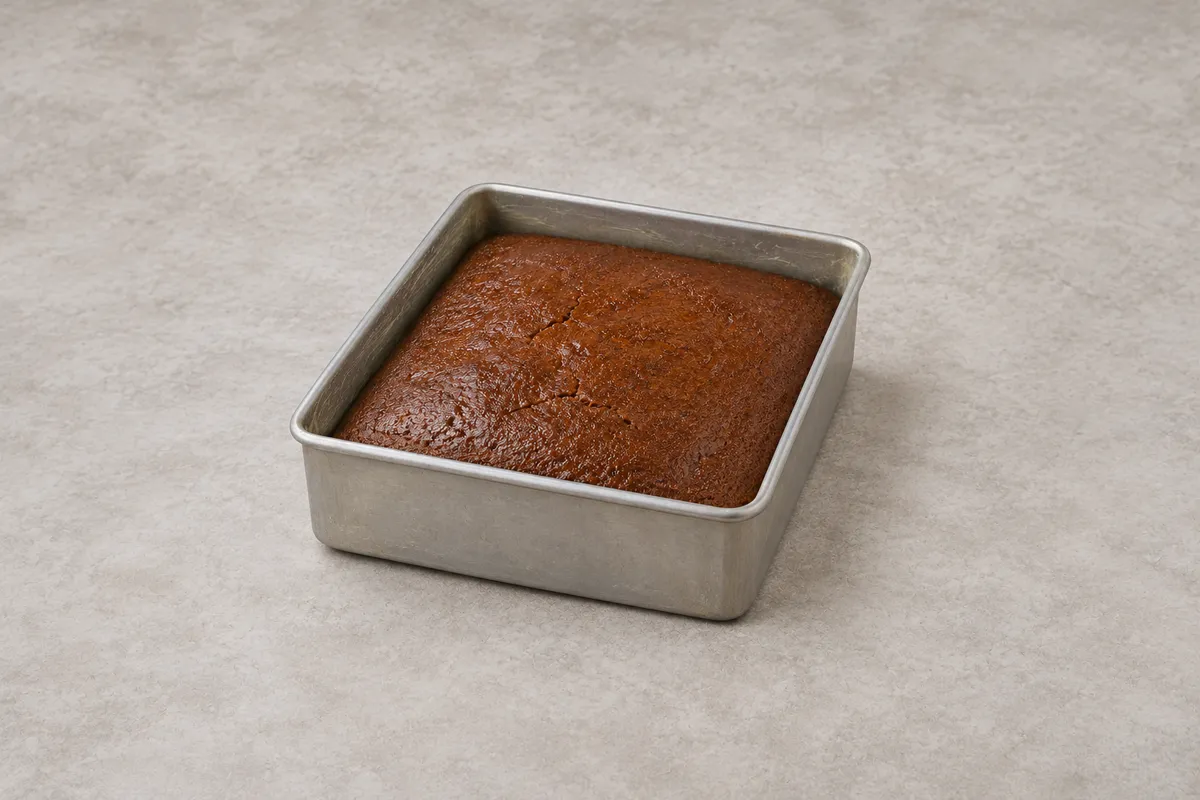
Two gingerbreads can use a dark syrup and still ask for quite different cooking. Beeton’s thick gingerbread has eggs, warm milk and an extra yolk wash near the end of baking. Farmer’s hot-water gingerbread lists no eggs or sour milk; boiling water is stirred into the molasses before the dry ingredients join it.
Choosing between them begins with more than translating treacle into molasses. You need a syrup you can identify and a complete formula to use it in. A precise weight conversion helps measure an ingredient, but it can’t decide whether a different jar will make the same cake.
Keep the qualifier on the shopping list
Golden syrup, black treacle and baking molasses are useful names to preserve. Shortening them all to syrup removes information just when you need it most.
Lyle’s describes its golden syrup as an invert sugar syrup from cane refining, with a golden color and a sweet caramel flavor. The maker describes its black treacle as dark and molasses-associated, with a slightly bitter character. These are the manufacturer’s product descriptions, useful for understanding its range rather than a tasting comparison made in our kitchen.
The modern Thick Black-Treacle Gingerbread selects black treacle. Hot-Water Molasses Gingerbread selects ordinary unsulfured cane molasses sold for baking and excludes products labeled blackstrap. Those are deliberate modern ingredient choices. Neither old recipe identifies a brand or a grade precisely enough to prove that the selected jar reproduces its historical syrup.
When a recipe explicitly names golden syrup, keep that name too. Its lighter appearance doesn’t make it a diluted version of black treacle, and a dark color doesn’t establish that two products have matching sweetness or acidity. Read the actual container as well as the front label.
An old word can be broader than a modern product
In her 1861 Book of Household Management, Isabella Beeton heads an explanatory note “Treacle, or Molasses.” She describes treacle in relation to the syrup drained from Muscovado sugar. Her paired names show that the words overlapped in this source.
That helps with historical reading, but it doesn’t settle the shopping. Her Thick Gingerbread says simply treacle. It doesn’t say golden syrup, black treacle or blackstrap, and the note doesn’t provide a measured composition for the ingredient in that recipe.
Preserve both pieces of information when adapting: the source’s ingredient name and the particular product chosen now. Calling the selection black treacle makes the modern recipe clearer without pretending that Beeton supplied those extra words.
This is also why a brand history can’t identify every earlier treacle. A date attached to a particular commercial product and a nineteenth-century cookbook’s vocabulary answer different questions. For these cakes, the useful evidence is the named syrup within the actual formula.

Read the diagram as text
Two complete gingerbreads Compare complete recipes; keep each formula together. Beeton: Thick Gingerbread SYRUP: Treacle, measured by weight. LIQUID: Warm milk. EGGS: 3 in the batter, plus a separate yolk and milk wash. SODA: Dissolved in the warm milk. VESSEL: Buttered tin. Farmer: Hot Water Gingerbread SYRUP: Molasses, measured by cup. LIQUID: Boiling water; no sour milk. EGGS: None listed. SODA: Sifted with the dry ingredients. VESSEL: Buttered shallow pan. Choose a complete recipe, then measure its specified syrup. This comparison is not a substitution guide.
Read across the gingerbread before changing it
Beeton’s Thick Gingerbread, no. 1760, uses a pound of treacle to a pound and a half of flour. Butter, coarse brown sugar, ginger and allspice join that substantial flour allowance. Three eggs go into the mixture, while soda is dissolved in warm milk. A separate yolk and a little milk make the late finishing wash.
The wash isn’t one of the three eggs quietly held back, and it isn’t part of the measured milk already used in the mixture. Combining those lines while copying the recipe would change it before any syrup substitution had even been considered.
Farmer’s Hot Water Gingerbread, published in Boston in 1896, uses one cup of molasses, half a cup of boiling water, two and a quarter cups of flour, melted butter and a teaspoon of soda, with ginger and salt. She directs the cook to add the water to the molasses, combine with the sifted dry ingredients, then add butter and beat. The mixture goes into a shallow pan.
The differences reach beyond the syrup name. Egg, liquid, flour basis, fat, mixing order and pan all belong to each recipe. Beeton’s thick preparation and Farmer’s shallow-pan cake aren’t the same formula with a British or American label attached.
| Read this part | Beeton’s Thick Gingerbread | Farmer’s Hot Water Gingerbread |
|---|---|---|
| Syrup in the original | Treacle, measured by weight | Molasses, measured by cup |
| Other liquid | Warm milk | Boiling water |
| Egg | Three in the mixture, plus a separate yolk wash | None listed |
| Soda | Dissolved in the warm milk | Mixed and sifted with the dry ingredients |
| Baking direction | A buttered tin; longer if very thick | A buttered shallow pan |
The table helps you choose and read a recipe. It isn’t a set of interchangeable components.
The same cup of molasses can sit in another system
Farmer gives an especially useful comparison on the same page. Her Sour Milk Gingerbread also uses one cup of molasses, but calls for a cup of sour milk and one and three-quarter teaspoons of soda. Its flour and butter allowances differ from the hot-water version too.
So a cup of molasses doesn’t automatically call for one fixed soda measure. Nor does every historical molasses gingerbread require sour milk. Farmer printed separate prescriptions for those combinations, rather than telling the cook to choose either liquid while leaving everything else unchanged.
Her discussion of bread making connects acids in molasses, sour milk and lemon juice with gas release from soda. That explains why the relationship deserves attention. It doesn’t tell us the measured acidity of the modern molasses on the shelf, so it can’t support calculating a new soda amount from the syrup’s color or name.
Before deciding between soda and powder, identify the complete leavening system already present in the formula. A syrup swap combined with a leavener swap is two changes to assess, even when the resulting list still looks like gingerbread.
Convert the measure without changing the ingredient
Turning one pound into grams is a weight conversion: one pound is about 454 g. The arithmetic doesn’t depend on whether the weighed ingredient is treacle or butter. Replacing that treacle with 454 g of golden syrup is an additional ingredient decision, even though the scale shows the same number.
A cup-to-gram conversion needs more information because a cup measures volume. The modern hot-water gingerbread uses approximately 340 g for its US cup of molasses under its declared ingredient-weight convention. That is a working amount for the specified baking molasses. It isn’t a universal density for golden syrup, black treacle or every historical molasses.
Keep the chosen measurement basis through the recipe. If cooking from a modern weight, weigh the named syrup directly; don’t move to an unrelated cup chart halfway through. If following a measured volume, use the specified cup rather than an ordinary drinking mug.
Old liquid measures need an explicit choice too. Beeton’s quarter pint of milk is treated as about 140 ml under the modern adaptation’s provisional Imperial-pint convention. Her book also discusses a wine-pint measure elsewhere, so the numerical milk allowance is a disclosed modern decision. It shouldn’t acquire an appearance of certainty simply because it is printed in milliliters.
Let a chosen formula set the next step
For the thick black-treacle version, expect the egg mixture, substantial spice allowance and late wash to remain part of the plan. For the hot-water version, have the shallow pan and dry ingredients ready before combining the hot liquid and molasses. Use each complete recipe for handling, quantities and doneness checks.
When the syrup you have differs from the one specified, a recipe written for that product gives you a firmer starting point than a general rule about all dark syrups. Record the product and any deliberate change if you adapt a batch. A weight can be exact while a substitution remains an experiment.
Sources
Isabella Beeton, The Book of Household Management, London: S.O.Beeton, 1861, p. 621, Treacle, or Molasses; p. 857, no. 1760, Thick Gingerbread; and p. 40, the book’s measures discussion. Fannie Merritt Farmer, The Boston Cooking-School Cook Book, Boston: Little, Brown, and Company, 1896, p. 57 and pp. 402–403, the gingerbread recipes. Current Lyle’s product descriptions are linked in the shopping discussion.