

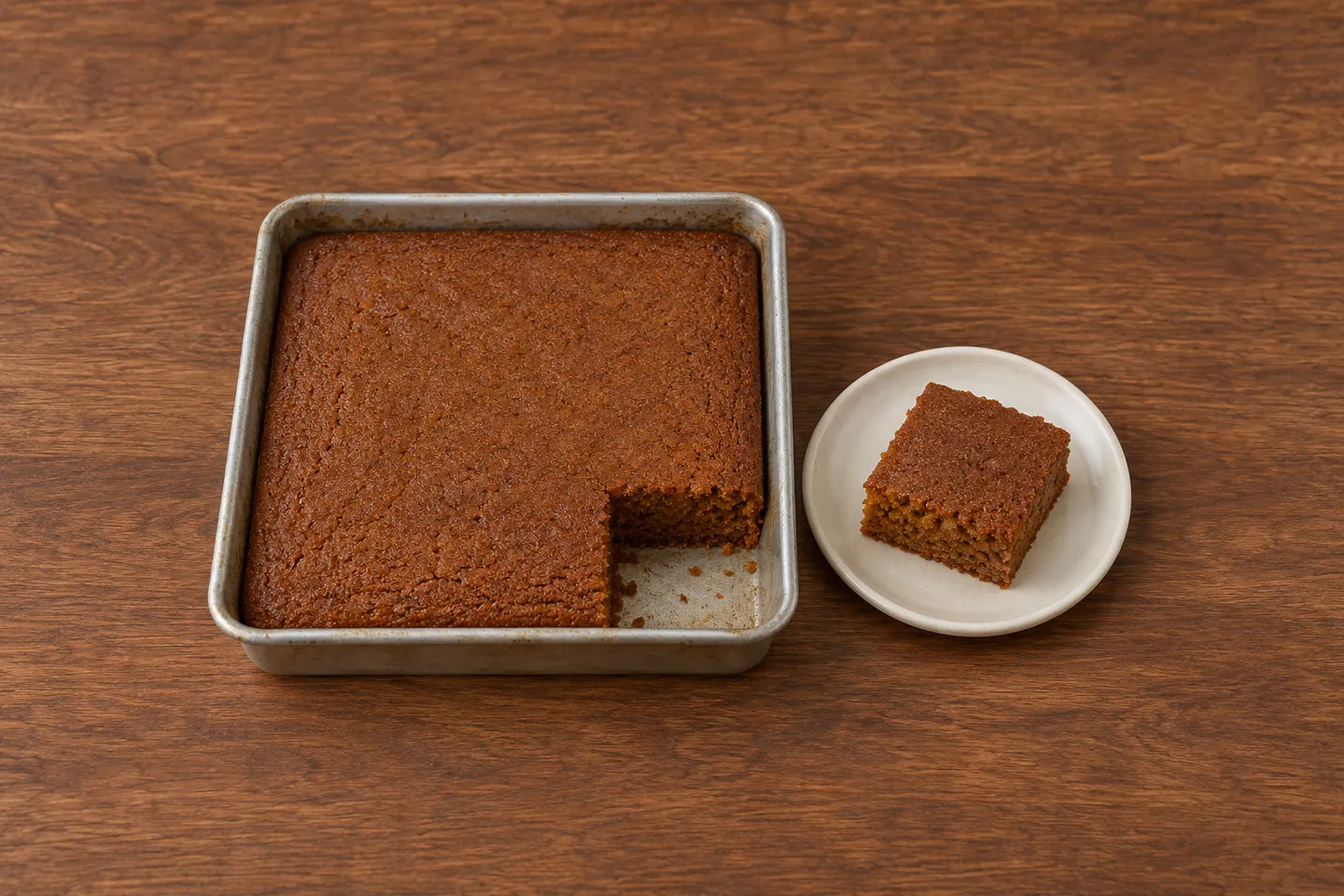
Hot-Water Molasses Gingerbread (1896)
A shallow-pan gingerbread adapted from Farmer's molasses, boiling water and soda formula, with no egg or sour milk in the mixture.
- Original yieldYield
- 1 shallow square cake, cut into 9 pieces1 shallow square cake, cut into 9 pieces
- PrepPrep time
- CookCook time
- TotalTotal time
Estimated: 15 minutes preparation, about 25–35 minutes baking and 10 minutes in the pan before further cooling. Check the center rather than relying on the range.
Published
Original recipe: 1 shallow square cake, cut into 9 pieces
The story behind the recipe
Boiling water goes into the molasses first. That gives Farmer's gingerbread a different beginning from a cake mixed around eggs and milk: the dark syrup is loosened with hot water, then combined with sifted dry ingredients and melted butter. There is no egg to separate or sour milk to prepare.
A short list in a shallow pan
Farmer prints this as Hot Water Gingerbread in her 1896 Boston Cooking-School Cook Book. The name is practical. It tells you which liquid to expect before you've reached the ingredients, and the method specifies a shallow pan rather than a deep tin.
Read more about this recipe
The neighboring cakes aren't substitutions
On the same page, Sour Milk Gingerbread also has a cup of molasses. It uses more soda, a different flour quantity and a larger liquid allowance. Soft Molasses Gingerbread takes another route again, with an egg and a different mixing sequence. Those are separate formulas, even though a cup of syrup appears in each.
That makes the hot-water cake particularly useful when reading an old recipe. You don't need to invent sour milk because another gingerbread uses it, or add an egg because it seems missing. The complete unit ends before the next heading, and its own list and instructions supply this version's starting point.
The source permits clarified chicken fat instead of butter. This adaptation selects butter, keeping the dairy ingredient visible. The absence of egg doesn't mean the cake has no allergens, and it isn't a reason to substitute a different fat without considering the recipe you're actually making.
Choose the molasses before measuring it
Use ordinary unsulfured cane molasses sold for baking, rather than blackstrap. Farmer doesn't name a grade in this recipe, so that product choice belongs to the modern version. It gives the ingredient list a useful boundary without claiming to identify the exact syrup in an 1896 pantry.
The cup also has a declared modern weight here. Approximately 340 g is the chosen equivalent for the molasses, and 270 g is the working weight for the flour. Those conventions aren't a recovered analysis of Farmer's ingredients. They let a reader use the scale consistently instead of switching between unrelated cup charts.
Golden syrup and black treacle keep their own names in a shopping list. A jar being thick, sweet or dark doesn't supply a measured acid equivalence. Farmer's own discussion connects molasses and soda, but it gives no acidity for the modern product you have. Retaining the specified baking molasses is clearer than redesigning the leavener at the mixing bowl.
Prepare before the hot mixture is ready
The pan, dry ingredients and melted butter can all be ready before water reaches the syrup. That organization matters because the soda is included with the dry mixture, and the batter should go promptly into the oven after mixing.
The hot liquid also deserves an ordinary practical pause. A stable heatproof bowl and a utensil long enough to stir comfortably are useful; the mixture isn't something to check with a finger. Once the dry ingredients are incorporated, the source asks for vigorous beating with the butter added. Follow that sequence instead of borrowing the separate egg-and-milk stages of another cake.
Twenty-five minutes begins the check
Farmer gives twenty-five minutes in a moderate oven. This version supplies a numerical setting and a square pan, then uses that time as the first center check. The middle must be baked even if the edges have already colored.
Nine squares are a modern way to divide the cake. The shallow shape remains more important to the bake than producing an exact number of identical pieces; extra batter needs another suitable pan, rather than a deeper layer in the original one.
Make it your wayOriginal: 9 servings · Makes 1 shallow square cake, cut into 9 pieces
Original recipe: 1 shallow square cake, cut into 9 pieces
Ingredients
For 1 shallow square cake, cut into 9 pieces. Quantities are shown as written.
Source measurement convention: US customary. Explicit unit definitions take precedence; unconfirmed measures must be checked before conversion.
Original quantities for 1 shallow square cake, cut into 9 pieces.
- Unsulfured cane molasses sold for baking, not blackstrap1 cupAuthor measures: 340 g.
- Freshly boiled water1/2 cupAuthor measures: 120 ml.
- All-purpose flour2 1/4 cupsAuthor measures: 270 g.
- Unsalted butter, melted3 tbspAuthor measures: 42 g.
- Baking soda1 tsp
- Ground ginger1 1/2 tsp
- Fine salt1/2 tsp
- Unsalted butter, for greasing the pan5 g
Measurement notes
- unsulfured cane molasses sold for baking, not blackstrap, freshly boiled water, all-purpose flour: US cup: 1 = 236.5882 ml (rounded).
- unsalted butter, melted: US tbsp: 1 = 14.7868 ml (rounded).
- baking soda, ground ginger, fine salt: US tsp: 1 = 4.9289 ml (rounded).
Measurement notes
Original ingredients
- 1 US cup (340 g) unsulfured cane molasses sold for baking, not blackstrapUS cup: 1 = 236.5882 ml (rounded).
- 1/2 US cup (120 ml) freshly boiled waterUS cup: 1 = 236.5882 ml (rounded).
- 2 1/4 cups (270 g) all-purpose flourUS cup: 1 = 236.5882 ml (rounded).
- 3 tbsp (42 g) unsalted butter, meltedUS tbsp: 1 = 14.7868 ml (rounded).
- 1 tsp baking sodaUS tsp: 1 = 4.9289 ml (rounded).
- 1 1/2 tsp ground gingerUS tsp: 1 = 4.9289 ml (rounded).
- 1/2 tsp fine saltUS tsp: 1 = 4.9289 ml (rounded).
- 5 g unsalted butter, for greasing the pan
Equipment
 20x20 cm (8x8 inch) square baking pan
- Large mixing bowl
 Wire cooling rack
Instructions
Prepare pan and melt butter
Heat a conventional oven to 350°F (175°C). Grease the specified square pan with the butter for greasing and line the base with baking parchment. Melt the butter for the batter and set it nearby.
Sift dry ingredients and loosen molasses
Mix and sift the flour, baking soda, ginger and salt. Put the molasses in a stable heatproof mixing bowl. Slowly stir in the freshly boiled water, pouring away from your hands.
Combine and beat the batter
Stir the sifted dry ingredients into the molasses mixture. Add the melted butter and beat vigorously with a wooden spoon until evenly combined. Don't taste the raw batter.
Fill the shallow pan
Transfer immediately to the prepared pan and level the top. At the original batch, use the specified shallow square pan; for more batter, use matching additional pans rather than increasing the depth.
Bake and check the center
Bake for 25 minutes, then check the center. Continue in about 5-minute intervals as needed until the center is set and a skewer comes out without wet batter; allow roughly 25–35 minutes, with longer baking if needed for the actual oven and pan.
Cool and cut
Cool in the pan for 10 minutes, then lift out and let cool on the wire cooling rack. Cut into nine pieces at the original quantity, or the selected number after scaling.
Recipe notes
When adjusting quantities
Keep the shallow depth: use matching additional pans for a larger batch and review a smaller pan separately for less batter. Prepare pans and dry ingredients before wetting the soda mixture. Don't multiply the baking time with the ingredient amounts.
Original recipe notes
These notes describe the original recipe. Quantities mentioned here do not change when you adjust servings.
Adapted from Farmer's complete hot-water formula, selecting butter instead of her optional clarified chicken fat. Baking molasses, flour weight at 120 g per cup, level modern measuring spoons, a 20 cm square pan, the 175°C oven setting, cooling and nine-piece division are modern specifications. The source has no egg, sour milk or separate sugar in this recipe.
Contains wheat and milk. Use the stated ingredient weights when weighing; the molasses equivalent isn't a universal density for every syrup. No golden-syrup or black-treacle substitution ratio is supplied.
Storage
Cool on a rack, then cover and refrigerate any portion not being served. No special keeping period is assigned.
Read the scaling guide. Times, temperatures and equipment need their own consideration. Open the recipe tool to review and correct individual amounts.
Sources and attribution
Fannie Merritt Farmer, The Boston Cooking-School Cook Book (Boston: Little, Brown, and Company, 1896), Hot Water Gingerbread, p. 402.
Fannie Merritt Farmer, The Boston Cooking-School Cook Book, Boston: Little, Brown, and Company, 1896, p. 402, Hot Water Gingerbread; the neighboring gingerbreads continue on p. 403. The recipe's acid discussion is on p. 57.
Recipe details
- Recipe tradition
- Vintage
- Cuisine
- American
- Cooking method
- Oven
- Browse category
- Baking & Desserts