

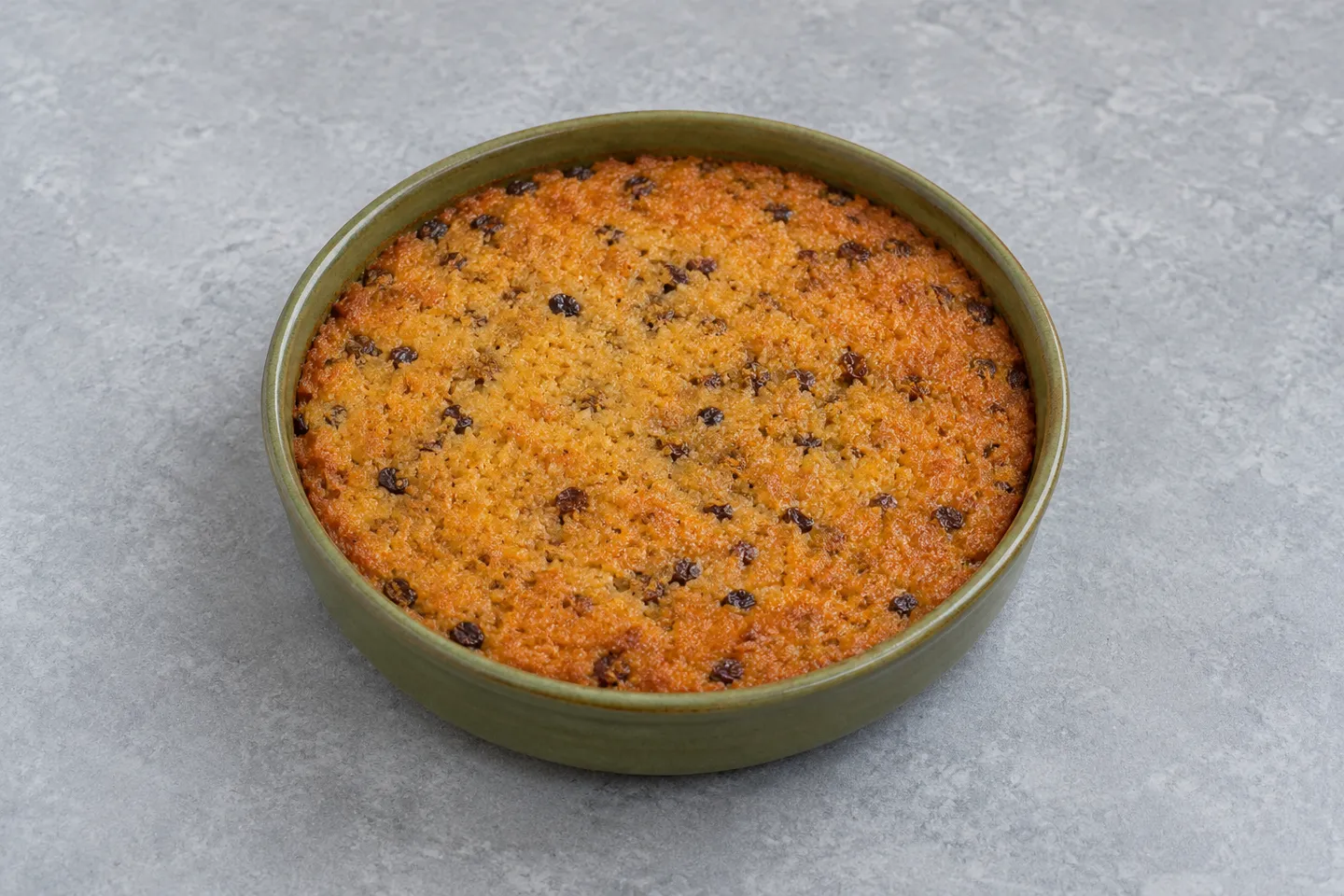
Baked Lemon Suet Pudding (1845)
A baked breadcrumb pudding with finely minced beef kidney suet, currants and fresh lemon, adapted from Eliza Acton's 1845 recipe.
- Original yieldYield
- 8 dessert portions from one approximately 20 cm pudding8 dessert portions from one approximately 20 cm pudding
- PrepPrep time
- CookCook time
- TotalTotal time
Estimated: 20 minutes preparation, about 45 to 60 minutes baking and 10 minutes standing. Suet preparation may take longer if the supplied piece needs extensive trimming.
Published
Original recipe: 8 dessert portions from one approximately 20 cm pudding
The story behind the recipe
Lemon peel, currants and fine crumbs make this a pudding with something to notice in every slice. It bakes in an ordinary ovenproof dish, with enough lemon juice to matter as well as the fragrant zest. The suet is finely minced before mixing; it isn't melted into a jug or replaced by the butter used to grease the dish.
A baked pudding in Acton's book
Eliza Acton's Modern Cookery, in All Its Branches gives this Lemon Suet-Pudding in its London 1845 edition. She directs a brisk oven and an hour's baking, rather than a long boil in a cloth. The date belongs to the printed recipe followed here. It doesn't make this a claim about when lemon pudding was first invented.
Read more about this recipe
Ask for the prepared ingredient
Buy food-grade beef kidney suet from a supplier who can identify it. Ask whether it has already been cleaned. A piece with skin and tough fiber still attached needs preparation before it can become the weight in the ingredient list, and the amount removed depends on the actual piece.
Acton makes that stage explicit elsewhere in the same book: the suet's weight is taken after mincing. In the lemon pudding itself, she again asks for fresh kidney suet freed from skin and minced very small. That is a more precise shopping instruction than an unspecified block of beef fat. Keep it chilled while you prepare the other ingredients, then work with clean tools and weigh the minced portion.
Rendered tallow, pork lard and butter are different ingredients. A shredded packet may also contain flour. None can be assumed to provide the same prepared ingredient simply because it can be measured to the same number of grams. If you want a butter-based dessert, choose a complete formula written for butter rather than improvising a replacement inside this one.
Fresh crumbs and a whole lemon
This version uses fine fresh white breadcrumbs. They're soft crumbs made without drying or toasting the bread. A bag of fine dry crumbs would change the moisture already present in the mixture, even though both products might look finely ground. The distinction is worth checking before you begin; our breadcrumb guide explains the forms side by side.
The lemon is used twice, for zest and juice. Grate the yellow skin finely, keeping the bitter white pith out, then strain the juice to remove seeds. The source asks for a large lemon without fixing its juice volume. This remains a fruit-based measure, with the natural variation that entails; there's no separate water allowance to pour in automatically.
Currants are one of her choices
Acton includes currants and also says the pudding is good without them. They remain in this version, where their small dark pieces give the pale crumb mixture a visible fruit component. Use dried currants, rather than assuming fresh red or black currants are the ingredient intended.
She offers more suet for readers who like a larger proportion, too. That doesn't turn every line of the formula into a range. The recipe below follows the listed suet amount and keeps the currants, leaving those alternatives in the source record rather than asking you to make several decisions halfway through mixing.
Check below the browned top
A golden surface can develop before the center has finished cooking. Acton moved her pan toward the oven mouth once it had browned. In a modern oven, loose foil over the top lets you protect its color while continuing to bake the middle.
After a short rest, serve the pudding from its dish if turning it out is awkward. This is a baked egg-and-crumb dessert, distinct from the boiled fruit puddings in Eggs, Milk or Neither?. Its own dish, oven and center check matter more than borrowing a cooking time from a Christmas pudding.
Make it your wayOriginal: 8 servings · Makes 8 dessert portions from one approximately 20 cm pudding
Original recipe: 8 dessert portions from one approximately 20 cm pudding
Ingredients
For 8 dessert portions from one approximately 20 cm pudding. Quantities are shown as written.
Source measurement convention: Metric. Explicit unit definitions take precedence; unconfirmed measures must be checked before conversion.
Original quantities for 8 dessert portions from one approximately 20 cm pudding.
- Fine fresh white breadcrumbs225 g
- Cleaned raw beef kidney suet, finely minced, prepared weight170 g
- Superfine sugar100 g
- Dried currants170 g
- Large lemon, finely grated zest and strained juice1
- Large eggs, beaten4
- Unsalted butter, for the dish15 g
- Powdered sugar, optional, to finish (level)1 metric tsp
Measurement notes
- powdered sugar, optional, to finish (level): tsp: 1 = 5 ml.
Measurement notes
Original ingredients
- 225 g fine fresh white breadcrumbs
- 170 g cleaned raw beef kidney suet, finely minced, prepared weight
- 100 g superfine sugar
- 170 g dried currants
- 1 large lemon, finely grated zest and strained juice
- 4 large eggs, beaten
- 15 g unsalted butter, for the dish
- 1 metric tsp powdered sugar, optional, to finish (level)tsp: 1 = 5 ml.
Equipment
- 20 cm round ovenproof dish, about 5 cm deep
 Food thermometer
Instructions
Prepare the dish and minced suet
Heat the oven to 375°F (190°C), conventional heat. At the original batch size, grease a round ovenproof dish about 20 cm across and 5 cm deep with the butter. For a changed quantity, use suitably sized or additional dishes to keep a similar filling depth. Keep the raw beef kidney suet chilled until needed; remove any skin and tough fiber, mince very finely, then weigh the listed prepared amount. Don't melt it. Clean hands, tools and surfaces after handling it.
Mix the lemon pudding
Mix the fresh breadcrumbs, prepared suet, superfine sugar and dried currants in a large bowl. Finely grate the yellow zest of the lemon, then squeeze and strain its juice. Add both zest and juice with the beaten eggs and mix thoroughly. For a fractional batch, beat and weigh the eggs and use the corresponding fraction of the lemon's zest and juice. Don't taste the raw mixture.
Bake and protect the browned top
Transfer to the greased dish and level the surface. Bake on the middle shelf, checking from about 45 minutes and allowing about 60 minutes, until the center is set with no raw mixture. Loosely shield the top with foil once it is well browned if it needs longer cooking.
Check the cooked center
Check the center with a clean food thermometer: it must reach at least 158°F (70°C) for 2 minutes as well as being cooked through. Continue baking if either requirement is unmet. Keep a similar filling depth when changing the quantity, using additional dishes rather than one much deeper pudding; check each dish separately.
Rest and serve
Let stand for about 10 minutes. Loosen the edge and carefully turn out only if the pudding releases; otherwise serve from the dish. Sift over the optional powdered sugar if wanted and divide into eight dessert portions at the original batch size. Serve hot and refrigerate leftovers promptly in small portions.
Recipe notes
When adjusting quantities
Weigh suet after removing skin and tough fiber and mincing it. Keep a similar filling depth, using additional dishes for a larger batch. Beat and weigh fractional eggs; use the corresponding fraction of lemon zest and juice. Oven temperature and baking time do not multiply.
Original recipe notes
These notes describe the original recipe. Quantities mentioned here do not change when you adjust servings.
Acton's amounts are 8 oz breadcrumbs, 6 oz prepared beef kidney suet, 3 1/2 oz sugar, 6 oz currants, 1 large lemon and 4 large or 5 small eggs. The rounded working weights are 225 g, 170 g, 100 g and 170 g respectively, with the four-large-egg route selected. Fresh white crumbs, modern large eggs, 15 g greasing butter, the dish, oven setting, foil shield, rest and temperature check are supplied for this version. The optional extra suet isn't included; her currants are retained.
Use plain raw kidney suet, cleaned and finely minced before weighing, rather than rendered fat or a flour-containing shredded product. Keep it refrigerated and follow the supplier's use-by instructions. The pudding contains wheat, egg and milk through the greasing butter; check the actual bread label too.
The center check follows the Food Standards Agency's cooking guidance. Cool leftover portions and refrigerate within 2 hours, eat within 48 hours or freeze, and reheat only once until steaming hot throughout, following its chilling advice. This pudding isn't intended for cupboard storage or maturation.
Storage
Cool leftovers in small portions and refrigerate within 2 hours. Eat within 48 hours or freeze; reheat only once until steaming hot throughout.
Read the scaling guide. Times, temperatures and equipment need their own consideration. Open the recipe tool to review and correct individual amounts.

Sources and attribution
Eliza Acton, Modern Cookery, in All Its Branches (London: Longman, Brown, Green and Longmans, 1845), Lemon Suet-Pudding, p. 467.
Adapted from Lemon Suet-Pudding, p. 467 of Acton's London 1845 *Modern Cookery*.
Recipe details
- Recipe tradition
- Vintage
- Cooking method
- Oven
- Browse category
- Baking & Desserts