

- Cooking
- Methods
- Bread
- Measurement
Fresh Breadcrumbs, Dried Breadcrumbs or Panko? Choose the Crumb for the Job
Compare soft fresh crumbs, fine dried breadcrumbs and panko by preparation, recipe role and weight before measuring or making a substitution.
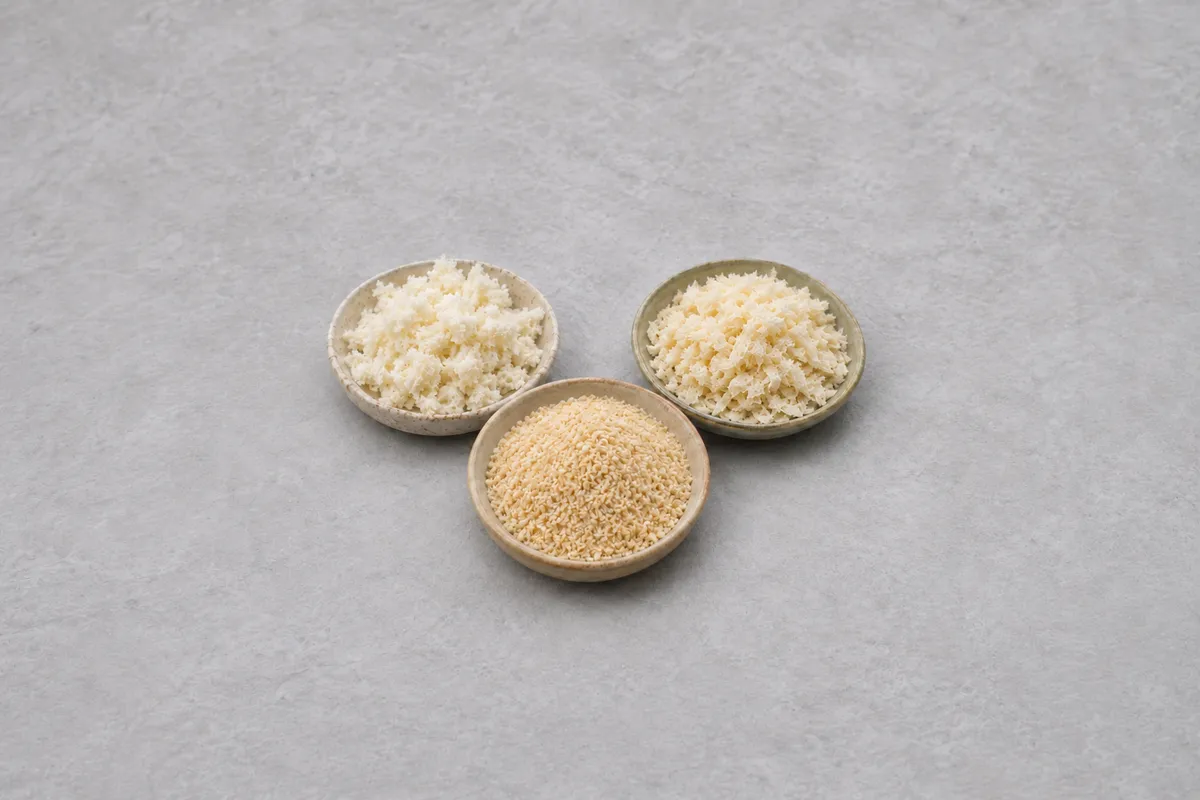
Choose soft fresh breadcrumbs when the recipe asks for bread crumbled without drying. Choose fine dry breadcrumbs for a fine dry coating or a mixture that specifically calls for them. Choose panko when the recipe is designed around its larger flakes and a rougher, crisp coating. The useful distinction is both what the crumbs are like and where they go.
One Scotch egg can need two kinds. In our ham-forcemeat version, fresh crumbs form part of the soft mixture wrapped around the egg; fine dry crumbs go on the outside. Buying one bag marked “breadcrumbs” leaves half the shopping decision unfinished.
In the photograph, left to right: fresh white breadcrumbs, fine dry breadcrumbs and panko.
Read beyond the word breadcrumbs
Fresh, fine and dry describe different things. Fresh or soft identifies a crumb that hasn’t been deliberately dried. Fine describes particle size. A fine crumb can therefore be soft or dry, and grinding a dry crumb more finely won’t turn it back into fresh bread.
For our walnut loaf, the preparation is explicit: use soft plain white bread and make fresh fine crumbs without drying or toasting it. Fill the measuring cup lightly and level the surface. That gives “two cups of breadcrumbs” a much clearer meaning than the quantity alone.
Panko deserves its own place on the list. Kikkoman USA describes its panko as larger, flakier, oblong crumbs made from specially baked crustless bread. Its unseasoned product has a mild flavor. For a cook choosing a coating, the conspicuous difference is the flake structure rather than a strong seasoning.
| Form named by a recipe | What to look for | A role in the recipes discussed here |
|---|---|---|
| Fresh or soft fine breadcrumbs | Soft bread crumbled finely, without drying or toasting | Mixed through the walnut loaf or the Scotch egg’s forcemeat |
| Fine dry breadcrumbs | Dry crumbs with a small, even particle size | The Scotch egg’s outer coating |
| Dried breadcrumbs | Dry crumbs in the form the recipe specifies | Mixed into the sausage filling for Deerfoot potatoes |
| Panko | Distinct flakes; check whether plain or seasoned | A different coating choice when a recipe calls for panko |
Dryness and size belong beside the bread type, too. Our fresh-crumb recipes specify white bread. A strongly flavored loaf or a seeded bread brings its own ingredients into the mixture, so keep the recipe’s bread description when preparing the crumbs.
A cup is a container, not a crumb specification
King Arthur Baking’s ingredient weight chart lists three separate entries:
| Ingredient in the chart | Listed volume | Listed weight | One-cup comparison, calculated from those entries |
|---|---|---|---|
| Dried breadcrumbs | ¼ cup | 28 g | 112 g |
| Fresh breadcrumbs | ¼ cup | 21 g | 84 g |
| Japanese panko | 1 cup | 50 g | 50 g |
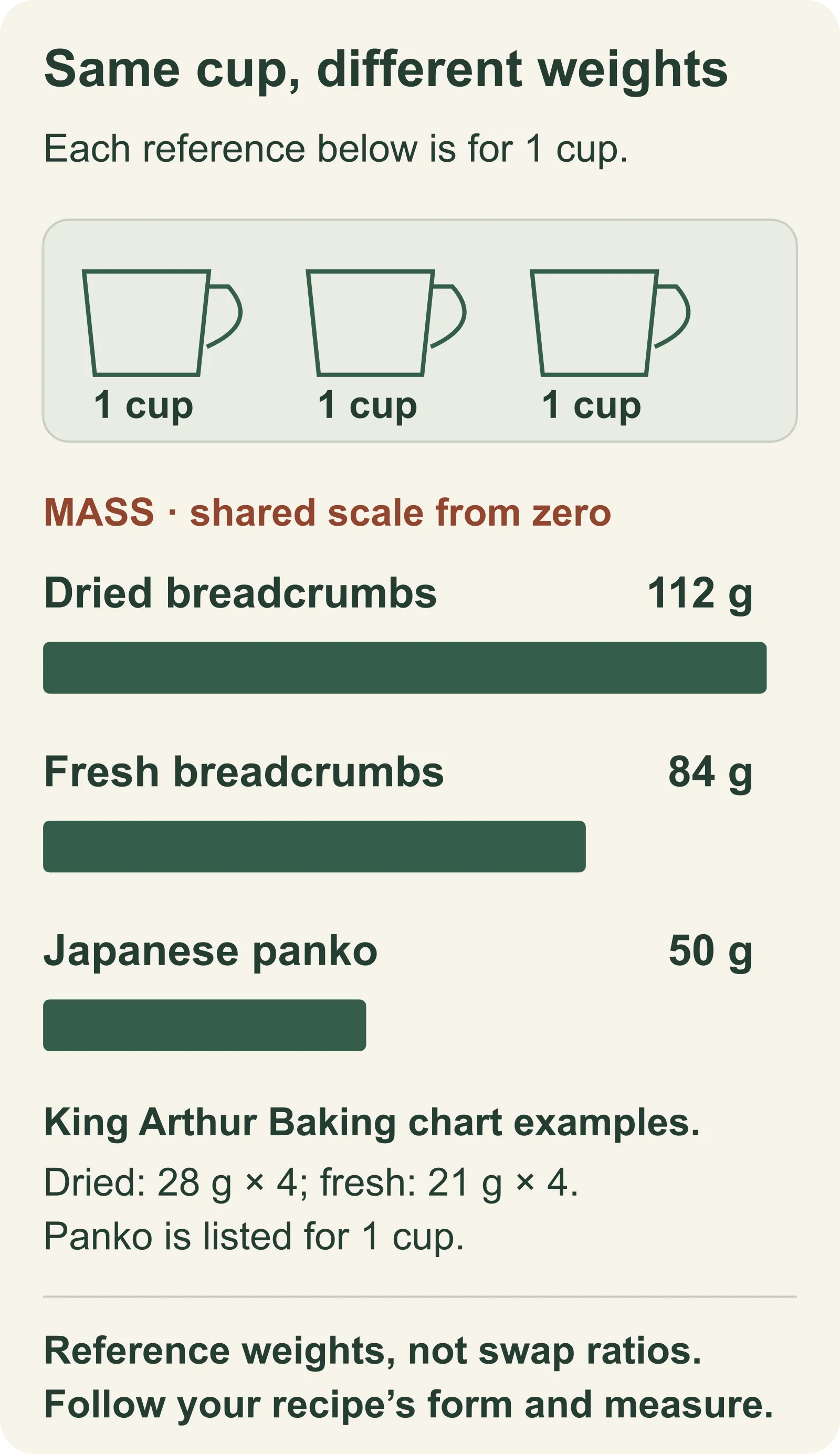
Equal volumes, different reference weights. Calculated from King Arthur Baking's chart; each bar uses the same mass scale. Diagram: TuneMyRecipe.
On that basis, a cup of dried crumbs weighs more than twice a cup of panko. These are reference values for the named forms, not universal weights for every product or homemade batch. Shape, packing and the bread itself can change what fits into a cup.
Use a recipe’s own stated weight when it provides one. If it gives a volume with preparation directions, keep those directions. The chart illustrates why the forms need separate entries; it doesn’t supply a substitution ratio between them.
Our cups-and-grams guide develops the same measurement question across other ingredients.
Two crumb bowls for one Scotch egg
The ingredient list for Scotch Eggs with Ham Forcemeat gives 85 g fresh white breadcrumbs and 50 g fine dry breadcrumbs at its original four-egg yield. Keep them separate as you prepare the other ingredients.
The fresh crumbs join finely minced cooked ham, shredded beef suet, a beaten egg, lemon zest, herbs and seasonings. Together they make the forcemeat, a seasoned stuffing wrapped around each boiled egg. Here bread contributes to the body of the wrapper, with ham distributed through it.
The dry crumbs arrive later. Each wrapped egg is rolled in a separate beaten egg, then in the fine dry crumbs. Those crumbs remain at the surface, where the coating fries. Their fineness helps give the exterior the comparatively even crumb texture described by the recipe.
Using panko outside would introduce larger flakes and a rougher surface. That may be a texture you want in another preparation, but it would be a variation on this version. It wouldn’t explain what to do with the fresh crumbs inside, where a change also affects the mixture’s composition.
Keep the complete cooking instructions with either choice. The recipe checks the forcemeat layer at 165°F (74°C), rather than relying on the color of the crumbs or the already-boiled egg in the center. Its chilling and cold-picnic handling directions remain part of the dish.
Inside the mixture doesn’t always mean fresh
The Walnut Loaf with Brown Sauce starts with two cups of fresh fine white bread crumbs, lightly filled and leveled. They are mixed with chopped walnuts, egg, melted butter, water and seasoning, then baked as a small loaf.
Keep the nuts in small recognizable pieces and the bread soft and fine. Those are two distinct preparations in the same mixture. Turning the walnuts into powder or replacing the crumbs with a tub of dry granules changes more than the ease of measuring.
The loaf retains its cup measure. Assigning it a weight from a general chart would add a precision the recipe hasn’t established for that preparation. Follow its stated crumb form, measuring method and pan instructions together.
Yet a filling can also call for dried crumbs. Our Deerfoot Sausages in Potato Blankets mixes 40 g dried breadcrumbs into pork sausage meat with parsley and seasoning. The mixture fills hollowed raw potato halves, with hot stock poured around them before baking.
Those crumbs extend the sausage filling; they aren’t sprinkled over it as a final crust. This is why “fresh for fillings, dry for coatings” is too broad a rule. The actual recipe decides. Follow the potatoes’ tenderness and sausage-center temperature checks as written, rather than treating a different crumb as a reason to shorten the bake.
When the crumbs absorb milk before cooking
Bread Muffins: the crumb form stays attached to the amount
Bread Muffins from the Goudiss 1918 cookbook soak crumbs in milk before flour, fat and a separated egg complete the batter. The modern version explicitly chooses fine dry plain crumbs. Keep that choice with its quantity: the source’s unqualified crumbs don’t establish that fresh crumbs or panko would give the same mixture.
Crumb Spice Pudding: dry means dry before soaking
The same book’s Crumb Spice Pudding explicitly names dry bread crumbs, which absorb hot milk before molasses, egg, spices and dried fruit are added. Dry describes the measured starting ingredient. Soaking it later doesn’t make its original cup measure equivalent to a cup of soft fresh crumbs or loose panko flakes.
Cook: Crumb Spice Pudding (1918)
These two entries, on pp. 26 and 61 of Foods That Will Win the War and How to Cook Them, extend the ingredient-form comparison. Their full recipes supply the soaking and cooking directions.
Check the packet, even when the brand is familiar
Product names can stay similar while ingredient lists differ. Kikkoman’s US panko lists wheat flour, cane sugar, yeast and salt. Its Australian 1 kg Panko Breadcrumbs page lists wheat flour, canola oil, vinegar, salt, yeast and acidity regulator (327).
These are two specific products, not a rule dividing all American and Australian panko. They show why the packet in your hand matters. Check its ingredients, allergen information and seasoning description instead of assuming that every product under a familiar name has the same formula.
Before measuring, settle three details: the bread or product, the crumb’s dryness and size, and its place in the method. Then keep the quantity attached to that choice. The soft crumbs in a loaf and the dry flakes around a cutlet may begin with bread, but the recipe has different work for them to do.
For slices, soft crumbs and fried cubes in finished dishes, Another Life for Bread follows three ways to cook with bread.