

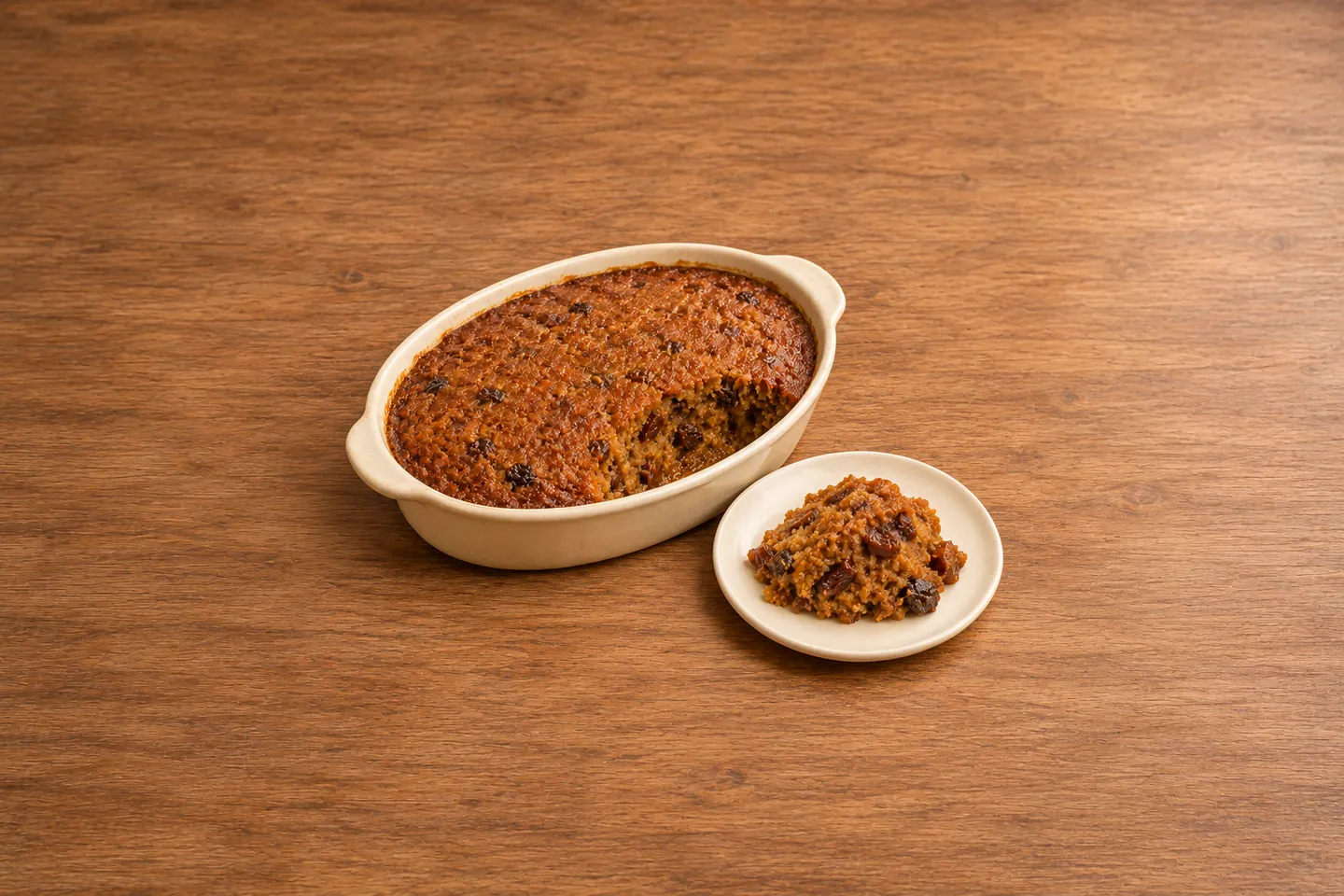
Crumb Spice Pudding (1918)
A baked pudding of milk-soaked dry breadcrumbs, molasses and mixed dried fruit, adapted from a 1918 wartime cookbook.
- Original yieldYield
- 6 small dessert portions6 small dessert portions
- PrepPrep time
- CookCook time
- TotalTotal time
Estimated: 20 minutes preparation, 10 minutes soaking, up to 15 minutes cooling, 45 to 60 minutes baking and 10 minutes standing. The fruit's 5-minute steam overlaps soaking. Cool longer if the crumb mixture is still hot.
Published
Original recipe: 6 small dessert portions
The story behind the recipe
The dry crumbs get a generous soaking before this pudding goes into the oven. Molasses darkens the mixture, and the chopped dried fruit gives you distinct pieces in each spoonful. It has the spice and sweetness of a substantial dessert, even though the old book filed it under Sugarless Desserts.
Sugarless didn't mean unsweetened
C. Houston Goudiss and Alberta M. Goudiss published Foods That Will Win the War and How to Cook Them in 1918. Their dessert chapter recommends alternatives to the sugar being conserved. Crumb Spice Pudding uses molasses, raisins, dates and prunes, so sugarless describes that historical substitution effort. It isn't a modern nutritional claim.
Read more about this recipe
Begin with dry crumbs
The source is specific about dry bread crumbs. That matters in a dish with milk measured separately: a bowl of soft fresh crumbs isn't the same prepared ingredient. Choose plain, fine dry breadcrumbs rather than a seasoned coating mix. Dry doesn't mean moldy, and a bread-rescue recipe doesn't make spoiled bread usable.
Our breadcrumb comparison separates particle size from moisture. Fine crumbs can be fresh or dry; panko has a different flake shape again. For this pudding, the fine dry form gives you the ingredient described here without asking a handful of large flakes or soft bread pieces to behave identically.
The crumbs soak in hot milk before the remaining ingredients are mixed in. That pause deserves space in your planning. You're preparing a moist crumb mixture first, rather than trying to distribute dry bread through a finished egg mixture at the last moment.
Five minutes belongs to the fruit
There are two different heating instructions in the short original. The mixed dried fruit is steamed for five minutes. The assembled pudding is baked for forty-five. They're easy to confuse if a note beside an ingredient is allowed to drift into the method for the whole dish.
Briefly steam the chopped fruit, then mix it into the soaked crumbs with the other ingredients. There's no tied pudding cloth, covered basin or long steaming pot for the completed mixture. A baking dish belongs in the oven, where you can check both the browned surface and the center. Its small size doesn't eliminate the need to cook the egg mixture through.
A mixed spice measure is one measure
Cinnamon has its own place in the ingredient list. Beside it is a small total amount of mixed cloves, nutmeg, allspice, mace and ginger. You aren't meant to measure half a teaspoon of every spice named. Combine a little of each in a separate bowl, then measure the required amount from the mixture.
The source doesn't prescribe their individual proportions, so there's room for a mild blend rather than a purportedly exact historical formula. Use the named ground spices and keep the total small. Molasses and fruit already give the pudding a pronounced character; a heavy-handed clove measure would change the balance before the dish reached the oven.
Bread saved, dessert chosen
This is another possibility beside the sliced bread and soft-crumb dishes in Another Life for Bread. It uses dry crumbs throughout the mixture, with molasses and fruit instead of visible layers of buttered bread and custard.
Choose it because you want that dessert. The extra milk, egg, sweetener and fruit are real ingredients, even when the crumbs are already in the cupboard. The historical recipe gives no finished portion count or ingredient bill, so its bread reuse can't establish a particular saving. Six small portions are a useful modern serving plan, with the pudding spooned warm from its baking dish.
Make it your wayOriginal: 6 servings · Makes 6 small dessert portions
Original recipe: 6 small dessert portions
Ingredients
For 6 small dessert portions. Quantities are shown as written.
Source measurement convention: Metric. Explicit unit definitions take precedence; unconfirmed measures must be checked before conversion.
Original quantities for 6 small dessert portions.
- Fine dry plain breadcrumbs100 g
- Pasteurized whole milk480 ml
- Molasses120 ml
- Large egg1
- Mixed raisins, pitted dates and pitted prunes, chopped100 g
- Fine salt (level)1/4 metric tsp
- Ground cinnamon (level)1/4 metric tsp
- Mixed ground cloves, nutmeg, allspice, mace and ginger, total (level)1/2 metric tsp
- Unsalted butter, as needed for greasing
Measurement notes
- fine salt (level), ground cinnamon (level), mixed ground cloves, nutmeg, allspice, mace and ginger, total (level): tsp: 1 = 5 ml.
Measurement notes
Original ingredients
- 100 g fine dry plain breadcrumbs
- 480 ml pasteurized whole milk
- 120 ml molasses
- 1 large egg
- 100 g mixed raisins, pitted dates and pitted prunes, chopped
- 1/4 metric tsp fine salt (level)tsp: 1 = 5 ml.
- 1/4 metric tsp ground cinnamon (level)tsp: 1 = 5 ml.
- 1/2 metric tsp mixed ground cloves, nutmeg, allspice, mace and ginger, total (level)tsp: 1 = 5 ml.
- Unsalted butter, as needed for greasing
Equipment
- 1-liter ovenproof baking dish
 Medium saucepan (2-quart)
- Heatproof sieve or steamer that fits above simmering water in the saucepan
 Food thermometer
Instructions
Soak and cool the crumbs
Put the dry breadcrumbs in a heatproof bowl. Heat the milk in a saucepan until steaming, then pour it over the crumbs and stir. Let stand for about 10 minutes, until the milk is absorbed. Set the bowl in cold water, keeping water out of the mixture, and stir occasionally until it no longer feels hot, allowing about 15 minutes or longer if needed before adding the egg.
Steam the dried fruit
While the crumbs soak, steam the chopped dried fruit in a heatproof sieve or steamer over simmering water for 5 minutes. Keep the fruit above the water, cover with a suitable lid and don't let the pan boil dry. Remove carefully and let the fruit drain. This short steaming stage is for the fruit only.
Prepare the dish and spice mixture
Heat the oven to 340°F (170°C), conventional heat. For the original batch, grease a 1-liter ovenproof baking dish with butter. For a changed quantity, use suitably sized or additional dishes to keep a similar filling depth. Combine small amounts of the named mixed ground spices separately, then measure the listed total from that mixture; don't use the listed amount of every spice.
Mix the pudding
Beat the egg with the molasses, salt, cinnamon and measured mixed spices. If the adjusted quantity needs part of an egg, beat it first and weigh the required fraction before mixing. Stir into the soaked crumbs with the drained fruit until evenly combined. Transfer to the prepared dish. Don't taste the raw egg mixture.
Bake and check the center
Bake for about 45 to 60 minutes, starting checks at 45 minutes, until the pudding is set rather than wet in the center. Check the center with a clean food thermometer: it must reach at least 160°F (71°C). Continue baking if either the set or temperature is unmet; loosely shield the top with foil if it browns too quickly.
Rest and serve portions
Let stand for about 10 minutes, then spoon into six small portions at the original batch size, or the adjusted portion count, and serve warm. Check each dish separately if using more than one. Refrigerate any leftovers promptly in shallow portions.
Recipe notes
When adjusting quantities
Keep a similar filling depth and use additional dishes for a larger batch. Beat and weigh a fractional egg before adding. The fruit gets a short steaming stage; the pudding is baked. Cooking time and oven temperature do not scale with the ingredients.
Original recipe notes
These notes describe the original recipe. Quantities mentioned here do not change when you adjust servings.
The source uses 1 cup dry crumbs, 1 pint milk, 1/2 cup molasses, 1 egg, 2/3 cup mixed fruit and the listed salt and spice measures. This version chooses 100 g crumbs and 100 g fruit as working weights, a 240 ml cup and a rounded 480 ml US pint. One large egg is specified. The 1-liter dish, oven setting, soaking and cold-water cooling guidance, six-portion yield, longer checking window and thermometer check are modern guidance. Only the fruit is steamed; the source bakes the whole pudding for 45 minutes.
Use plain baking molasses, not a product with added flavorings; blackstrap or another syrup isn't an automatic same-quantity replacement. The mixed-spice amount is a total, with no fixed proportions supplied by the source. The pudding contains wheat, milk and egg; check the actual bread and fruit labels as well.
The center-temperature and prompt-refrigeration guidance follows the FDA's egg safety advice. Divide leftovers into shallow containers and refrigerate within 2 hours, or within 1 hour above 90°F (32°C). The historical Sugarless Desserts heading doesn't mean the pudding is free of sugars.
Storage
Refrigerate leftovers promptly in shallow portions, within 2 hours of cooking or 1 hour if the room is above 90°F (32°C). Reheat leftovers to 165°F (74°C) throughout.
Read the scaling guide. Times, temperatures and equipment need their own consideration. Open the recipe tool to review and correct individual amounts.

Sources and attribution
C. Houston Goudiss and Alberta M. Goudiss, Foods That Will Win the War and How to Cook Them (New York: World Syndicate Company, 1918), Crumb Spice Pudding, p. 61.
Adapted from Crumb Spice Pudding, p. 61 of the Goudisses' 1918 *Foods That Will Win the War and How to Cook Them*.
Recipe details
- Recipe tradition
- Vintage
- Cooking method
- Oven
- Browse category
- Baking & Desserts