

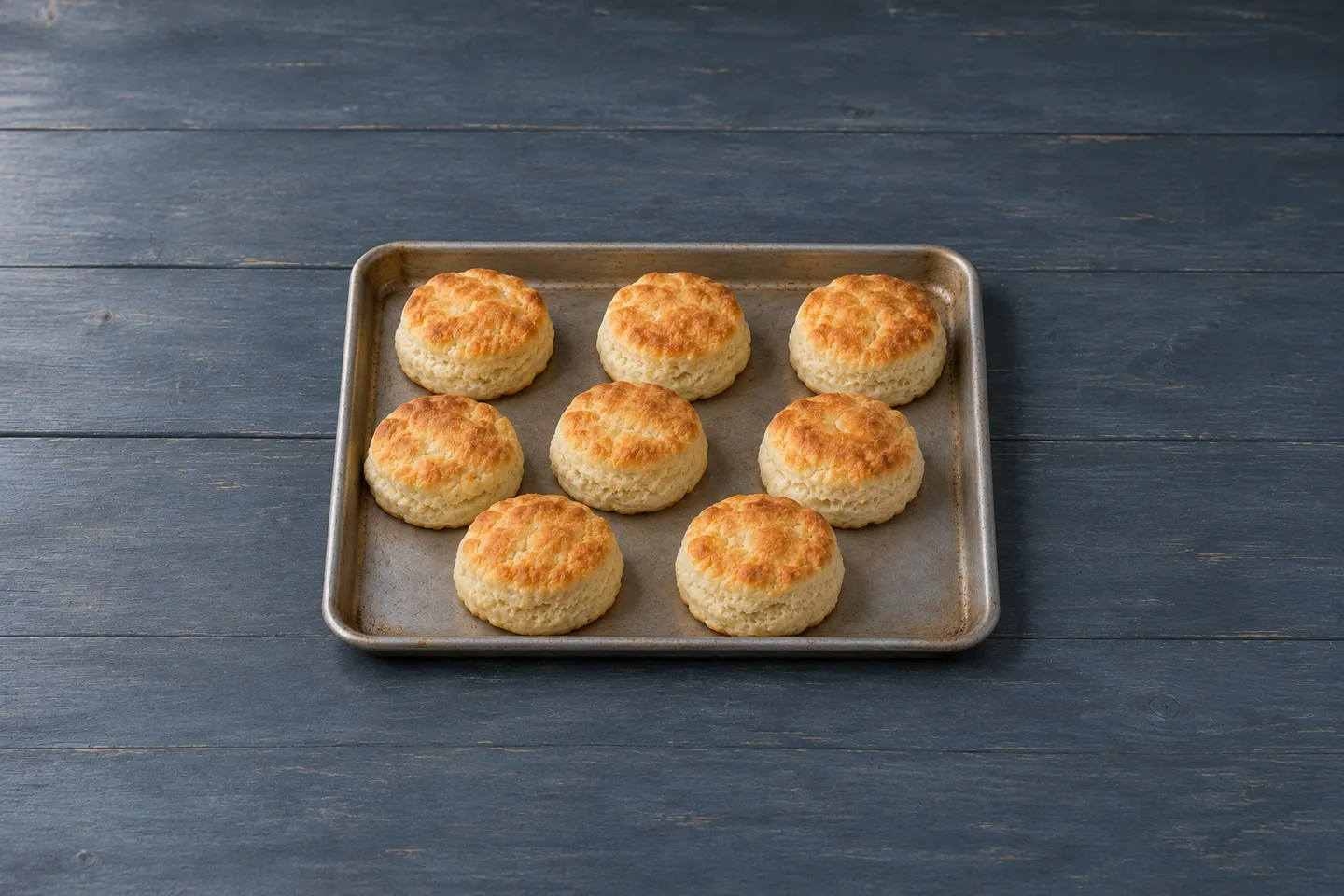
Baking-Powder Biscuits (1896)
Small butter-and-lard biscuits with a soft dough and a hot oven, adapted from Fannie Merritt Farmer's 1896 recipe.
- Original yieldYield
- Approximately 8 small biscuits, 2 per servingApproximately 8 small biscuits, 2 per serving
- PrepPrep time
- CookCook time
- TotalTotal time
Estimated: about 20 minutes preparation and 12 to 15 minutes baking. Heat the oven before mixing in the liquid. Extra trays may need separate baking rounds.
Published
Original recipe: Approximately 8 small biscuits, 2 per serving
The story behind the recipe
The milk jug isn't an instruction to use every drop. Farmer's biscuit recipe gives a liquid allowance, then warns that differences in flour make an exact amount impossible to prescribe. Stop at a soft dough. It's a sensible bit of permission in a recipe that otherwise moves briskly from the mixing bowl to a hot oven.
Two fats and a plain dough
These biscuits contain both butter and lard, with milk and water in equal parts for the liquid. There's no sugar in the dough. Cut them small, bake them while the oven is hot and serve them warm, split beside breakfast or a bowl of soup. The useful appeal is a plain bread you can make without waiting for yeast dough to rise.
Read more about this recipe
The powder is already prepared
Fannie Merritt Farmer included Baking Powder Biscuit I in her 1896 Boston Cooking-School Cook Book. The title names a ready preparation: baking powder, rather than separately measured soda and an acid. Her directions still ask the cook to sift, work in the fats, judge the dough and bake promptly. A prepared powder saves one kind of measuring without making those decisions disappear.
Baking soda and baking powder aren't equal spoonfuls of the same ingredient. Soda is sodium bicarbonate; baking powder supplies an acid ingredient alongside it, commonly with starch. This recipe uses commercial baking powder. A homemade cream-of-tartar mixture or a spoonful of soda would change the leavening preparation, so neither is a casual substitute for the amount here.
Keep the flour basis visible
The modern batch begins with a weighed amount of all-purpose flour. That's more useful than assuming that any scoop called a cup will contain the same mass. Farmer's two cups are the historical starting point; the working weight here is a declared modern choice, with the detailed differences in the recipe notes.
Keep a little extra flour for the board, where it prevents sticking while you shape the dough. It isn't an invitation to knead in an indefinite second helping. If the dough needs a light dusting to handle, use one. If you keep adding flour until it feels firm and dry, you've moved away from the soft dough the recipe describes.
Set out the tray before the liquid
The oven and buttered sheet should be ready before the dough is wet. That leaves you free to cut the rounds and bake, rather than interrupt the work to search for equipment. Farmer specifically warns against an oven too slow to let the gas do its work. Her warning doesn't give us a calibrated temperature for every historical stove, but it does explain why oven preparation belongs at the beginning.
This is a different setup from a batter poured into a muffin tin. In our gem-pan and muffin-tin guide, the pan's material and starting temperature are part of the method. These biscuits are shaped first and baked on a sheet; the cutter and dough thickness determine the individual pieces.
Rounds, scraps and the last biscuit
Cut the first rounds close together, then press the scraps together lightly for another cut. The last pieces may look less tidy. You don't need to work the whole dough again to make them match the first ones.
Keep the same thickness when making more biscuits. A larger batch needs more space on the sheet, or another round in the oven. It doesn't need taller pieces that take a different path to a cooked center. The approximate count is helpful for planning, while the thickness remains useful at every batch size.
Make it your wayOriginal: 4 servings · Makes Approximately 8 small biscuits, 2 per serving
Original recipe: Approximately 8 small biscuits, 2 per serving
Ingredients
For Approximately 8 small biscuits, 2 per serving. Quantities are shown as written.
Source measurement convention: Metric. Explicit unit definitions take precedence; unconfirmed measures must be checked before conversion.
Original quantities for Approximately 8 small biscuits, 2 per serving.
- All-purpose flour240 g
- Commercial baking powder (level)4 metric tsp
- Fine salt3 g
- Cold unsalted butter, diced15 g
- Cold lard, in small pieces15 g
- Milk, maximum allowance90 ml
- Water, maximum allowance90 ml
- All-purpose flour, as needed for dusting
- Unsalted butter, as needed for greasing
Measurement notes
- commercial baking powder (level): tsp: 1 = 5 ml.
Measurement notes
Original ingredients
- 240 g all-purpose flour
- 4 metric tsp commercial baking powder (level)tsp: 1 = 5 ml.
- 3 g fine salt
- 15 g cold unsalted butter, diced
- 15 g cold lard, in small pieces
- 90 ml milk, maximum allowance
- 90 ml water, maximum allowance
- All-purpose flour, as needed for dusting
- Unsalted butter, as needed for greasing
Equipment
 Baking sheet
 Fine-mesh sifter
 Rolling pin
- Round biscuit cutter (about 6 cm)
Instructions
Prepare the oven, sheet and liquid
Heat the oven to 425°F (220°C), conventional heat. Lightly grease a baking sheet with butter and set out a round cutter about 6 cm across. Mix the measured milk and water in equal parts in a jug; this is the maximum liquid allowance, and you may not need all of it.
Sift dry ingredients and rub in fats
Mix the flour, commercial baking powder and salt, then sift them together twice. Use level 5 ml teaspoons for the baking powder. Rub in the cold butter and lard with fingertips until distributed, leaving small pieces of fat.
Add liquid to a soft dough
Add the mixed milk and water gradually, cutting and turning with a table knife. Stop as soon as you have a soft, cohesive dough; don't pour in the remaining liquid once the dough is moist enough. Don't taste raw dough.
Roll and cut the biscuits
Turn onto a lightly floured board. Pat and roll lightly to about 13 mm (1/2 inch) thick, then cut rounds with the cutter. Press scraps together lightly and cut again. The original batch makes approximately 8 small biscuits; keep the thickness and cutter size the same for a changed quantity.
Bake and serve warm
Put the biscuits on the prepared sheet without overlapping and bake for about 12 to 15 minutes, until risen and golden with a baked center. Check a center piece rather than judging only the top. Serve warm. For additional trays, bake in further rounds as needed and check each round separately.
Recipe notes
When adjusting quantities
Keep biscuits about 13 mm thick and use the same cutter. Mix equal parts milk and water, then add only enough for a soft dough. Make more pieces and use additional trays or baking rounds for larger batches; oven temperature and individual baking time do not multiply.
Original recipe notes
These notes describe the original recipe. Quantities mentioned here do not change when you adjust servings.
The source gives 2 cups flour, 4 teaspoons baking powder, 1 teaspoon salt, a tablespoon each of butter and lard, and 3/4 cup milk and water in equal parts. This version chooses 240 g flour, 15 g of each fat and a 240 ml working cup for the liquid, giving a maximum 90 ml milk plus 90 ml water. Salt is deliberately reduced to 3 g. The flour weight isn't a measured historical cup conversion, and the variable-liquid instruction remains.
The level 5 ml powder spoons, cold fats, modern oven setting, 6 cm cutter and approximate eight-biscuit yield are supplied for this version. Use commercial baking powder, not baking soda or an assumed equal quantity of homemade powder. The source doesn't identify a powder brand or its exact formulation. The biscuits contain wheat, milk and pork fat; no vegetarian label applies.
Serve freshly baked. Don't taste uncooked dough; see the FDA's flour safety guidance. No make-ahead dough holding time or tested keeping-quality interval is supplied.
Read the scaling guide. Times, temperatures and equipment need their own consideration. Open the recipe tool to review and correct individual amounts.
Sources and attribution
Fannie Merritt Farmer, The Boston Cooking-School Cook Book (Boston: Little, Brown, and Company, 1896), Baking Powder Biscuit I, p. 70.
Adapted from Baking Powder Biscuit I, p. 70 of Farmer's 1896 *Boston Cooking-School Cook Book*.
Recipe details
- Recipe tradition
- Vintage
- Cooking method
- Oven
- Browse category
- Baking & Desserts