
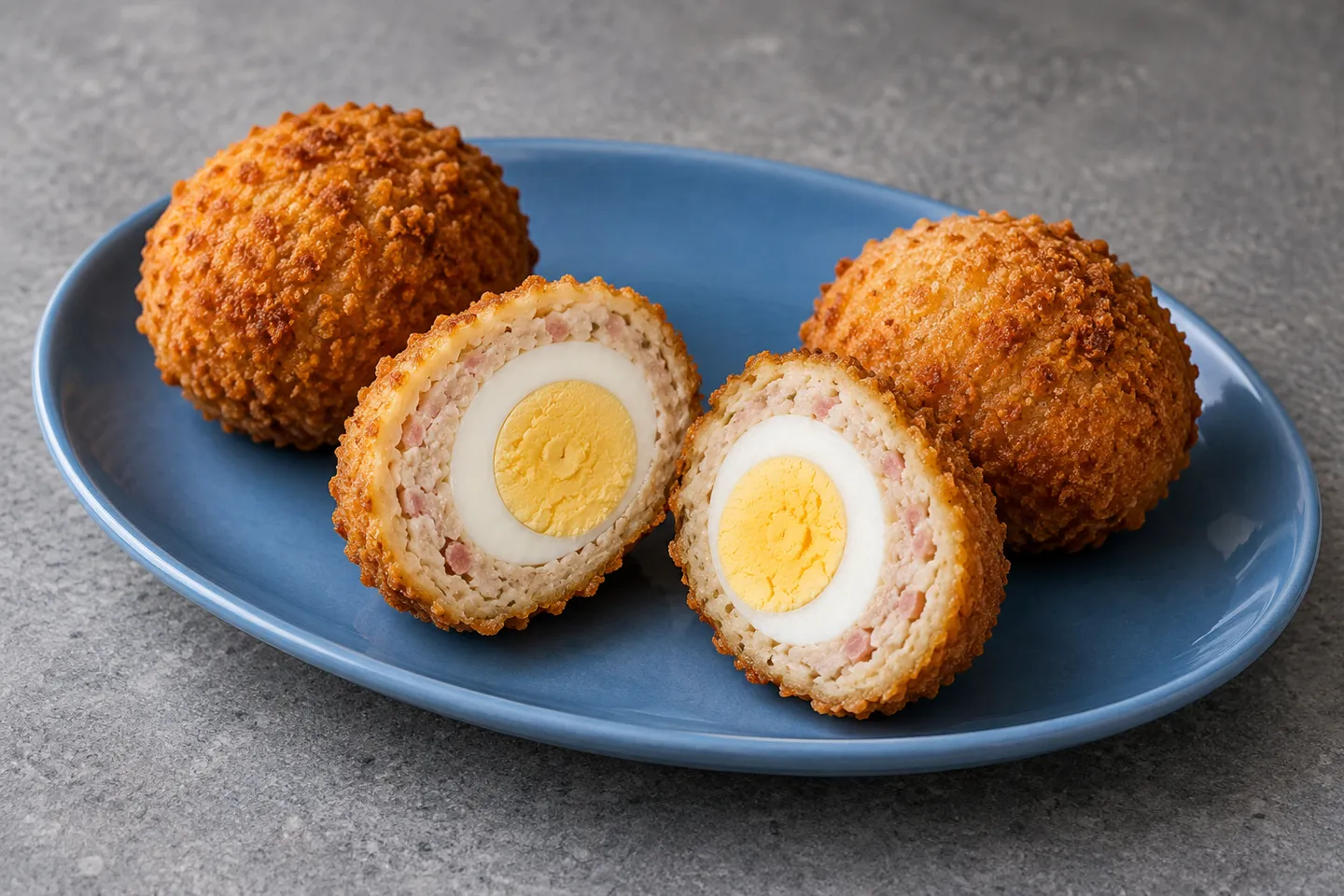
Scotch Eggs with Ham Forcemeat, Adapted from Beeton (1861)
Firm-yolk eggs wrapped in ham, breadcrumb and suet forcemeat, crumbed and fried, then chilled for a modern picnic.
- Original yieldYield
- 4 Scotch eggs; 4 picnic portions4 Scotch eggs4 picnic portions
- PrepPrep time
- CookCook time
- TotalTotal time
Estimated: 30 minutes preparation, 25 minutes boiling/frying, 20 minutes chilling the coated eggs, then at least 2 hours final chilling for cold picnic service.
Published
Original recipe: 4 Scotch eggs; 4 picnic portions
The story behind the recipe
Beeton's Scotch egg has a breadcrumb-and-suet forcemeat flavored with ham. It isn't the familiar modern sausage-meat wrapper. Cut one open and the firm egg should be surrounded by a relatively thin stuffing layer beneath its fried crumbs.
Ham in the coating
Use fully cooked ham, finely chopped enough to distribute through the fresh breadcrumbs. Shredded beef suet supplies the source's fat component. The egg in that mixture binds the coating; it is separate from both the boiled eggs and the egg used for the outer crumbs.
Read more about this recipe
Two recipes make one Scotch egg
Recipe 1666 in the 1861 Book of Household Management directs the reader to forcemeat 417. That second entry contains ham or lean bacon, suet, breadcrumbs, lemon peel, herbs and eggs. Following the reference changes the picture of the dish: the coating is a seasoned stuffing, with the ham seasoning carried through it.
Beeton also gives a further direction for the Scotch eggs themselves: the ham or anchovy flavor should be prominent. This version follows the ham branch. Finely mincing it lets a modest quantity flavor the whole coating, rather than leaving a few large, salty pieces in otherwise plain crumbs.
The herbs and lemon make sense in that mixture. They are small seasonings for the wrapper, not a salad garnish added at the end. Keeping them finely chopped avoids long pieces catching while the coating is spread around the egg.
The crumbs were optional
The source describes beaten egg and breadcrumbs as an optional improvement to appearance. Here they are the chosen finish, giving the surface a distinct crumb texture. That outer dry coating has a different purpose from the fresh crumbs mixed into the forcemeat.
Don't swap the two without considering their forms. Fresh breadcrumbs contribute moisture and body to a stuffing. Fine dry breadcrumbs are easier to distribute over a wet outer layer. A packet of very coarse crumbs would make a rougher surface than the one described here.
A firm egg travels more neatly
The original tells the cook to boil the eggs for ten minutes. These picnic eggs retain a firm yolk, which can be sliced cleanly after chilling. The yolk stays inside its half when the egg is cut.
Cool and dry the peeled eggs before wrapping them. A slippery wet surface makes the coating harder to keep in place. Once wrapped, a short refrigerator rest firms the eggs before frying, but it doesn't replace the final cooking check on the raw egg in the forcemeat.
From a hot dish to the cool box
Beeton serves the fried eggs with brown gravy poured around them. The picnic adaptation omits that gravy and is thoroughly chilled after cooking. The gravy stays off so the fried crumbs can keep their texture.
Pack them cold in a rigid container so the crumbs aren't crushed by everything else in the bag. Keep the container in an insulated cool box with ice packs, and take out only what will be eaten. Bring out a few at a time, leaving the rest cold until they're wanted.
Explore the historical background and companion recipes in A Victorian Picnic, Tuned for Today.
Make it your wayOriginal: 4 servings · Makes 4 Scotch eggs; 4 picnic portions
Original recipe: 4 Scotch eggs; 4 picnic portions
Ingredients
For 4 Scotch eggs; 4 picnic portions. Quantities are shown as written.
Source measurement convention: Metric. Explicit unit definitions take precedence; unconfirmed measures must be checked before conversion.
Original quantities for 4 Scotch eggs; 4 picnic portions.
- Large eggs, for boiling4
- Fully cooked ham, very finely minced60 g
- Shredded beef suet55 g
- Fresh white breadcrumbs85 g
- Large egg, beaten, for the forcemeat1
- Lemon, finely grated zest only1/4
- Finely chopped fresh parsley1/2 tsp
- Finely chopped fresh thyme1/2 tsp
- Ground mace1/8 tsp
- Cayenne pepper1/8 tsp
- Fine salt1/8 tsp
- Large egg, beaten, for coating1
- Fine dry breadcrumbs, for coating50 g
- Sunflower oil, for frying1.5 l
Measurement notes
- finely chopped fresh parsley, finely chopped fresh thyme, ground mace, cayenne pepper, fine salt: US tsp: 1 = 4.9289 ml (rounded).
Measurement notes
Original ingredients
- 4 large eggs, for boiling
- 60 g fully cooked ham, very finely minced
- 55 g shredded beef suet
- 85 g fresh white breadcrumbs
- 1 large egg, beaten, for the forcemeat
- 1/4 lemon, finely grated zest only
- 1/2 US tsp finely chopped fresh parsleyUS tsp: 1 = 4.9289 ml (rounded).
- 1/2 US tsp finely chopped fresh thymeUS tsp: 1 = 4.9289 ml (rounded).
- 1/8 US tsp ground maceUS tsp: 1 = 4.9289 ml (rounded).
- 1/8 US tsp cayenne pepperUS tsp: 1 = 4.9289 ml (rounded).
- 1/8 US tsp fine saltUS tsp: 1 = 4.9289 ml (rounded).
- 1 large egg, beaten, for coating
- 50 g fine dry breadcrumbs, for coating
- 1.5 liters sunflower oil, for frying
Equipment
 Large heavy pot or Dutch oven
 Deep-fry thermometer
 Food thermometer
 Wire cooling rack
Instructions
Boil, cool and peel the eggs
Lower the 4 boiling eggs into gently boiling water and cook for 10 minutes. Transfer to cold water until cool enough to peel. Peel carefully and pat dry; keep the eggs refrigerated while preparing the coating.
Mix and apply the ham forcemeat
Mix the ham, suet, fresh breadcrumbs, forcemeat egg, lemon zest, parsley, thyme, mace, cayenne and salt thoroughly. Divide into four equal portions at the original yield. Flatten each between clean hands and enclose one boiled egg, sealing the coating around it.
Coat and chill the eggs
Put the coating egg and dry breadcrumbs in separate shallow dishes. Roll each wrapped egg in the beaten egg, then the crumbs. Refrigerate for 20 minutes.
Fry and check the coating
In a deep heavy pot of at least 5 liters, heat the sunflower oil to 340°F (170°C). Keep the pot no more than one-third full; use a suitable narrower pot if the oil would be too shallow to fry the eggs safely. Lower in two eggs at a time and fry for about 5 to 7 minutes, turning carefully, until evenly golden and the forcemeat layer reaches at least 165°F (74°C). Check the coating rather than only the already-cooked center. Continue cooking at a slightly lower oil temperature if it colors before the coating is done.
Chill and pack for the picnic
Drain on a rack. Refrigerate promptly in a shallow container, within 2 hours of cooking, or within 1 hour above 90°F (32°C). Chill thoroughly for at least 2 hours before cold service. Pack in a cool box with ice packs and keep at 40°F (4°C) or below until eating.
Estimated calories 340 kcal
Nutrition portion: 1/4 of recipe · Original yield: 4 Scotch eggs; 4 picnic portions
Source & assumptions
Rough estimate per original Scotch egg (1 of 4 picnic portions). Includes the boiled-egg core and ham/suet wrapper; outer egg and crumb coating use published round-snack pickup proxies, with frying fat modeled on the wrapper separately. Coating and suet fat retention may differ substantially; not measured or validated for this specific recipe.
Recipe notes
When adjusting quantities
Keep four portions of coating for four eggs at the original yield. Fry in small batches with the same oil depth and temperature; oil for the pot isn't an amount absorbed per serving. Don't multiply the oil into the same pot.
Original recipe notes
These notes describe the original recipe. Quantities mentioned here do not change when you adjust servings.
Adapted from Beeton's 1861 book, nos. 1666 and 417. The source uses six eggs with six historical tablespoons of forcemeat and fries them in lard, serving them hot with gravy. This four-egg version uses a weighed coating, increases the ham relative to a half batch of 417, selects the optional crumb finish, substitutes sunflower oil and omits the gravy for chilled picnic service. The weighed coating replaces the source's spoon measure.
Contains eggs, wheat and beef suet; check the suet and ham labels. Cool and pack following FoodSafety.gov's time and temperature guidance. Keep the finished eggs refrigerated, eat the following day at the latest, and don't treat time in an unchilled basket as refrigerated storage.
Read the scaling guide. Times, temperatures and equipment need their own consideration. Open the recipe tool to review and correct individual amounts.
Sources and attribution
Isabella Beeton, The Book of Household Management (1861), Scotch Eggs, no. 1666, p. 828, and Forcemeat, no. 417, p. 200.
Recipe details
- Recipe tradition
- Vintage
- Course or meal
- Lunch
- Cuisine
- British
- Browse category
- Snacks & Dips