
- Victorian food
- Picnic
- Pastry
- Food history
A Victorian Picnic, Tuned for Today
Borrow the pastry, eggs and cake from Beeton's picnic world, with four manageable recipes and a modern plan for cooling and packing.
The picnic list remembers three corkscrews. Ice gets a more tentative instruction: take a little, if it can be managed. Beeton’s forty-person outing has room for roast birds, pies, lobsters and several kinds of pudding, but its priorities aren’t the packing plan to follow today.
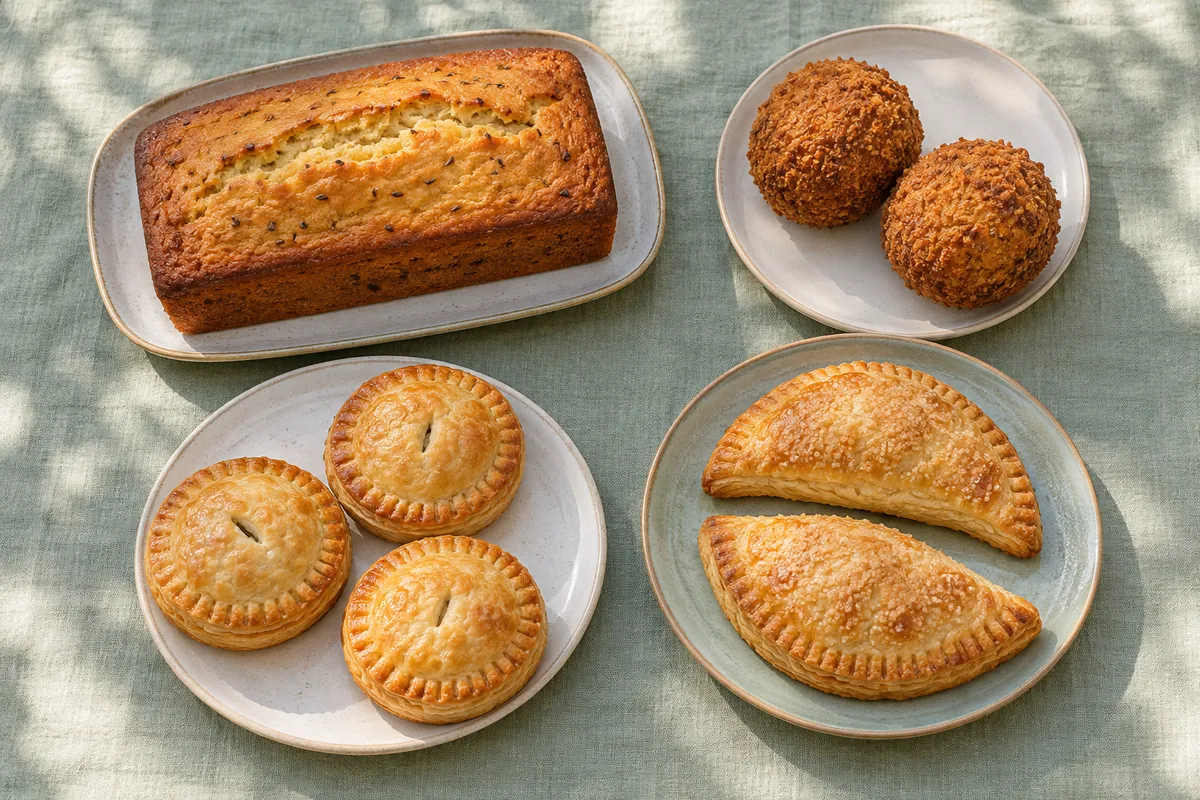
We can borrow a more manageable part of that world: a firm-yolk Scotch egg, a small chicken-and-ham pie, a caraway seed cake and an apple turnover. The question is what happens between making them and lifting the lid at the picnic site. Some need chilling; some need protection from steam, damp or crushing. All need a little room in the schedule.
Borrow the variety, leave the banquet
The bill of fare in the 1861 Book of Household Management, entries 2149–2152, is explicitly for forty people. Its scale is part of its character. Cold roast and boiled beef appear beside lamb, four roast fowls, two ducks, ham, tongue and pies. The sweet dishes include two dozen fruit turnovers as well as cakes, biscuits and molded puddings.
Beeton’s published proposal is lavish, and dividing every quantity by ten still leaves an awkward picnic for four. You would still have a collection of small amounts requiring a great many separate preparations.
Instead, choose by what a dish contributes. An egg has a firm center and a savory wrapper. A pie supplies a pastry-and-filling contrast. Cake can be packed whole and sliced later. A turnover is already an individual serving. The variety comes from those differences, with four preparations instead of a banquet.
Our four recipes can make a generous spread, or serve as options for a smaller outing. Each has its own portion count. There is no need to bake a whole cake and then insist everyone also eat a large turnover.
An egg with a different wrapper
Beeton’s Scotch Eggs, no. 1666, sends the reader to forcemeat 417. Follow the reference and the wrapper becomes a mixture of ham or bacon, suet, breadcrumbs, herbs, lemon peel and eggs. It isn’t simply a period name for the sausage meat used in many current versions.
That source detail gives the companion recipe its identity. In our Scotch eggs with ham forcemeat, finely chopped cooked ham flavors a breadcrumb-and-suet coating around a firm boiled egg. The optional outer egg-and-crumb finish is selected, giving the fried surface a visible texture of its own.
The original dish is served hot, with brown gravy poured around the eggs. Our picnic version omits the gravy and is thoroughly chilled after cooking. That changes the serving plan as well as the size of the batch.
Keep the egg whole while transporting it, then cut it on a clean plate if wanted. The firm yolk is intentional. A dramatic runny center would change both the recipe and the way it is eaten outdoors.
Give the filling a case that can travel
Chicken or Fowl Patties, no. 928, describes pastry cases baked with bread inside. The cook removes the bread and fills the hollow with a hot mixture of cooked chicken, ham, cream and gravy. The bread is a temporary support, not a mysterious extra ingredient in the finished filling.
That construction is worth knowing before ordering the ingredients. It produces a filled case, while our chicken-and-ham picnic hand pies are enclosed before baking. Separate pastry lids make a compact form that can be lifted from a container, but that convenience is a modern change.
The filling retains the source’s combination of cooked poultry, a smaller quantity of ham and lemon-scented sauce. The sauce is thickened and cooled separately before the chilled meat is added. The assembled pies are then baked until their centers are thoroughly hot. This avoids repeatedly heating and cooling the chicken during preparation.
Don’t seal a warm filling into cold puff pastry. The waiting time gives the butter layers a chance to stay firm during assembly, as well as making the pies easier to handle. A clean pastry border matters too: sauce at the seam makes it harder for the lid and base to meet.
Two sweets, two ways to pack
Caraway seed cake and apple turnovers give the sweet part of the spread different shapes. One can remain a whole loaf in a tin; the others are individual folded pastries. Neither needs a cream garnish to justify its place in the basket.
Our caraway seed cake follows Beeton’s richer recipe, A Very Good Seed-Cake, no. 1776. Its butter-and-egg formula sits beside a different common seed cake made with dough and dripping. The caraway is a specific flavor choice, not a generic handful of seeds.
The smaller modern loaf uses a stated brandy amount and a defined pan. An old wineglass doesn’t silently acquire a universal capacity, and the original large cake’s oven time isn’t automatically halved with its ingredients. Let the baked center and a clean skewer guide the finish.
Fruit Turnovers, no. 1278, is explicitly labeled suitable for picnics. It offers raw fruit, cooked fruit or jam as filling options. Our apple turnovers follow the cooked-fruit branch: a cooled filling goes onto a pastry circle, which folds into a half-moon. Egg white and sugar finish the top.
Cool both sweets completely before packing. A closed tin can’t distinguish desirable warmth from moisture that will condense under its lid. Give the cake time on its rack and keep the turnovers spaced apart while their steam escapes.
Make a cooling plan before a packing list
The egg and chicken dishes need the refrigerator and a properly chilled cool box. Their pastry or breadcrumb covering protects their form; it doesn’t make the perishable filling shelf-stable.
Current FSA picnic guidance recommends ice or frozen gel packs distributed through the cool box, with the lid opened as little as possible. A decorative basket can carry plates and napkins, but it isn’t the cold storage for cooked meat and eggs.
Use a refrigerator temperature of 40°F (4°C) or below and keep the food that cold during the journey. FoodSafety.gov’s household guidance limits time unrefrigerated to two hours, or one hour above 90°F (32°C). That shorter limit matters in hot weather, including a warm car. Time outside refrigeration includes preparation and service, not just the drive.
Cooked food should go into shallow containers and be refrigerated promptly. Don’t interpret completely cool before packing as permission to leave a meat pie on the counter all afternoon. The recipe schedules include final chilling before the food is transferred to the cool box.
| Food | What needs protection | Packing choice |
|---|---|---|
| Ham-forcemeat Scotch eggs | Cold temperature and an intact crumb coating | Chilled rigid container in the cool box |
| Chicken-and-ham hand pies | Perishable filling and fragile pastry lids | Chilled shallow container, with room around each pie |
| Caraway seed cake | Dryness and an uncrushed loaf | Clean dry cake tin, after complete cooling |
| Apple turnovers | Pastry edges and trapped steam | Completely cooled, in a flat container for same-day service |
Put the work in a comfortable order
For the simplest outing, bake the seed cake first and let it cool fully. The meat and egg dishes can be prepared ahead within the recipes’ short refrigerated limits, leaving time to chill them before departure. Apple filling can cool while you prepare another task, but keep it away from raw egg handling and the meat-preparation area.
The pastry recipes both use a hot oven, though their centers have different checks. The chicken filling needs a temperature check; a turnover needs properly baked pastry underneath as well as a browned top. Avoid crowding every tray onto one shelf and assuming the printed time will cover them all.
Pack a clean knife for the cake and eggs, serving utensils, plates, napkins, ice packs and drinking water. Keep the cool box closed until food is needed, then serve a little at a time. The luxury here is being able to sit down with the meal already cooked, cooled and ready to share.

Read the diagram text
Cold storage for perishables; dry protection for cooled sweets. Scotch eggs Keep the crumb coating intact during transport. Chill to 40°F / 4°C or below Rigid container in a cool box with ice or frozen gel packs. Chicken-and-ham pies The filling is perishable; the pastry is fragile. Chill to 40°F / 4°C or below Shallow container with room around each pie, inside the cool box. Caraway seed cake Cool completely before closing the tin. Keep dry and uncrushed Pack the whole loaf in a clean, dry cake tin. Apple turnovers Let steam escape during complete cooling. Protect the pastry edges Use a flat container for same-day service. Keep the cool box closed. Perishables: at most 2 hours unrefrigerated, or 1 hour above 90°F / 32°C. Count preparation and service time too. A basket does not provide refrigeration.
Sources
Isabella Beeton, The Book of Household Management (1861): Scotch Eggs 1666, p. 828; Forcemeat 417, p. 200; Chicken or Fowl Patties 928, p. 445; puff pastes 1205–1206, pp. 612–613; Fruit Turnovers 1278, p. 645; A Very Good Seed-Cake 1776, pp. 863–864; picnic bill of fare and reminders 2149–2152. Current handling advice is linked where discussed. These are selected historical recipes with declared modern batch and packing adaptations.