
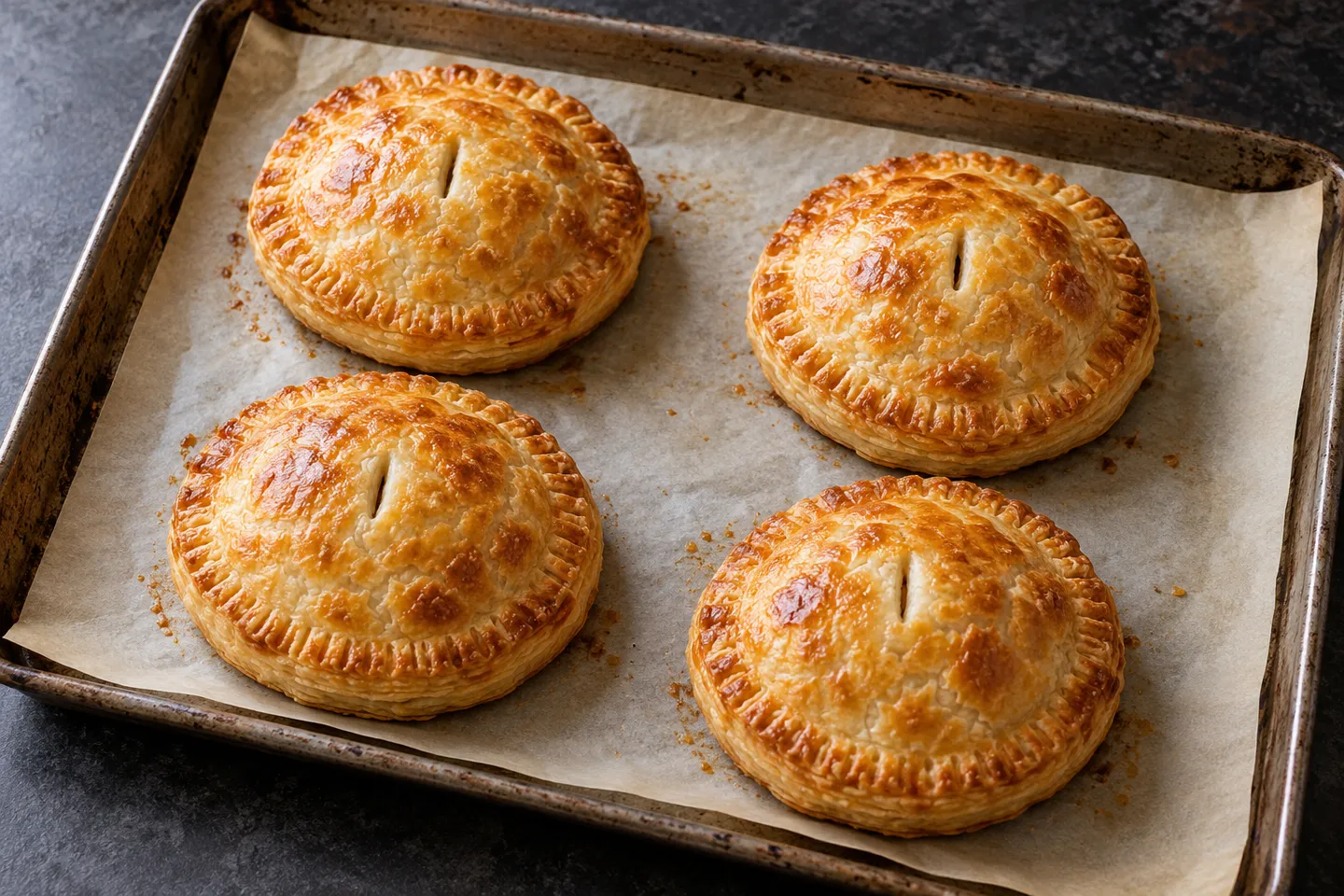
Chicken-and-Ham Picnic Hand Pies, Adapted from Beeton (1861)
Small sealed puff-pastry pies with cooked chicken, ham and a thick lemon-scented cream filling, adapted from Beeton's chicken patties.
- Original yieldYield
- 8 small pies; 4 picnic portions8 small pies4 picnic portions
- PrepPrep time
- CookCook time
- TotalTotal time
Estimated: 40 minutes preparation, 5 to 10 minutes sauce cooking, 30 minutes filling cooling, 25 to 30 minutes baking, then at least 2 hours final chilling. Allow another 25 to 30 minutes if baking the trays separately.
Published
Original recipe: 8 small pies; 4 picnic portions
The story behind the recipe
These are sealed hand pies, with a thin lid as well as a base. The chicken-and-ham filling is enclosed before baking, so each small pie can be lifted from its container without a spoonful of filling slipping out.
A case and a hand pie aren't the same thing
Beeton's chicken patties are pastry cases baked with a piece of bread inside. The bread is removed and the cooked chicken mixture goes into the hollow. This picnic version uses the same filling family in a different pastry form, enclosed before baking for easier carrying.
Read more about this recipe
Cooked meat, measured after preparation
The source uses the remains of cold roast chicken or fowl. It tells the cook to remove the skin and mince the white meat. The weight in this recipe likewise means prepared, cooked chicken, not a raw breast or a chicken weighed with its bones.
Ham is a smaller part of the filling. In the source, two ounces accompany every half pound of chicken. Keeping roughly that four-to-one relationship gives the ham a seasoning role without making it an equal second filling.
Cooked meat still needs careful handling. Use chicken that has been cooled and refrigerated safely, within its existing storage limit. Turning leftovers into pastry doesn't give older meat a new use-by date.
A thick filling for a small space
Cream, gravy, lemon and butter moisten Beeton's chopped chicken. A hand pie needs enough cohesion to stay inside while its edges are sealed, so the modern sauce is deliberately thick.
The sauce is cooked separately, cooled quickly and mixed with the cold meat. The chicken is therefore reheated in the oven once, rather than heated into a filling, cooled, then reheated again. That order also keeps hot sauce away from the pastry while you assemble the pies.
Cold filling helps the pastry keep its shape. If the mixture is warm enough to soften the butter layers, the seam becomes harder to seal and the base may sag when lifted. Have the filling ready before rolling the pastry.
Two circles and a clear edge
These pies use a separate round lid, not the folded half-circle of an apple turnover. A border free of filling gives the pastry something to seal against. A small central slit lets steam escape as the pie cooks.
Ready-made all-butter puff pastry makes the batch manageable. Beeton's book includes several pastry formulas, including versions with lard, but the modern product below is specified as all-butter. Check its weight and follow its thawing directions rather than warming it on the counter until soft.
Chill the finished pies before packing
A crisp-looking lid can hide a filling that is still warm. Give the pies room on a rack, then refrigerate promptly and let them chill fully before they go in the cool box. Don't pile warm pastries into a closed container to cool one another.
Take a rigid container, with enough room that the lids won't be pressed flat. These are perishable chicken pies, even though the pastry protects their shape. The insulated cold storage does the food-safety work on the journey; the crust does the carrying.
Explore the historical background and companion recipes in A Victorian Picnic, Tuned for Today.
Make it your wayOriginal: 4 servings · Makes 8 small pies; 4 picnic portions
Original recipe: 8 small pies; 4 picnic portions
Ingredients
For 8 small pies; 4 picnic portions. Quantities are shown as written.
Source measurement convention: Metric. Explicit unit definitions take precedence; unconfirmed measures must be checked before conversion.
Original quantities for 8 small pies; 4 picnic portions.
- Chilled fully cooked roast chicken, skin and bones removed, finely chopped225 g
- Fully cooked ham, finely chopped55 g
- Unsalted butter20 g
- All-purpose flour, for the sauce10 g
- Heavy cream60 ml
- Unsalted chicken stock30 ml
- Lemon juice10 ml
- Lemon, finely grated zest only1/4
- Cayenne pepper1/8 tsp
- Ground black pepper1/4 tsp
- All-butter puff pastry, thawed in the refrigerator500 g
- All-purpose flour, for rolling15 g
- Large egg, beaten, for glazing1
Measurement notes
- cayenne pepper, ground black pepper: US tsp: 1 = 4.9289 ml (rounded).
Measurement notes
Original ingredients
- 225 g chilled fully cooked roast chicken, skin and bones removed, finely chopped
- 55 g fully cooked ham, finely chopped
- 20 g unsalted butter
- 10 g all-purpose flour, for the sauce
- 60 ml heavy cream
- 30 ml unsalted chicken stock
- 10 ml lemon juice
- 1/4 lemon, finely grated zest only
- 1/8 US tsp cayenne pepperUS tsp: 1 = 4.9289 ml (rounded).
- 1/4 US tsp ground black pepperUS tsp: 1 = 4.9289 ml (rounded).
- 500 g all-butter puff pastry, thawed in the refrigerator
- 15 g all-purpose flour, for rolling
- 1 large egg, beaten, for glazing
Equipment
 Small saucepan
 Rolling pin
 Baking sheet
 Wire cooling rack
 Food thermometer
Instructions
Cook the thick cream sauce
Melt the butter in a small saucepan. Stir in the 10 g sauce flour and cook for 1 minute. Gradually whisk in the cream and stock. Simmer for 2 to 3 minutes, stirring, until very thick. Remove from the heat and stir in the lemon juice, zest, cayenne and black pepper.
Cool the sauce and add the meat
Transfer the sauce to a shallow bowl set in cold water and stir until cold, about 20 to 30 minutes, refreshing the cooling water as needed. Fold in the chilled chicken and ham. Keep refrigerated while preparing the pastry.
Roll and cut the pastry circles
Heat the oven to 400°F (200°C), conventional heat. Line two baking sheets with baking parchment. If your oven cannot bake both evenly, work in two batches and keep the second tray refrigerated. On a surface lightly dusted with the rolling flour, roll the cold puff pastry about 3 mm thick. Cut sixteen 10 cm circles at the original yield, lightly stacking and rerolling trimmings once if needed. Keep the circles cold.
Fill, seal and glaze the pies
Space four base circles on each sheet, leaving at least 3 cm between pies, and divide the filling between them, about 45 to 50 g per pie, leaving a 1.25 cm border. Lightly brush the borders with a little beaten egg, add the lids and press the edges firmly with a fork. Brush the tops with the remaining egg and cut a small steam slit in each lid. Discard unused egg wash.
Bake and check the filling
Bake for 25 to 30 minutes per batch, until risen and deeply golden, with the filling at least 165°F (74°C). Continue baking if needed; lightly cover the tops if they color before the centers are hot.
Chill and pack the pies
Transfer to a rack, then refrigerate promptly in shallow containers, within 2 hours of cooking, or within 1 hour above 90°F (32°C). Chill thoroughly for at least 2 hours before packing. Keep in a cool box with ice packs at 40°F (4°C) or below until eating.
Estimated calories 720 kcal
Nutrition portion: 1/4 of recipe · Original yield: 8 small pies; 4 picnic portions
Source & assumptions
Estimated calories per picnic portion (2 of 8 small pies), using CoFID 2021, USDA and representative raw all-butter pastry/stock labels. Circles use one 500 g-sheet geometry model at about 3 mm, with full small egg-wash and rolling-flour allowances. Pastry, rerolling, scraps and glazing vary; not measured.
Recipe notes
When adjusting quantities
Make additional pies of the same size rather than thicker pies. Keep the filling chilled and the pastry cold; baking and cooling times don't scale. Use two baking sheets or bake in batches; each extra batch needs its own oven time.
Original recipe notes
These notes describe the original recipe. Quantities mentioned here do not change when you adjust servings.
Adapted from Beeton's Chicken or Fowl Patties, no. 928, p. 445. Her puff-pastry cases are baked with bread inside, hollowed and filled afterward with hot chicken, ham, cream and gravy. This version uses sealed pies, purchased all-butter pastry, a separately cooked thick sauce and chilled cooked meat. It changes the sauce quantities, substitutes chicken stock for veal gravy and uses a modern oven setting and cold picnic service.
Contains wheat, milk and egg. Prepare with freshly cooked and safely chilled meat or suitably dated purchased cooked meat; don't use the recipe to extend an existing leftover's storage limit. Keep refrigerated and eat the following day at the latest. The FSA picnic guidance explains keeping cooked foods cold in transit and during service.
Read the scaling guide. Times, temperatures and equipment need their own consideration. Open the recipe tool to review and correct individual amounts.
Sources and attribution
Isabella Beeton, The Book of Household Management (1861), Chicken or Fowl Patties, no. 928, p. 445; puff-paste context, nos. 1205–1206, pp. 612–613.
Recipe details
- Recipe tradition
- Vintage
- Cuisine
- British
- Cooking method
- Oven
- Browse category
- Baking & Desserts