
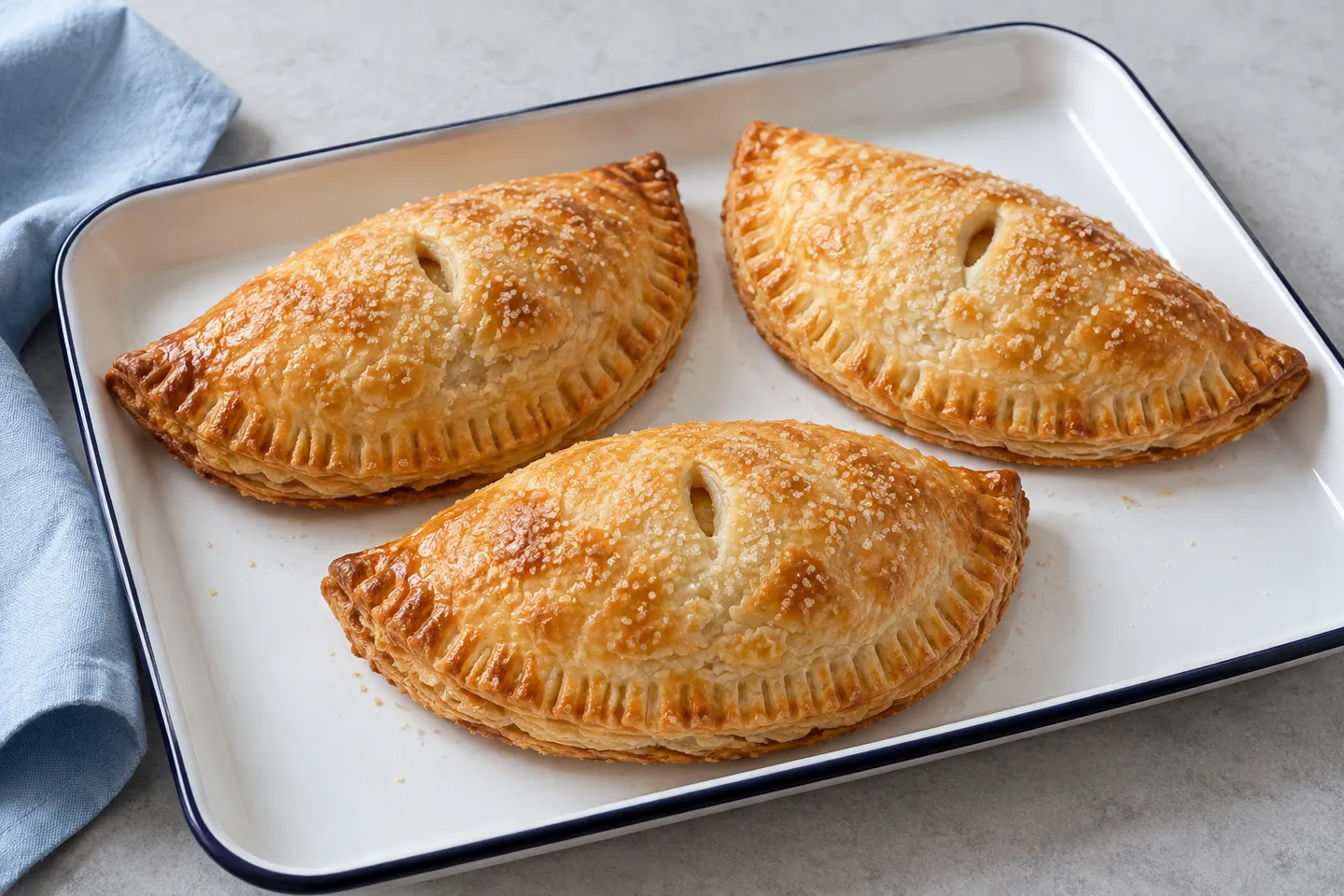
Apple Turnovers, Adapted from Beeton (1861)
Half-moon puff-pastry turnovers with a cooled apple filling and an egg-white sugar finish, adapted from Beeton's picnic fruit turnovers.
- Original yieldYield
- 6 large turnovers; 6 portions6 large turnovers6 portions
- PrepPrep time
- CookCook time
- TotalTotal time
Estimated: 30 minutes preparation, 10 minutes filling cooking, 30 minutes filling cooling, 25 to 30 minutes baking and 1 hour final cooling. Allow another 25 to 30 minutes if baking the trays separately.
Published
Original recipe: 6 large turnovers; 6 portions
The story behind the recipe
One circle of pastry makes a turnover: the filling sits on one half, and the other half folds over it. The curved seam and sugar-speckled top give these apple pastries a different shape from the round chicken pies beside them in the picnic spread.
An entry written for picnics
Beeton's recipe 1278 is headed Fruit Turnovers, suitable for picnics. The menu isn't the only evidence for their place in the basket. The separate recipe describes the folded pastry, egg-white finish and sugar on top.
Read more about this recipe
Choose the cooked-fruit branch
The source allows several fillings: raw fruit, fruit cooked down with sugar, or jam. These are alternatives with different moisture and handling. This version chooses small apple pieces, briefly cooked and completely cooled before they meet the pastry.
The apple weight means prepared fruit. Peel and core first, then weigh the pieces going into the saucepan. A large unprepared apple includes a core and skin that won't be part of this filling, so counting fruit alone would make the batch less clear.
A tart apple leaves room for the sugar without making the filling taste like jam. The cooking should soften the pieces while reducing free liquid. The aim isn't a perfectly smooth purée; a few recognizable pieces belong inside the finished pastry.
Puff pastry takes its own time
Beeton refers to medium puff-paste 1206, a mixture containing both butter and lard. This recipe uses purchased all-butter puff pastry. All-butter pastry changes that fat mixture while keeping the flaky case.
Cold pastry is easier to roll cleanly and seal around a mound of filling. Warm filling can soften it before it reaches the oven, which is why the cooling stage isn't optional preparation that disappears from the total time.
Roll an even sheet and cut circles large enough to fold. There will be trimmings around the rounds. Don't press them onto the circles, which would thicken some parts unevenly. Keep them cold and use them separately if wanted.
Leave room at the seam
It is tempting to fill right up to the rim, especially with a spoonful left in the bowl. Leave the border clean. The two pastry surfaces need to touch if they are to seal, and fruit caught between them can create an opening for juice.
The egg white and sugar belong on the outside after shaping. They give the top a different finish from a whole-egg glaze. Keep the sugar light enough that the pastry's color remains visible as it bakes.
Cool them before the lid goes on
A hot turnover holds steam as well as fruit. Set the pastries on a rack, with room between them, before packing. Closing a container over warm pastry traps moisture against the crust you have just baked.
These are generous individual pastries, best packed in a single layer. A flat container protects the curved edges better than a soft bag at the bottom of the hamper. Pack the sweet pastries separately from the chilled meat dishes, so their crisp surfaces don't sit against a cold, damp container.
Explore the historical background and companion recipes in A Victorian Picnic, Tuned for Today.
Make it your wayOriginal: 6 servings · Makes 6 large turnovers; 6 portions
Original recipe: 6 large turnovers; 6 portions
Ingredients
For 6 large turnovers; 6 portions. Quantities are shown as written.
Source measurement convention: Metric. Explicit unit definitions take precedence; unconfirmed measures must be checked before conversion.
Original quantities for 6 large turnovers; 6 portions.
- Tart apples, peeled and cored weight, diced small300 g
- Light brown sugar, for the filling30 g
- Water15 ml
- All-butter puff pastry, thawed in the refrigerator500 g
- All-purpose flour, for rolling15 g
- Large egg white, lightly beaten1
- Superfine sugar, for the tops15 g
Measurement notes
Measurement notes
Original ingredients
- 300 g tart apples, peeled and cored weight, diced small
- 30 g light brown sugar, for the filling
- 15 ml water
- 500 g all-butter puff pastry, thawed in the refrigerator
- 15 g all-purpose flour, for rolling
- 1 large egg white, lightly beaten
- 15 g superfine sugar, for the tops
Equipment
 Small saucepan
 Rolling pin
 Baking sheet
 Wire cooling rack
Instructions
Cook the apple filling
Put the apples, brown sugar and water in a small saucepan. Cover and cook over medium-low heat for 5 minutes. Uncover and cook for another 5 minutes, stirring, until the pieces are tender and excess liquid has evaporated. Spread in a shallow bowl and cool completely, about 30 minutes.
Cool the filling and prepare the oven
Heat the oven to 400°F (200°C), conventional heat. Line two baking sheets with baking parchment. Bake in two batches if your oven cannot bake both evenly; keep the waiting tray refrigerated. Roll the cold puff pastry on a surface lightly dusted with the flour into a rectangle about 30 by 45 cm and approximately 3 mm thick. Cut six 15 cm circles at the original yield; keep trimmings separately refrigerated rather than thickening the circles with them.
Fill and fold the turnovers
Arrange three circles on each sheet, leaving at least 3 cm between the shaped turnovers. Divide the cooled filling between one half of each circle, leaving a 1.5 cm border. Moisten the edges with a little water, fold the bare half over the filling and press the curved edges together firmly with a fork.
Fill, fold and finish the turnovers
Brush lightly with the egg white, sprinkle with the superfine sugar and make one small steam slit in each top. Discard unused egg white.
Bake and cool the pastries
Bake for 25 to 30 minutes per batch, until well risen, deeply golden and cooked through underneath. Transfer to a rack and cool completely, about 1 hour, before packing in a clean dry container.
Estimated calories 320 kcal
Nutrition portion: 1/6 of recipe · Original yield: 6 large turnovers; 6 portions
Source & assumptions
Ingredient-based estimate using CoFID 2021, identified manufacturer information. Approximately 320 kcal per nutrition portion. One original turnover. Uses a geometry-derived estimate of about 393 g of pastry for six 15 cm circles from the original 30 by 45 cm sheet. Includes all measured rolling flour and egg white; actual offcuts and glaze vary. Ingredients, brands and preparation affect values.
Recipe notes
When adjusting quantities
Make more 15 cm pastry circles rather than bigger turnovers. Keep filling amounts and thickness similar; use extra sheets or batches. Baking and cooling times don't scale.
Original recipe notes
These notes describe the original recipe. Quantities mentioned here do not change when you adjust servings.
Adapted from Beeton's Fruit Turnovers, no. 1278, p. 645, using its cooked-fruit option. The apple, sugar, pastry weight, size and oven setting are modern specifications. Purchased all-butter puff pastry replaces the butter-and-lard paste referenced in 1206. The source's half-pound-of-pastry yield of a dozen small turnovers isn't treated as six large modern portions.
Contains wheat, milk and egg. Follow the pastry package's handling instructions. Pack completely cooled for same-day service; keep the cooled pastries protected from damp and crushing. Pastry trimmings may be saved separately according to the package instructions.
Read the scaling guide. Times, temperatures and equipment need their own consideration. Open the recipe tool to review and correct individual amounts.
Sources and attribution
Isabella Beeton, The Book of Household Management (1861), Fruit Turnovers, no. 1278, p. 645; Medium Puff-Paste, no. 1206, p. 613.
Recipe details
- Recipe tradition
- Vintage
- Cuisine
- British
- Cooking method
- Oven
- Browse category
- Baking & Desserts