
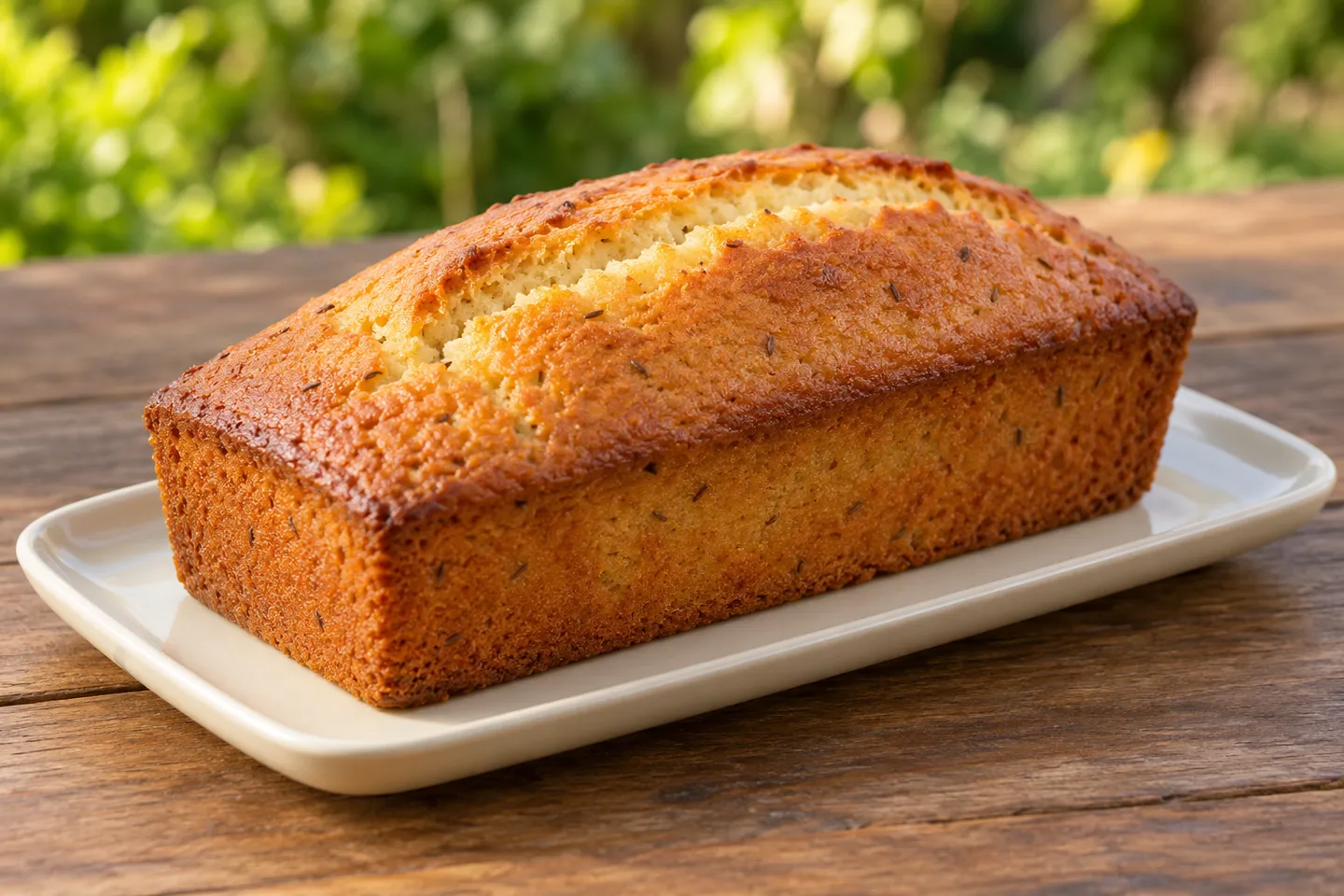
Caraway Seed Cake, Adapted from Beeton (1861)
A rich butter loaf cake with caraway, mace, nutmeg and a little brandy, adapted from Beeton's A Very Good Seed-Cake.
- Original yieldYield
- 1 loaf; 10 small slices1 loaf10 small slices
- PrepPrep time
- CookCook time
- TotalTotal time
Estimated: 20 minutes preparation, 65 to 85 minutes baking, 15 minutes in the pan and at least 75 minutes cooling. Pack only when completely cool.
Published
Original recipe: 1 loaf; 10 small slices
The story behind the recipe
The seeds in this cake are caraway. They fleck a rich butter crumb, with mace, nutmeg and a small amount of brandy behind them. A modest slice is enough to taste the distinction from a plain pound cake.
The seed has a name
Buy caraway seeds, not cumin, fennel or a packet labeled mixed seeds. Caraway has an aromatic, slightly anise-like character that belongs to this version. The seeds run through the crumb, so you taste them in a plain slice.
Read more about this recipe
Beeton's richer version
The 1861 book places A Very Good Seed-Cake beside a Common Seed-Cake. The common version begins with dough from the baker and uses dripping. The richer recipe starts with a pound each of butter and flour, six eggs and three-quarters of a pound of sugar.
Those two entries explain more than the word Victorian alone. Seed cake could describe quite different formulas, with different fats, mixing and expectations. The butter-and-egg recipe gives this loaf its rich base.
Beeton even offers a currant variation, leaving out the caraway. That would change the cake's defining flavor, so it isn't the branch followed here. The seeds remain throughout the crumb rather than appearing as a decorative sprinkle on top.
Butter, eggs and a measured tin
There is no baking powder in the source formula or in this adaptation. The mixing matters: softened butter can be beaten with sugar, and the eggs incorporated gradually, before the flour is folded through. Cold, hard butter wouldn't perform that first step in the same way.
Expect a rich butter cake with a close crumb. A loaf tin gives it a practical shape for a small picnic, with slices that can be cut evenly. Leave room above the batter and judge the center as well as the top when deciding whether it is baked.
The specified spices are small amounts. Mace and nutmeg should accompany the caraway, not turn the loaf into a heavily spiced fruitcake. Use the written spoon amounts rather than adding a handful because the seeds look modest in the mixing bowl.
A little brandy stays in the recipe
The original gives a wineglassful, without establishing a universal vessel capacity. The modern loaf uses a stated amount of brandy. That makes the shopping and mixing practical without claiming an exact conversion from an old glass.
The brandy belongs in the flavor as well as the ingredient list. Baking doesn't remove all alcohol, so choose another cake when that matters to the people sharing it.
Let the whole loaf cool
Keep the cake whole for packing if that suits the outing, then slice it with a clean knife. Warm cake enclosed in a tin releases steam against its own crust. Cooling on a rack first helps avoid a damp lid and crushed edges.
A plain cake can occupy a dry container while the egg and chicken dishes stay in the cool box. That separation is useful even for a small spread: different foods need different protection on the journey.
Explore the historical background and companion recipes in A Victorian Picnic, Tuned for Today.
Make it your wayOriginal: 10 servings · Makes 1 loaf; 10 small slices
Original recipe: 1 loaf; 10 small slices
Ingredients
For 1 loaf; 10 small slices. Quantities are shown as written.
Source measurement convention: Metric. Explicit unit definitions take precedence; unconfirmed measures must be checked before conversion.
Original quantities for 1 loaf; 10 small slices.
- Unsalted butter, softened227 g
- Superfine sugar170 g
- Large eggs, at room temperature3
- All-purpose flour227 g
- Caraway seeds11 g
- Ground mace1/4 tsp
- Freshly grated nutmeg1/4 tsp
- Brandy25 ml
- Unsalted butter, for greasing5 g
Measurement notes
- ground mace, freshly grated nutmeg: US tsp: 1 = 4.9289 ml (rounded).
Measurement notes
Original ingredients
- 227 g unsalted butter, softened
- 170 g superfine sugar
- 3 large eggs, at room temperature
- 227 g all-purpose flour
- 10.6 g caraway seeds
- 1/4 US tsp ground maceUS tsp: 1 = 4.9289 ml (rounded).
- 1/4 US tsp freshly grated nutmegUS tsp: 1 = 4.9289 ml (rounded).
- 25 ml brandy
- 5 g unsalted butter, for greasing
Equipment
 9x5 inch loaf pan
 Electric mixer
 Wire cooling rack
Instructions
Prepare the oven and loaf pan
Heat the oven to 325°F (160°C), conventional heat. Grease a 9x5-inch loaf pan with the 5 g butter and line its base and long sides with baking parchment.
Cream the butter and add eggs
Beat the 227 g butter and sugar until pale and fluffy, about 3 to 5 minutes. Beat in the eggs gradually, scraping the bowl; if the mixture begins to separate, add a spoonful from the measured flour.
Fold in flour, seeds and brandy
Mix the remaining flour with the caraway, mace and nutmeg. Fold it into the butter mixture, alternating with the brandy, just until combined. Spoon into the pan and level the top; don't fill more than three-quarters full.
Bake the seed cake
Bake for 65 to 85 minutes, until the center springs back lightly and a skewer inserted into it comes out free of wet batter. Cover loosely with foil if the top darkens before the center is baked.
Cool completely before packing
Cool in the pan for 15 minutes, then lift onto a rack. Cool completely, at least another 75 minutes, before placing in a dry airtight tin. Cut into ten small slices at the original yield.
Estimated calories 350 kcal
Nutrition portion: 1/10 of recipe · Original yield: 1 loaf; 10 small slices
Source & assumptions
Ingredient-based estimate using CoFID 2021, USDA SR Legacy (2018), the Norwegian Food Composition Table. About 350 kcal per nutrition portion (1/10 of the recipe). Includes all measured butter and the brandy before baking. Alcohol loss during baking may lower the estimate by up to about 6 kcal per slice. Actual ingredients and preparation affect the estimate.
Recipe notes
When adjusting quantities
Use additional pans of the same size for larger batches. Don't multiply the batter into a deeper pan. Beat eggs together and weigh the required fraction for smaller batches; baking times do not scale.
Original recipe notes
These notes describe the original recipe. Quantities mentioned here do not change when you adjust servings.
Adapted from Beeton's A Very Good Seed-Cake, no. 1776, pp. 863–864. The butter, flour, sugar, egg count and caraway follow approximately half the source batch. The 25 ml brandy and spice amounts are modern choices, not exact wineglass or to-taste conversions. This version uses a loaf pan, conventional creaming order and a defined oven setting, instead of transferring the source's 1 1/2-to-2-hour large-cake timing unchanged.
Contains wheat, milk, eggs and alcohol. Keep the cooled loaf in a clean dry tin for the outing; cool it fully before closing the lid. Use a clean knife and keep the cake separate from raw ingredients and meat-pie containers.
Read the scaling guide. Times, temperatures and equipment need their own consideration. Open the recipe tool to review and correct individual amounts.
Sources and attribution
Isabella Beeton, The Book of Household Management (1861), A Very Good Seed-Cake, no. 1776, pp. 863–864.
Recipe details
- Recipe tradition
- Vintage
- Cuisine
- British
- Cooking method
- Oven
- Browse category
- Baking & Desserts