
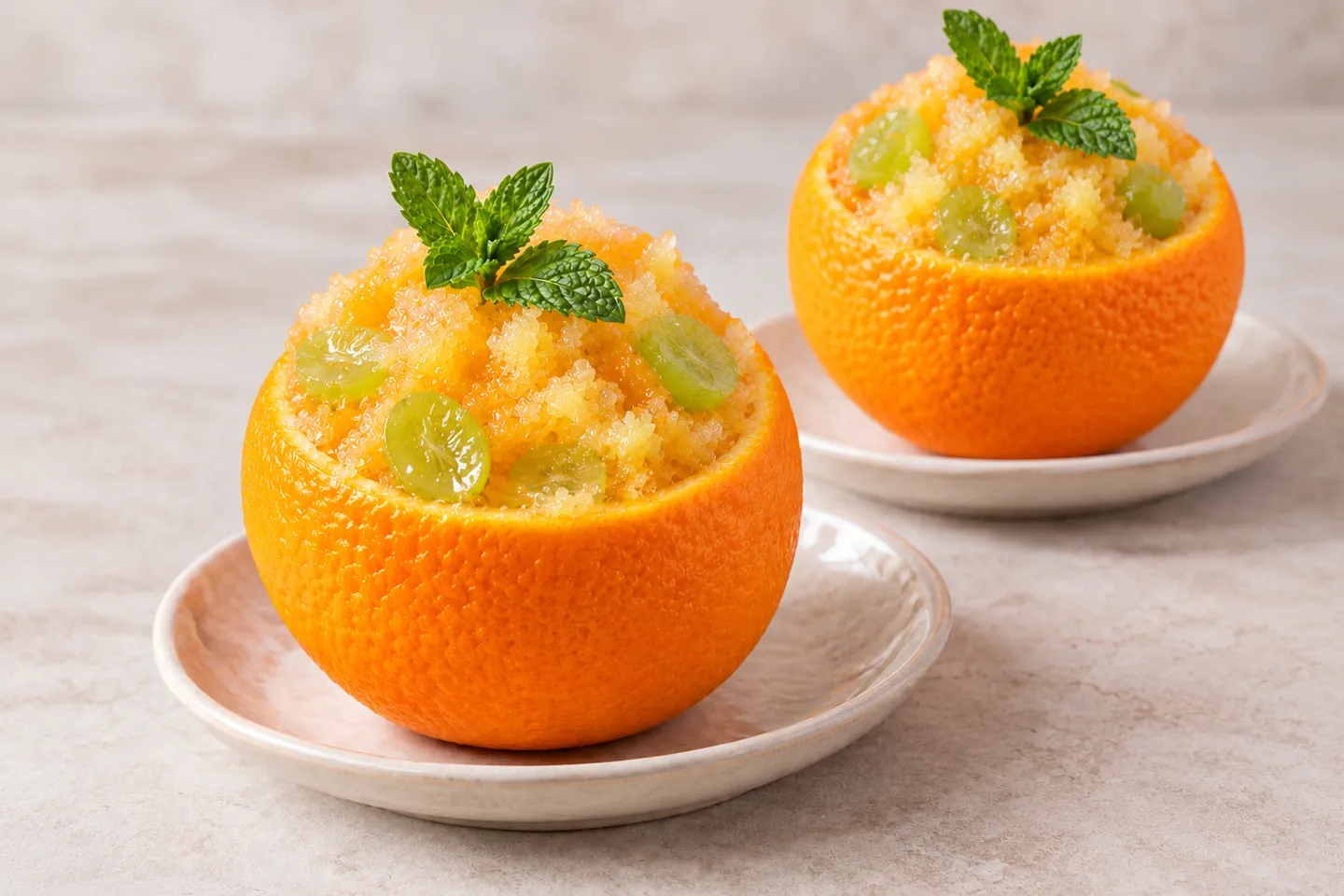
Frozen Orange-Pineapple Fruit Cup (1927)
A refreshing 1920s luncheon starter made with fresh orange pulp, crushed pineapple, and seedless grapes, chilled in the freezing tray until icy and slushy.
- Original yieldYield
- 4 servings4 servings
- PrepPrep time
- TotalTotal time
Allow 1 1/2 to 2 hours for freezing until slushy.
Published Updated
Original recipe: 4 servings
The story behind the recipe
The orange supplies its own serving cup. Pulp and juice go into a freezer pan with pineapple and grapes, then return to the saved skin as a soft, icy fruit mixture. A mint sprig finishes the cup, but the spoonable slush is the part to get right.
Cocktail means a fruit course here
There is no alcohol in this recipe. Alice Bradley's 1927 orange fruit cocktail is a cold first course, with a soft frozen liquid around pieces of fruit. It belongs among the serving ideas in her Electric Refrigerator Menus and Recipes.
Read more about this recipe
A cup with another use
Bradley has the cook scoop pulp and juice from small oranges, keeping the skins. The fruit mixture goes into the chilling unit until the liquid becomes mushy, with occasional stirring. The saved skins are one serving option; glasses surrounded by crushed ice are another.
The orange-shell version makes especially good use of the main ingredient. The fruit goes through a change of texture while its outside stays ready to hold it. It is a small piece of presentation built into the preparation, with no separate mold needed for each portion.
The listed orange weight includes the skins, so the amount of pulp and juice will vary from fruit to fruit. Their size and shape also affect the cups left behind, so scoop carefully and keep the little leveling adjustment in the notes in mind.
Fruit pieces in a soft frozen liquid
Orange pulp remains the base. Crushed canned pineapple joins it with its juice, supplying smaller pieces and more liquid. Seedless grapes are halved but left with their skins, giving a distinct bite among the softer fruit. Bradley's grapes were skinned and seeded.
The modern recipe measures the lemon and sugar that Bradley gives to taste, keeps a small pinch of salt, and adds mint. Those changes provide one particular mixture to make, while the source supplies the slushy finish and orange-skin serving idea.
That finish distinguishes these cups from a fruit salad taken straight from the refrigerator. Crystals develop in the liquid, but it should still move around the fruit rather than holding everything in a hard block. It also differs from the decorated ice in Card-Party Fruit Cup, where solid cubes cool a drink.
A freezer project with return visits
The stirring is part of the waiting. It breaks up developing crystals and gives you a chance to see how much liquid is still loose. Pan depth and freezer temperature affect the schedule, so the written time is a planning range rather than the only sign of readiness.
Fill the shells when the mixture is icy and easy to spoon, then serve promptly. Each cup holds several kinds of fruit, with a cold, crystalline liquid around them. For another example of Bradley putting the cook to work between freezer stages, see the lemon dessert in our refrigerator-cookbook feature.
Make it your wayOriginal: 4 servings
Original recipe: 4 servings
Ingredients
For 4 servings. Quantities are shown as written.
Source measurement convention: Metric. Explicit unit definitions take precedence; unconfirmed measures must be checked before conversion.
Original quantities for 4 servings.
- Whole oranges (about 4 medium, pulp and juice scooped, skins saved for cups)600 g
- Canned crushed pineapple (with juice)150 gAuthor measures: about 2/3 metric cup (250 ml per cup).
- Green seedless grapes (halved)100 gAuthor measures: about 2/3 metric cup (250 ml per cup).
- Fresh lemon juice15 mlAuthor measures: 1 metric tbsp (1 metric tbsp = 15 ml).
- Granulated sugar25 gAuthor measures: about 2 metric tbsp (1 metric tbsp = 15 ml).
- Fine salt1 pinch
- Fresh mint(for garnish)4 sprigs
Measurement notes
Measurement notes
Original ingredients
- 600 g whole oranges (about 4 medium, pulp and juice scooped, skins saved for cups)
- 150 g canned crushed pineapple (with juice, approx. 2/3 cup)
- 100 g green seedless grapes (halved, approx. 2/3 cup)
- 15 ml fresh lemon juice (1 tbsp)
- 25 g granulated sugar (approx. 2 tbsp)
- 1 pinch fine salt
- 4 fresh mint sprigs (for garnish)
Equipment
 Shallow metal baking pan or ice tray
Instructions
Hollow the orange shells
Cut a thin slice from the top of each of the medium oranges. Using a small paring knife and spoon, carefully scoop out the orange pulp and juice into a mixing bowl, keeping the orange skin shells intact to use as serving cups.
Mix fruit, juices and seasonings
In the bowl with the orange pulp and juice, stir in the canned crushed pineapple, halved green seedless grapes, fresh lemon juice, granulated sugar, and fine salt.
Transfer to a freezer pan
Pour the fruit mixture into a shallow metal pan or ice cube tray.
Freeze and stir to a slush
Place the pan into the freezer compartment for 1 1/2 to 2 hours, stirring with a fork every 30 minutes, until the liquid becomes an icy, slushy frappe.
Fill the orange shells
Spoon the frozen fruit mixture generously into the hollowed orange shells.
Garnish with mint and serve
Garnish each cup with a fresh mint sprig and serve immediately on small appetizer plates.
Estimated calories 100 kcal
Nutrition portion: 1/4 of recipe · Original yield: 4 servings
Source & assumptions
Ingredient-based estimate using CoFID 2021. Approximately 100 kcal per nutrition portion. Includes orange pulp and juice using a whole-orange reference that already accounts for discarded peel, plus pineapple packed in juice. Mint garnish is excluded. Ingredients, brands and preparation affect values.
Recipe notes
When adjusting quantities
Scale ingredients proportionally. Freeze until slushy and crystalline; do not freeze into a solid block of ice.
Original recipe notes
These notes describe the original recipe. Quantities mentioned here do not change when you adjust servings.
Do not allow the fruit to freeze solid; stirring occasionally breaks up ice crystals to create a soft, spoonable granita texture.
If your oranges do not stand level on a plate, slice a tiny sliver off the bottom of each orange skin without cutting through to the inside.
Read the scaling guide. Times, temperatures and equipment need their own consideration. Open the recipe tool to review and correct individual amounts.
Sources and attribution
Alice Bradley, Electric Refrigerator Menus and Recipes (General Electric, copyright 1927; fourth edition, September 1928), p. 63
Alice Bradley, Electric Refrigerator Menus and Recipes (General Electric, copyright 1927; fourth edition, September 1928), p. 63. Fruit quantities and forms, measured seasoning, mint and freezer timing are adapted.