
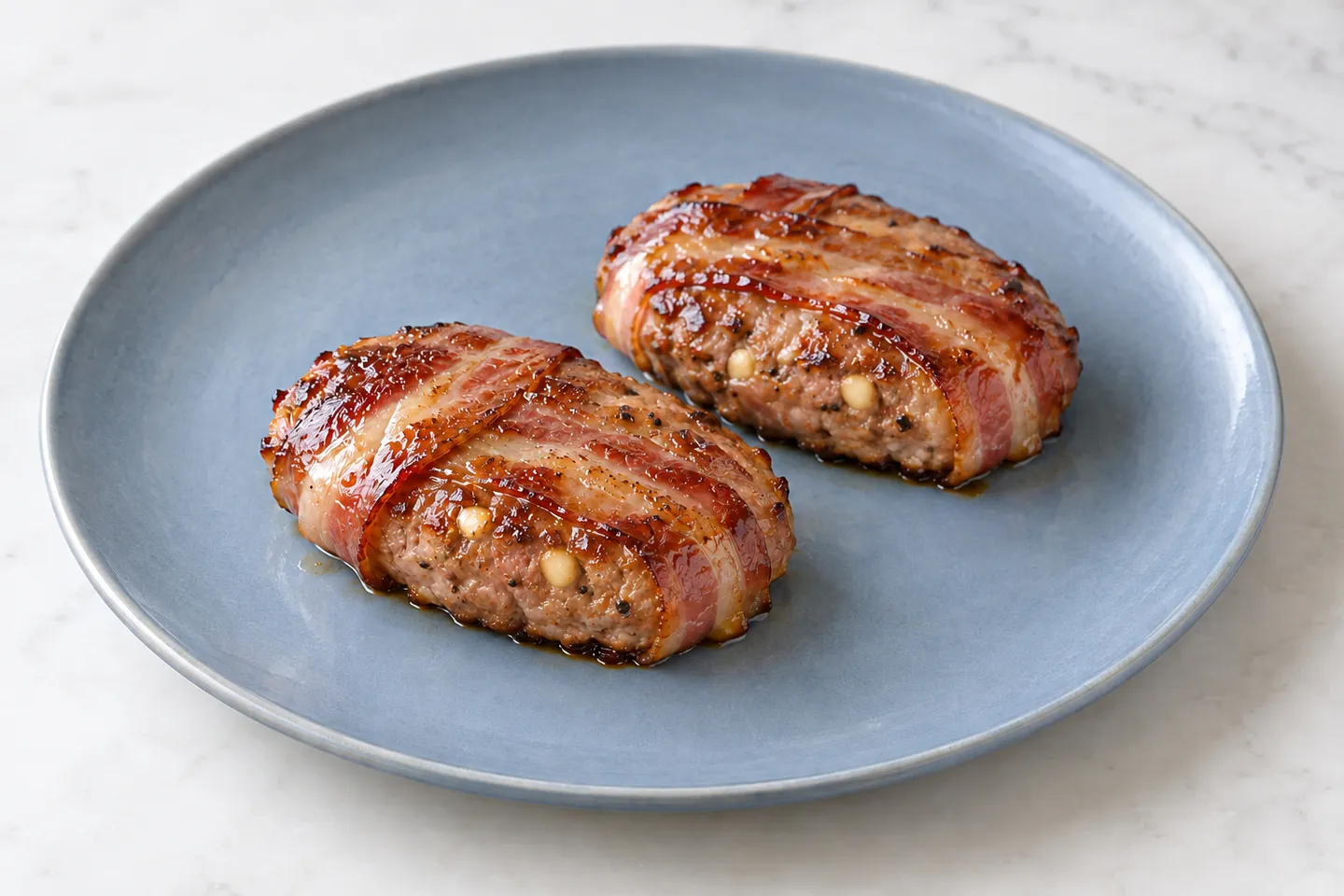
Isicia Omentata (Roman Pork Patties)
Bacon-wrapped pork patties with wine-soaked bread, pine nuts, pepper, and fish sauce, finished with a little grape syrup.
- Original yieldYield
- 4 servings (8 small patties)4 servings (8 small patties)
- PrepPrep time
- CookCook time
- TotalTotal time
Allows for two skillet batches and a 3-minute rest; larger patties may need longer to reach the safe center temperature.
Published Updated
Original recipe: 4 servings (8 small patties)
The story behind the recipe
Wine-soaked bread goes into these pork patties, pine nuts remain in small pieces, and grape syrup finishes the pan juices. Bacon encloses the mixture.
A thin covering
The original isicia omentata wraps its meat in caul, the delicate fatty membrane used to enclose meat. Thin unsmoked bacon is our accessible alternative. It makes a more substantial covering and adds salt of its own; the notes also give a caul option.
Read more about this recipe
Wine inside the patty
Book II of Apicius tells the cook to pound chopped meat with fine wheat bread crumb soaked in wine. Pepper, fish sauce, and optional myrtle berries season the mixture. Nuts and pepper go inside the little patties, which cook in their caul wrapping with caroenum, a reduced grape product. The Apicius article explores this sweet-and-savory pairing alongside the pear patina, whose fruit meets cumin and pepper.
The bread is worth noticing. It isn't a modern binder borrowed from meatloaf: the source puts it there, soaked in wine before the meat is pounded. In our mixture, soft bread crumb takes up the wine and is mashed before it joins the pork. Chopped nuts stay more distinct than the softened bread.
The source doesn't name the meat as pork or provide quantities. We use ground pork and pine nuts, mix the nuts through the meat, omit the optional myrtle, and finish with grape saba after cooking. Those choices give the old preparation a manageable skillet form. This particular passage doesn't ask for silphium or asafoetida.
Bacon and grape syrup
Thin bacon bends around the small ovals more readily than thick, stiff slices. Divide the weighed amount across all eight patties before cooking, cutting or overlapping strips where needed. The covering shouldn't dictate that one patty be twice the size of another just because a slice happens to be longer.
Plain grape saba brings concentrated fruit sweetness to the pan juices. Buy grape syrup, not a balsamic glaze: the latter would add a different sourness. Only a small finishing sauce is intended, enough to spoon over the patties without hiding them under a thick coating.
The syrup joins the pan after the pork is cooked, so its finishing stage doesn't need to compete with browning raw meat. The source cooks with the grape reduction; our sequence keeps the stove work easier to judge separately.
Eight small ovals
Two patties per person make four servings. Keeping them small leaves space for browning in batches and makes a modest portion easy to serve. Brown bacon on the outside doesn't establish that the ground pork at the center is ready; the thermometer check below does.
Bread can pick up the little sauce left on the plate, and greens offer another texture alongside the meat. Keep the sauce modest: the browned bacon and the nut-studded pork should still be recognizable beneath the grape finish.
Make it your wayOriginal: 4 servings · Makes 4 servings (8 small patties)
Original recipe: 4 servings (8 small patties)
Ingredients
For 4 servings (8 small patties). Quantities are shown as written.
Source measurement convention: Metric. Explicit unit definitions take precedence; unconfirmed measures must be checked before conversion.
Original quantities for 4 servings (8 small patties).
- Ground pork (about 20% fat)500 g
- Soft white bread crumb, crusts removed60 g
- Dry white wine45 ml
- Raw pine nuts, coarsely chopped50 g
- Southeast Asian fish sauce15 ml
- Ground black pepper2 g
- Thin-sliced unsmoked bacon150 g
- Grape saba syrup20 ml
- Water (for the finishing sauce)30 ml
Measurement notes
Measurement notes
Original ingredients
- 500 g ground pork (about 20% fat)
- 60 g soft white bread crumb, crusts removed
- 45 ml dry white wine
- 50 g raw pine nuts, coarsely chopped
- 15 ml Southeast Asian fish sauce
- 2 g ground black pepper
- 150 g thin-sliced unsmoked bacon
- 20 ml grape saba syrup
- 30 ml water (for the finishing sauce)
Equipment
 Heavy cast-iron skillet (10 or 12-inch)
 Instant-read meat thermometer
Instructions
Soak the bread in wine
Put the soft white bread crumb in a dish with the dry white wine. Leave for 5 minutes, then mash together; retain the absorbed wine.
Mix the pork and seasonings
Combine the bread mixture with the ground pork, coarsely chopped pine nuts, fish sauce, and ground black pepper. Mix just until evenly distributed and slightly tacky.
Shape the patties
Divide into 8 equal portions, about 84 g each before wrapping. Shape into oval patties approximately 2 cm thick and 7 cm long.
Wrap the patties in bacon
Divide the thin bacon slices between the 8 patties, cutting or overlapping strips as needed to enclose each one. Place the overlapping ends underneath. Use bacon thin enough to bend easily around the meat.
Brown the patties
Heat a 10- or 12-inch heavy skillet over medium heat. Place 4 patties seam-side down in the dry pan, leaving space between them. Cook for about 5 to 7 minutes per side, adjusting the heat so the bacon browns without scorching. Turn onto the narrow edges briefly if needed to cook exposed bacon.
Check doneness and cook the remaining batch
Check the center of each patty with an instant-read thermometer; ground pork must reach at least 160°F (71°C). Continue over lower heat if the bacon is browned before the centers are ready. Transfer the cooked patties to a clean plate and repeat with the remaining 4.
Make the grape glaze and finish
Pour away excess bacon fat, leaving a thin coating in the skillet. Add the grape saba syrup and water. Stir over low heat for 1 to 2 minutes, scraping up the browned bits, until lightly syrupy. Spoon a little over the patties and let them rest for 3 minutes before serving.
Estimated calories 550 kcal
Nutrition portion: 1/4 of recipe · Original yield: 4 servings (8 small patties)
Source & assumptions
Ingredient-based estimate using CoFID 2021, USDA SR Legacy, a representative Giusti saba label and published meat cooking factors. About 550 kcal per original serving of two bacon-wrapped patties. Pork uses a pan-fried meat retention model; bacon uses a protein-balanced grilled-bacon equivalent. Includes the full small wine and grape-glaze allowances. Rendered fat left in the filling or glaze, bacon type and cooking affect the result; this is not measured retention.
Recipe notes
Original recipe notes
These notes describe the original recipe. Quantities mentioned here do not change when you adjust servings.
Caul option: Use 150 g cleaned pork caul fat, cut into 8 pieces large enough to enclose the patties, in place of the bacon. It is a thinner, less salty covering and may brown differently; retain the same safe pork endpoint. This brings the wrapping closer to the source while leaving the other modern choices in place.
Serving and scaling: Serve two patties per person with bread and greens. Keep patties the same size when changing yield and allow extra skillet batches; cooking time does not scale directly with the ingredient amounts.
Storage: Refrigerate in shallow covered containers within 2 hours, or within 1 hour if the surroundings are above 90°F (32°C). Keep at 40°F (4°C) or below for up to 3 to 4 days and reheat to 165°F (74°C).
Read the scaling guide. Times, temperatures and equipment need their own consideration. Open the recipe tool to review and correct individual amounts.

Sources and attribution
Apicius II.1.7: Latin passage and Vehling's 1936 translation, recipe 47.
For the drinking side of the Roman table, explore what Romans drank besides wine on our sister site, Forgotten Drink.
Recipe details
- Recipe tradition
- Vintage
- Cuisine
- Ancient Roman
- Historical period
- Roman
- Browse category
- Main Dishes